Chip suppliers shrug off Huang’s exit
POLICY RISKS: Executives cited Nvidia’s CUDA software platform and lengthy supplier approvals as buffers, but said US export rules for China remained a concern
The departure of Nvidia Corp cofounder Jensen Huang (黃仁勳) could accelerate diversification in the artificial intelligence (AI) chip market but is unlikely to significantly disrupt Taiwan’s semiconductor supply chain, industry executives and investment advisers said yesterday.
Nvidia announced on Thursday that Huang had resigned as its president, CEO and a member of its board. The company did not give a reason for his departure.
Nvidia appointed chief financial officer Colette Kress as interim CEO while its board searches for a permanent successor.
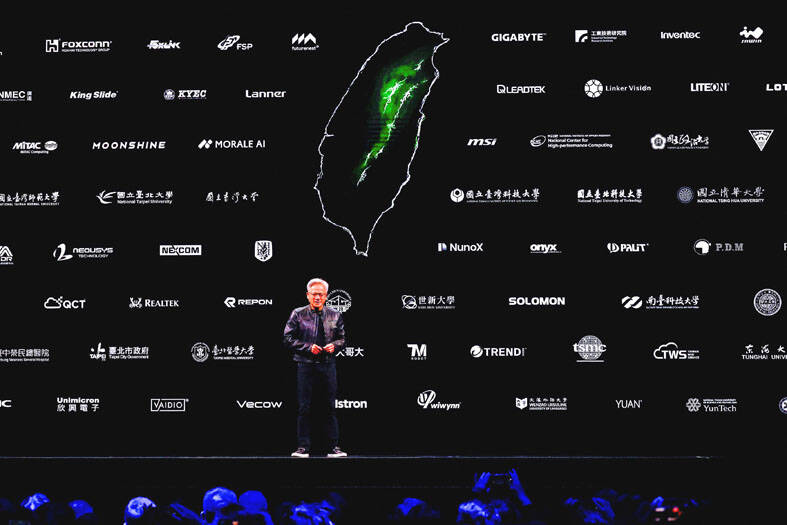
Then-Nvidia CEO Jensen Huang makes a keynote speech at Computex Taipei on May 19 last year.
Photo: Reuters
Huang’s resignation could accelerate the diversification of AI chip orders, potentially benefiting Nvidia rivals AMD and Broadcom, as well as Amazon and Google, which are developing their own application-specific integrated circuits (ASICs), or chips designed for specific tasks, Taishin Securities Investment Advisory (台新投顧) said in a report released yesterday.
Several senior semiconductor industry executives interviewed by CNA said ASIC development could gain momentum, but they did not expect it to significantly alter the competitive balance between ASICs and graphics processing units (GPUs), key to Nvidia’s AI business. Nvidia’s GPUs would be hard to replace because many AI developers rely on CUDA, Nvidia’s software platform for developing and running AI applications, which is designed to work with its chips, an executive in the semiconductor substrate industry said.
Despite a potential shift in AI chip demand from GPUs to ASICs, Taiwan’s chip suppliers are expected to face limited disruption because chipmakers maintain close relationships with Taiwanese suppliers, according to Taishin’s report.
Mega International Investment Services (兆豐國際投顧) vice president Alex Huang (黃國偉) also said Nvidia’s leadership change was unlikely to significantly affect Taiwanese suppliers, which remain integral to the AI supply chain amid rising demand and efforts to reduce reliance on China.
Individual suppliers will continue to adjust their operations in response to changes in product demand and technological developments, Alex Huang added.
An executive at a semiconductor packaging and testing company said the company might reallocate some of its 2027 budget to mitigate risks in the short term.
In the longer term, GPUs and ASICs had promising prospects, and the company would continue serving both markets based on customer demand, the executive said.
Another semiconductor executive said the change in Nvidia’s leadership would not affect its orders from Taiwanese suppliers, as increasingly complex GPU technology and lengthy supplier qualification processes make it difficult for Nvidia to switch suppliers.
For Taiwan’s semiconductor suppliers, changes in US export policy toward China remain an issue to watch, including any revisions to the rules governing Nvidia’s H200 shipments, Taishin Securities Investment Advisory said.
The US currently requires export licenses for Nvidia’s H200 AI chips shipped to approved Chinese customers, with each application subject to a security review.
KioskNews shows a cleaned-up reading view extracted from the publisher’s page — the original always lives on their site, not ours.