Chinese commercial reactor achieves nuclear fusion with clean hydrogen-boron fuel
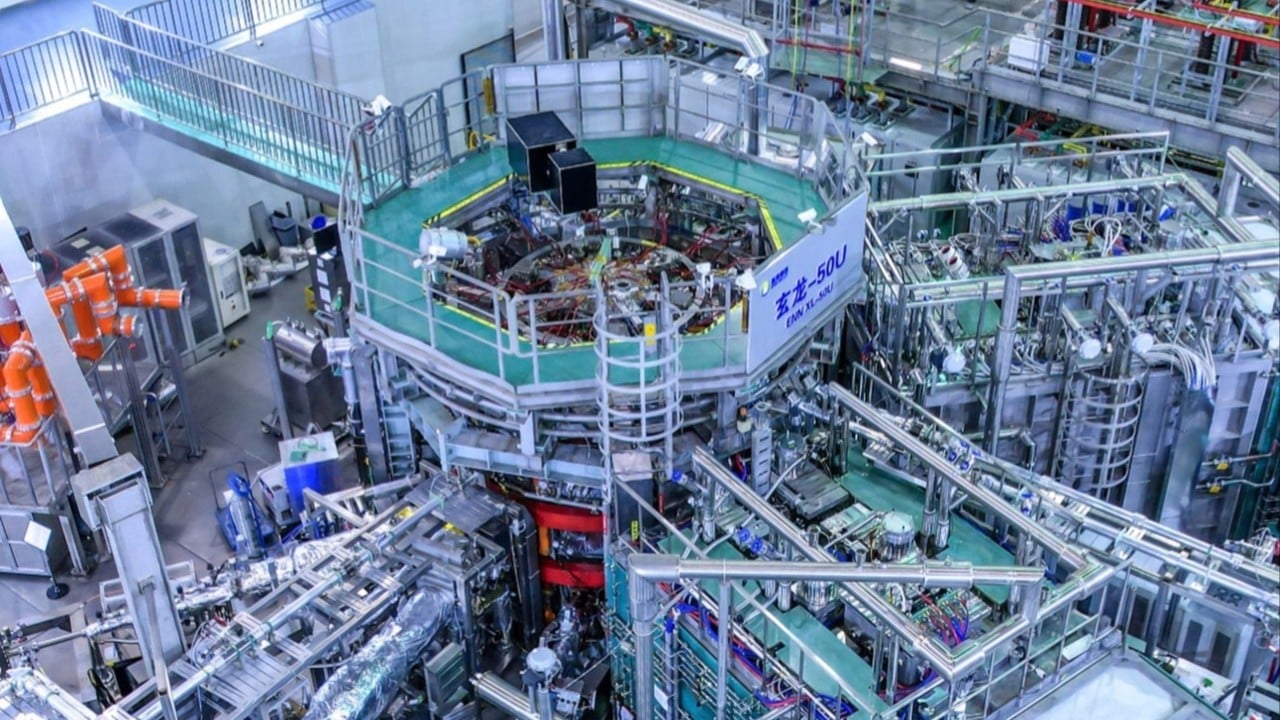
In a first, a Chinese company has achieved high-parameter hydrogen-boron plasma control, marking a “significant and valuable” advance in research into neutron-free magnetic confinement fusion.
ENN Group, based in Langfang, Hebei province, announced on Monday that its EXL-50U spherical device – a compact tokamak that uses a magnetic field to confine charged gas, or plasma, for nuclear fusion research – had successfully achieved hydrogen-boron fusion reactions.
“This marks the first time a commercial fusion company has achieved a hydrogen-boron fusion reaction on its own device,” the company stated.
Currently, mainstream-controlled nuclear fusion research, represented by the International Thermonuclear Experimental Reactor (ITER) in France, predominantly uses deuterium-tritium (D-T) as fuel.
09:18
Is the world embracing a new nuclear age 40 years after the Chernobyl disaster?
While D-T fusion is relatively easier to achieve technologically, the availability of tritium is extremely limited. It exists only in trace amounts in nature, cannot be mined and is exorbitantly expensive.
Furthermore, tritium is inherently radioactive, and the induced radioactivity potentially triggered by the high-energy neutrons released during the D-T fusion process cannot be ignored.
In contrast, ENN Group, a leading Chinese clean energy provider, has opted for the hydrogen-boron route.
This advanced fusion reaction combines a hydrogen proton with a boron-11 nucleus to produce harmless helium nuclei (alpha particles) and energy, without releasing high-energy neutrons.
Several prominent private fusion energy companies – including TAE Technologies in the US and Marvel Fusion in Germany – are developing hydrogen-boron fusion, according to World Nuclear News.
Yang Yuanming, the chief engineer who led the fusion project at ENN, previously told the South China Morning Post that the fuels for hydrogen-boron fusion were abundant and easily accessible.
The reaction could generate electricity directly and the process did not release high-energy neutrons, Yang said.
However, it is widely acknowledged that the most significant challenge facing this approach is the exceptionally demanding reaction conditions and the immense technical difficulty involved.
Now, amid international commercial competitors, this Chinese experimental device has taken a significant step forward.
02:24
A look inside the world's largest nuclear fusion reactor in Japan
The ENN team eschewed the conventional approach of universally raising the plasma temperature.
Instead, through the synergistic effect of high-energy neutral beam injection and radio frequency waves, they precisely targeted and stimulated the energy region where the fuel is most prone to react, known as the “first resonance peak”.
Under this mechanism, a large number of “fast protons” are rapidly generated within the system.
Acting as a catalyst for the reaction, these high-energy particles triggered a chain reaction, pushing the overall fusion reaction rate beyond 100 million times per second.
ENN Group said that more than 10 leading experts in the field, hailing from international research institutes and renowned universities, convened a special meeting to review the experimental results.
The group reportedly “unanimously agreed” that the effective and repeatable measurement of alpha particles – the product of the fusion reaction in this experiment – substantiated the results.
It added that the feat represented “a significant and valuable contribution” to global research on magnetic confinement hydrogen-boron reactions.
Earlier this month, the company held a groundbreaking ceremony for the Helong-2 project at its fusion R&D centre.
This third-generation fusion device built by ENN would serve as an important engineering platform in the drive towards a smart fusion power plant, the company said.
Yang, the chief engineer, shared this latest milestone on social media on Monday morning, commenting: “[We will] strive to get the plasma to 100 million degrees Celsius (180 million degrees Fahrenheit) as soon as possible!”
KioskNews shows a cleaned-up reading view extracted from the publisher’s page — the original always lives on their site, not ours.