Drones, teargas, riot squads: why has the UK gone to war against asylum seekers already fleeing conflict? | Diane Taylor
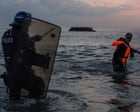
Garang*, 18, is one of thousands of refugees recently caught in the crossfire of French riot police, who threw teargas and beat them with batons when they boarded dinghies to travel to the UK. He is a victim of a war in his home of South Sudan – and one being fought on France’s northern shores.
He borrows a phone from anyone with credit who will let him try to call home, where his family is displaced. Garang doesn’t have enough money on the £10-a-week allowance from the Home Office to make a long-distance call. All he wants is to speak to his mum, to hear her voice, and let her know he is alive and safe in the UK despite the violence he has faced.
On Thursday, stopping more people like Garang from reaching the UK in small boats topped the “to do” list of the prime minister, Andy Burnham, and the French president, Emmanuel Macron, when they held talks. The leaders agreed they were making headway in reducing small boat crossings in the English Channel but now needed to go further.
How much further can the war on refugees go? Along with the use of teargas and beatings, there are now surveillance drones and more French officers to tackle dinghy launches from other parts of the coast. The UK government is increasingly using military terms such as “surge” and “neutralise” in relation to small-boat crossings. The home secretary, Shabana Mahmood, has vowed to continue to be “relentless” in this battle. Burnham said the government wanted to “prevent smugglers exploiting vulnerable migrants”, but was silent on alternatives to offer to these vulnerable people.
When the government tried to seal off the lorry route for people crossing from France into the UK a decade ago, ministers did not foresee its replacement with small boats. The maritime option required greater reliance on smuggling networks, which have vastly increased in size, complexity and profits. Worst of all are the optics, which have been seized upon by the right – shots of overcrowded dinghies carrying people in orange lifejackets bobbing up and down against the blue horizon.
These images have fuelled anger, with some Britons believing that most refugees are shunning other countries to beat a path to our door. In fact, the number of irregular arrivals to Europe in the last year has dropped significantly, and the UK ranks 16th in Europe per head of population for asylum claims. According to this newly released data, a majority of asylum seekers do not arrive in small boats – 41% were already in the UK and held a visa or other leave prior to claiming and 20% arrived by other routes, many likely to be clandestine means, such as lorries.
Channel crossings so far this year from France to the UK have dropped by more than 40% compared with the same period last year. Countries such as Turkey and Iran tower over us in terms of the number of refugees they take in.
But the UK government continues to pursue its war against refugees on the beaches of northern France. Home Office data shows that those in small boats overwhelmingly come from war and conflict zones: Eritreans fleeing indefinite military conscription; Afghans escaping the Taliban; Iranians who have opposed the regime or converted from Islam to Christianity, trying to dodge execution; and Sudanese crossing the desert to escape a brutal civil war. Nobody steps into an overcrowded dinghy that might end their life if it capsizes unless they are desperate.
Nigel Farage and Reform UK have poisoned the public discourse on people fleeing war, people who run because they don’t want to be killed or to kill others. The UK government can shift the dial. Instead of boasting about the paraphernalia of war deployed against refugees who have experienced unimaginable horrors, ministers can restore the humanity of those seeking refuge. Along with promoting safe routes, it can remind people of how few refugees in absolute terms are arriving here seeking safety – and of what they have been through.
As for Garang, he is still desperately trying to get through to his mum on the phone, relying on South Sudan’s hopelessly overwhelmed phone network. A few days ago, he managed to reach his brother, but by the time he had run to find their mum, the call disconnected. Just as Garang wants to tell her he’s OK, he wants to know the same of her. “Now I know she’s alive I will not give up trying to call whenever anyone lets me use their phone,” he says. “All I want is to speak to my mum.”
after newsletter promotion
* Name has been changed
-
Diane Taylor writes on human rights, racism and civil liberties
-
Do you have an opinion on the issues raised in this article? If you would like to submit a response of up to 300 words by email to be considered for publication in our letters section, please click here.
KioskNews shows a cleaned-up reading view extracted from the publisher’s page — the original always lives on their site, not ours.