Bank of America advises NT dollar buys
‘LONG ON NT’: An official said the NT dollar was the Asian currency most correlated with AI exchange-traded funds, making its drop consistent with a positioning squeeze
The New Taiwan dollar and the South Korean won offer buying opportunities after the artificial intelligence (AI)-driven equity selloff, a Bank of America Corp executive said in an interview released yesterday.
Both currencies have weakened in tandem with AI-linked stocks, but the size of their current-account surpluses gives investors “substantial” cover to build long positions, said Claudio Piron, head of Asia foreign-exchange and rates strategy at Bank of America’s global research unit.
“That will come into play,” he told Bloomberg TV. “I would say at the margin that these levels here provide an opportunity for people to enter into long [South] Korean won positions and long Taiwan positions.”
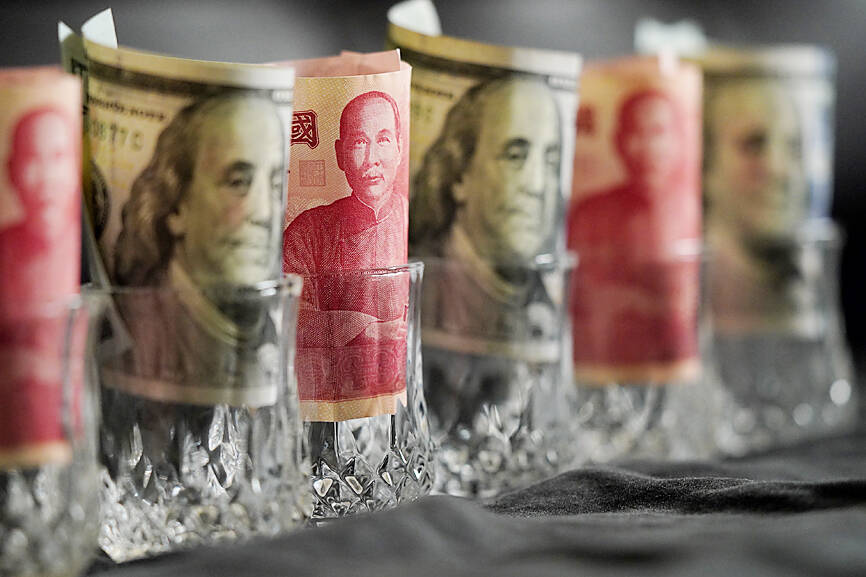
New Taiwan dollar and US dollar banknotes are pictured in Taipei on May 5 last year.
Photo: CNA
Piron said the NT dollar was the Asian currency most correlated with AI exchange-traded funds, making its recent decline consistent with a positioning squeeze rather than a fundamental deterioration.
The NT dollar fell as much as 0.5 percent to NT$33.040 per US dollar in early session yesterday, making it Asia’s worst performer.
However, the local currency reversed its earlier losses and turned stronger against the US dollar later yesterday. It gained NT$0.108, or 0.33 percent, to close at NT$32.768 in Taipei trading.
With the NT dollar rarely trading beyond NT$33 versus the US dollar over the past decade, authorities are likely to stay vigilant, although their focus will remain on smoothing volatility rather than defending a specific level, Oversea-Chinese Banking Corp (華僑銀行) foreign exchange strategist Christopher Wong (黃經隆) said.
“Near term, we expect the [New] Taiwan dollar to remain volatile, with equity market performance and foreign portfolio flows likely to dominate FX direction,” Wong said, adding that the currency risks sliding toward NT$33.3 per US dollar.
Morning outflows by foreign funds were cushioned at about midday by aggressive exporter US dollar sales, according to local foreign-exchange traders.
As domestic stocks pared losses, state-owned banks stepped up US dollar sales, pushing the currency pair back below the NT$33 mark, said the traders, who asked not to be identified as they are not allowed to speak publicly.
The central bank recently eased restrictions on US dollar sales by exporters to reduce depreciation pressure on the NT dollar and encouraged exporters with conversion needs to sell US dollars rather than wait for a better rate.
KioskNews shows a cleaned-up reading view extracted from the publisher’s page — the original always lives on their site, not ours.