‘I look up when I walk’: 1961 hit Sukiyaki welcomes Japan’s Takaichi at Apec gala
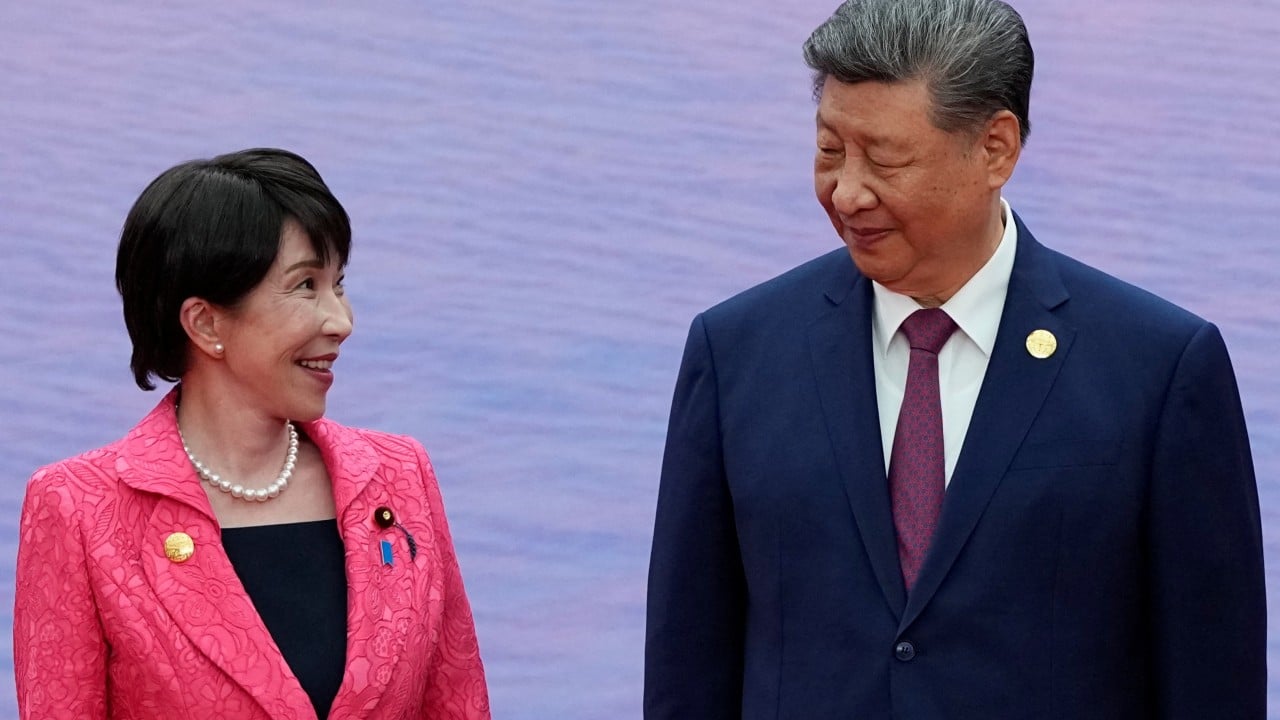
When Japanese Prime Minister Sanae Takaichi arrived at the Shenzhen International Communication Centre for a welcome banquet for the Apec leaders on Wednesday night, an ensemble on the stage switched to a bittersweet tune.
The music arranged to welcome Takaichi was the Japanese hit “Ue o muite arukou”, known as the Sukiyaki song in the West. It was first released in Japan in 1961 and performed by the late singer Kyu Sakamoto.
The lyrics tell the story of someone who looks up while walking alone, so that tears will not fall, with the verses describing this person’s memories and feelings.
The song became famous in the West over the next few years, spending three weeks at the top of the American Billboard charts in June 1963. An NPR report in 2013 described the phenomenon as “an interesting metaphor for that global expansion of Japan on the world scene”.
Taikaichi smiled as she walked by the ensemble, giving the musicians a slight bow of acknowledgement.
Xi calls for elimination of trade barriers in Apec summit speech
Reactions to the music were varied, with one commenter on social media describing it as “a soul song that gets every Japanese person fired up and ready to stand together”.
Ken Moriyasu, senior fellow for Greater Asia at the Hudson Institute, said it was an “intriguing musical choice”, suggesting that it could mean hope or political irony.
“The 1961 song was inspired by disillusionment over the failed protests against the US-Japan Security Treaty. A song rooted in opposition to the US-Japan alliance, played to welcome a Japanese prime minister in China,” he wrote.
Chinese social media users also picked up on this. One commentator wrote that “it was such a meticulous design on the Chinese side, great job”, while another said it could express a hope for Japan to “drop their obsession with militarism and face new international relations, move forward”.
Other leaders were also greeted with popular music from their own cultures. When US President Donald Trump walked in, the tune switched to the iconic “America the Beautiful”. He stopped and clapped, later standing in front of the ensemble for the cameras.
When Russian leader Vladimir Putin entered, he was greeted with music from the Tchaikovsky ballet The Nutcracker.
Takaichi’s interaction with Xi was closely watched. She shook hands with the president and his wife, Peng Liyuan, as they posed for the greeting photos and Xi’s response was a smile but no words.
It was the first interaction between the two leaders since bilateral ties plunged to a historic low following Takaichi’s remarks a year ago that a crisis in the Taiwan Strait could constitute a “survival-threatening situation” for Japan, potentially paving the way for military intervention.
Beijing sees Taiwan as part of China to be reunited by force if necessary. Most countries, including the US, do not recognise Taiwan as an independent state, but Washington is opposed to any attempt to take the self-governed island by force and is committed to supplying it with weapons.
The song that greeted the Japanese leader can be roughly translated as:
KioskNews shows a cleaned-up reading view extracted from the publisher’s page — the original always lives on their site, not ours.