‘The only method I have found that relieved my illness is to keep creating art’: Remembering Yayoi Kusama
Already have Rappler+?
to listen to groundbreaking journalism.
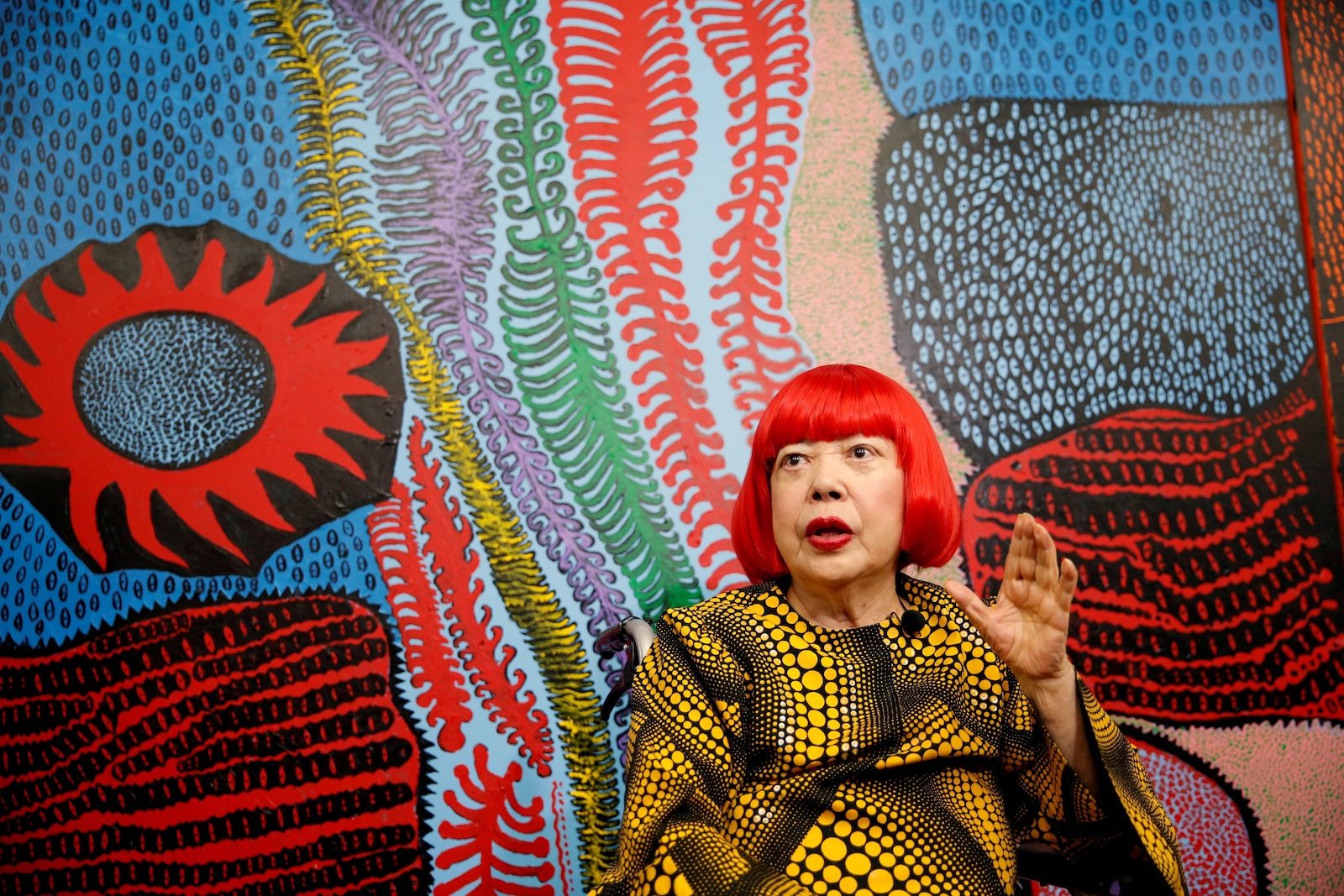
ICON. Japanese avant-garde artist Yayoi Kusama speaks to journalists at her studio in Tokyo, Japan September 26, 2017.
Toru Hanai/File Photo/REUTERS
She suffered from hallucinations from childhood and by the age of 10 had created paintings in watercolors, pastels, and oils using polka dot and net motifs that she encountered in her visions
AT A GLANCE
- Yayoi Kusama, a renowned Japanese artist, held the National Gallery of Victoria's most successful ticketed exhibition, attracting over 570,000 visitors in 2024-25.
- Kusama's art, characterized by polka dots and infinity mirror rooms, has significantly influenced various art movements and has been widely celebrated globally.
- Despite a challenging childhood and struggles with mental health, Kusama continued to create art, which she described as her path to salvation, leading to numerous prestigious exhibitions and accolades.
This is AI-generated. Read the article for full context. Report any errors.
In the history of the National Gallery of Victoria, their most successful ticketed exhibition did not feature the work of Vincent van Gogh, Claude Monet or Pablo Picasso. It was of the veteran Japanese artist, Yayoi Kusama, who has died aged 97.
Held over the summer months in 2024–25, the Melbourne exhibition attracted 570,537 ticketed visitors.
Kusama’s exhibitions throughout the world have attracted huge crowds. Her infinity mirror rooms, sprawling seas of polka dots, dancing pumpkins, and huge expanses of reflective surfaces have become some of the most photographed art objects in human history.
Her art has had a huge impact on many art movements of the 20th and 21st centuries, including pop art, performance art, minimalism, environmental art, video art, fashion, filmmaking, and feminism.
A difficult childhood
Kusama was born on March 22, 1929 in Matsumoto, Nagano Prefecture, Japan, to parents who were merchants and operated a plant nursery and seed farm.
She suffered from hallucinations from childhood and by the age of 10 had created paintings in watercolors, pastels, and oils using polka dot and net motifs that she encountered in her visions.
She described her childhood as traumatic, with a physically abusive mother and a womanizing father, and a time when her artistic endeavors were discouraged. She found refuge in her art.
Her childhood was overshadowed by World War II. By the time she was 13, she was sewing parachutes for Japanese soldiers and was aware of American bombers flying overhead and of constant air-raid sirens. She attended Arigasaki High School and, in 1948, studied Nihonga painting at the Kyoto Municipal School of Arts and Crafts.
By 1950, Kusama was exhibiting in Japan, to some acclaim, her sprawling paintings, mainly on paper, of abstracted natural forms and would cover all surfaces — floors, walls, ceilings and naked assistants with polka dots that she would term “infinity nets.”
Concerning her painting, Flower (D.S.P.S), 1954, she wrote:
One day I was looking at the red flower patterns of the tablecloth on a table, and when I looked up I saw the same pattern covering the ceiling, the windows, and the walls, and finally all over the room, my body and the universe. I felt as if I had begun to self-obliterate, to revolve in the infinity of endless time and the absoluteness of space and be reduced to nothingness.
The heart of the art scene
In 1957, Yayoi Kusama traveled to the United States and settled in New York. She was at the heart of the American post-war art movement where she exhibited to considerable applause large paintings, soft sculptures and environmental sculptures using mirrors and electric lights.
In the 1960s, she staged many happenings, such as body painting festivals, fashion shows and anti-war demonstrations.
It has been argued that her work had a profound impact on artists, including Claes Oldenburg and Andy Warhol.
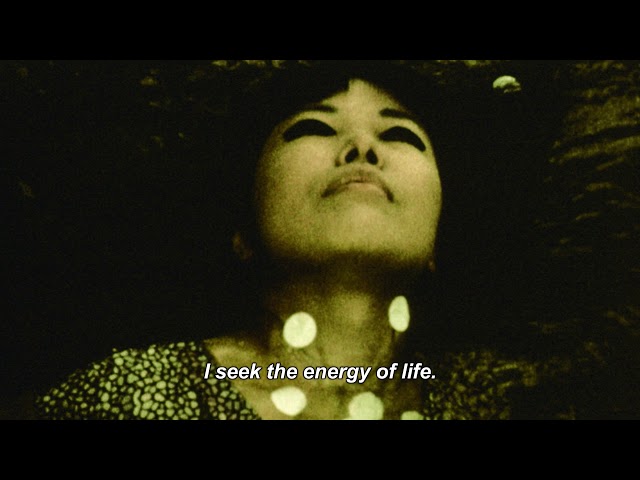
She was also involved in film productions and newspaper publication.
In 1968, the film Kusama’s Self-Obliteration, that Kusama produced and in which she played the leading role, won a prize at the Fourth International Experimental Film Competition in Belgium and the Second Maryland Film Festival and the second prize at the Ann Arbor Film Festival.
She held exhibitions and staged happenings in various countries in Europe and participated in the Venice Biennale in 1966, where she exhibited her Narcissus Garden comprising of hundreds of mirrored spheres.
(Narcissus Garden entered the collection of the National Gallery of Victoria in 2024, in its new iteration of 1,400 stainless steel balls, each 30cm in diameter.)
The artist’s physical and mental health deteriorated while she was in America and she attempted suicide.
For her, her art was the path to salvation.
A return to Japan
Kusama returned to Japan to live there permanently in 1973.
After experiencing a further suicide attempt, in 1977 she admitted herself into the Tokyo psychiatric institute, the Seiwa Hospital for the Mentally Ill, from which she was never discharged.
She lived in the hospital and made daily excursions to her studio where she maintained a frenetic pace of work.
Yayoi Kusama was one of the most acclaimed artists of her time. A major retrospective exhibition of her work held in 1998 at the Los Angeles County Museum of Art traveled to the Museum of Modern Art in New York, the Walker Art Center in Minneapolis, and the Museum of Contemporary Art in Tokyo.
There were also major retrospective exhibitions at the Whitney Museum, New York, and Tate Modern, London, in 2012, and at the Hirshhorn Museum in Washington, DC in 2017. In 2017, the Yayoi Kusama Museum opened in Tokyo.
Commercially, her work achieved record prices and she has received various awards for her novels, poetry, and films.
In an interview with Infinity Net in 2012, Yayoi Kusama said:
I fight pain, anxiety, and fear every day, and the only method I have found that relieved my illness is to keep creating art. I followed the thread of art and somehow discovered a path that would allow me to live.
If this article has raised issues for you, or if you’re concerned about someone you know, call the National Center for Mental Health Crisis in the Philippines at hotline number 1553.
– The Conversation/Rappler.com
Sasha Grishin is an Adjunct Professor of Art History at the Australian National University
This article is republished from The Conversation under a Creative Commons license. Read the original article.
KioskNews shows a cleaned-up reading view extracted from the publisher’s page — the original always lives on their site, not ours.