Aviva Klompas: Palestinians deserve the dignity of accountability
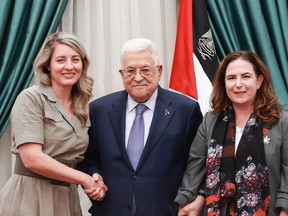
On July 30, 2025, Prime Minister Mark Carney announced that Canada would recognize a Palestinian state. He was careful to explain that recognition was not unconditional.
Sign In or Create an Account
Canada’s decision, Carney said, was predicated on commitments from Palestinian Authority President Mahmoud Abbas to fundamentally reform Palestinian governance, hold general elections in 2026 in which Hamas could play no part and demilitarize a future Palestinian state.
These conditions never answered the most obvious objection to Canada’s policy: Why recognize a state before the institutions capable of governing it peacefully and democratically actually exist?

The National Post newsletter that doesn’t hold back, giving readers the unvarnished truth on media, politics and culture.
By signing up, you consent to receive the above newsletter from Postmedia Network Inc.
A welcome email is on its way. If you don't see it, please check your junk folder.
The next issue of Right? will soon be in your inbox.
We encountered an issue signing you up. Please try again
Canada went ahead and did it anyway.
There is a curious double standard at the heart of Canada’s policy toward the Israeli-Palestinian conflict. Israel is treated as a country whose leaders make choices and must live with their consequences. Palestinians are treated as a people to whom history happens.
Consider the typical diplomatic discussion surrounding the conflict. Israel must accept a ceasefire, restrain its military, halt settlement expansion, negotiate with its enemies, make territorial concessions and articulate a credible political horizon. Some of those demands are reasonable and others can be debated, but they all make it clear that Israel possesses agency.
Now, consider the expectations placed on Palestinian leaders.
Mahmoud Abbas was elected president in 2005 and has remained in office ever since, despite repeatedly promising to hold elections. Hamas spent years turning Gaza into a terrorist stronghold before launching the deadliest attack against Jews since the Holocaust. Palestinian politics remain fractured, corruption is endemic within the Palestinian Authority and its education system continues to glorify violence and deny the Jewish people’s historical connection to the land.
Yet the diplomatic dogma remains overwhelmingly focused on what everyone else should do for Palestinians. Israel should change its policies and tactics. Washington should exert more pressure on Israel. Western governments should recognize Palestine, the United Nations should confer greater legitimacy and donor countries should provide more assistance.
What, precisely, are Palestinian leaders expected to do? Expecting nothing is not allyship, it’s paternalism.
If Palestinians are entitled to sovereignty, as the Carney government believes they are, then Palestinian leaders should be responsible for building the institutions that make sovereignty viable.
They should be responsible for whether their people vote, whether public money rewards violence, whether schools prepare children for co-existence and whether their political culture treats negotiation and compromise as diplomacy or betrayal.
None of this absolves Israel of responsibility for its actions. It is held accountable for the decisions of its elected government because that is what it means to treat a nation as a sovereign political actor. Palestinians deserve the same standard.
Successful states are built on institutions, accountability, the rule of law and political leadership capable and willing to make difficult choices. Foreign governments cannot manufacture a viable Palestinian state by removing the expectations placed on the people who would govern it.
This is what makes Canada’s decision so baffling. Ottawa granted one of the Palestinians’ most important diplomatic objectives before the reforms it deemed essential to statehood had been adopted. The message was that Palestinian leaders could receive the benefits of statehood before demonstrating their willingness or ability to assume its responsibilities.
The international community speaks about Palestinian dignity and self-determination. But dignity is inseparable from agency. Treating Palestinians with dignity means recognizing they are not victims of forces beyond their control, but a people whose leaders make choices about war and peace, democracy and authoritarianism, education and incitement, corruption and good governance.
The refusal to hold those leaders accountable has real consequences. A Palestinian born when Mahmoud Abbas was elected president could now be old enough to have children without ever having voted in a presidential election. That is not an Israeli policy. It is a Palestinian political failure.
Nor should Hamas’s continued armed presence in Gaza be treated as an unfortunate fact that everyone else must accommodate. Its leaders made choices, its members committed atrocities and its continued brutality carries consequences for the society in which it operates.
A serious commitment to Palestinian statehood requires more accountability, not less.
Canada says it wants Palestinians to exercise the right of self-determination. Then it should treat them as a people capable of exercising it, with all the responsibilities that entails. Palestinians do not need the international community to expect less of them. They need it to take their aspirations seriously enough to expect more.
National Post
Aviva Klompas is CEO and cofounder of Boundless, a nonprofit dedicated to fighting antisemitism. She is also the host of the Boundless Insights podcast.
Join the Conversation
This website uses cookies to personalize your content (including ads), and allows us to analyze our traffic. Read more about cookies here. By continuing to use our site, you agree to our Terms of Use and Privacy Policy.
KioskNews shows a cleaned-up reading view extracted from the publisher’s page — the original always lives on their site, not ours.