'American Intellectual Antisemitism': Shai Davidai exposes universities’ deep-rooted antisemitism

In 1919, my grandmother applied for admission to Barnard College of Columbia University. The notoriously antisemitic dean at the time, Virginia Gildersleeve, told her she would not be notified of her acceptance until after the start of freshman year, in an attempt to encourage her to choose a different school. My grandmother stood her ground and entered the graduating class of ’23 only a few days late.
In ousted Columbia Prof. Shai Davidai’s exposé, American Intellectual Antisemitism, I learned that Gildersleeve, who supported Nazi Germany’s expulsion of Jews from academia, was taking her cue from the higher-ups at Columbia.
“After Jewish enrollment reached 40% of the incoming class of 1919… the university implemented a series of exclusionary policies explicitly designed to curb the presence of Jews on campus,” he writes.
Jew-hatred is nothing new in the Ivy League. It just takes on new forms.
“American Intellectual Antisemitism” is the term Davidai coined for what he defines as “a modern and insidious form of Jew-hatred that cloaks itself in progressive jargon and academic rhetoric,” using the “language of social justice” to disguise bigotry as intellectual virtue, and constitutes “a direct assault on Western liberal values.”
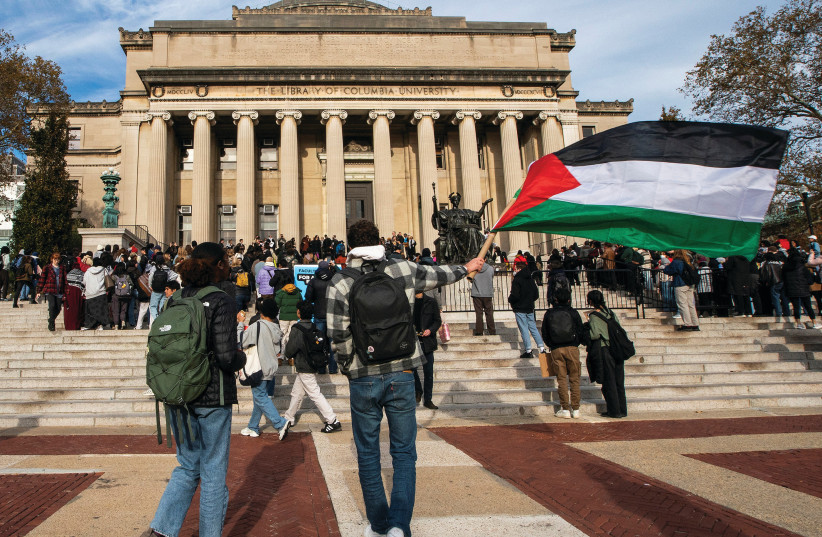
Davidai became known throughout the world after he posted a long letter on social media on October 18, 2023, in reaction to vile and violent post-October 7 events – and top-tier American university leaders’ shocking support, or at least lack of condemnation, of those pro-terror, anti-Jewish incidents.
'We cannot protect your child[ren]'
“I want this message to get to every parent who sent their kids to Columbia University, entrusted their kids and their children’s safety with us. I want this message to get to every parent in America who sent their kids to New York University, to Harvard, to Stanford, to Berkeley, and I want you to know one thing: We cannot protect your child[ren],” he wrote, calling Columbia University President Minouche Shafik “a coward.”
Over the following year, he organized rallies, appeared on prime-time television, and testified before Congress.
Davidai paid dearly for his ongoing peaceful activism on behalf of beleaguered Jewish students, organized with “a small but dedicated group of Jewish students, postdocs, faculty, staff, and alumni.” He and his family received death threats, and he was barred from teaching his award-winning business course. He was derided by detractors as a “genocidal maniac,” “a hate-mongering charlatan,” and an “extremely dangerous” professor.
A year after the Hamas-led massacres in Israel, when Davidai’s video of the unchecked disruption of a campus memorial service for October 7 victims garnered over a million views in a few hours, Columbia’s administration suspended him – not the perpetrators – from campus.
“The decision’s timing told me everything I needed to know about Columbia’s priorities,” he writes.
Blending a firsthand account with broader analysis, his book exposes the radical politics, ideological indoctrination, institutional indifference, leadership failures, and moral unraveling of American academia.
The timing of the book’s release coincides with the beginning of another school year. “Across the nation, more than 1.5 million new students are stepping into lecture halls for the first time, joining student organizations, and attending campus events where the dogmas of American Intellectual Antisemitism are paraded as moral virtue,” he writes.
“Adopting their professors’ radical ideology, 18-year-old students – many of whom could not even point out Israel on a map – quickly discovered that condemning Israel’s existence and ostracizing dissenters became an easy route to social acceptance and community,” he says.
Having studied or worked at higher education institutions, including Cornell, Princeton, and The New School, before joining Columbia in 2019, he saw how “college students have realized that sowing chaos and disruption is an effective way to silence speakers with opposing views.”
University administrators across America have “capitulated to student protests, letting the loudest and most aggressive voices dictate which conversations were considered ‘acceptable’ on campus,” he writes.
Davidai delves into a variety of factors supporting “the open embrace of terrorism” in higher education. For example, “Columbia has taken an estimated $300 million from Qatar; Carnegie Mellon, $750 million; and Georgetown University, $1 billion. Cornell University alone has received close to $2 billion from Qatar.”
Jewish students at Columbia told Davidai they felt like outcasts and were negatively affected socially and academically by the relentless pro-Hamas drumbeat set by students and faculty alike. Administrators offered “no meaningful reforms, no accountability, nor a shred of remorse… bent rules to appease the mob, overlooked misconduct, empowered those who spread hate, and actively nurtured the very chaos they were supposed to stop.”
Many students lamented “that they were paying tens of thousands of dollars to attend a school that showed no concern for their well-being.”
Davidai concludes with a list of action items following his doctrine of countering fanaticism through “radical moderation.” For instance, parents “must insist on concrete guarantees of physical safety for Jewish students, publicly support their children when they speak out and are targeted for it, file formal complaints when universities violate their own professed values and mission statements, and leverage their financial resources, professional networks, and social capital to engage outside civil rights and legal organizations when internal channels fail.”
He uses the words “naive” or “naively” seven times in the book to describe himself, such as: “I naively believed that I had joined an institution that shared my commitment to intellectual rigor and open disagreement.”
His suggestions seem largely naive as well, considering that in the book he has amply proven an entrenched, ever-worsening anti-Jewish problem on college campuses: “By intentionally rebuilding learning environments where intellectual courage is rewarded, and dissent is treated as a civic virtue rather than a moral failure, American higher education can gradually earn back the public’s trust and reclaim its role not merely as a professional credentialing system but as a true training ground for democratic citizenship,” he writes.
That statement is pure naivete. Davidai could have questioned the prevalent “Ivy League or bust” attitude among many American Jews. He could have encouraged Jewish parents to put their “tens of thousands” – it’s actually hundreds of thousands – toward a quality education at, say, Yeshiva University or at institutions of higher learning in Israel that cater to English-speakers, rather than continue to bankroll schools that tolerate extremist ideologies while disrespecting their children’s views, beliefs, and physical safety.
Yes, it would be nice if American colleges heed his cry to “reclaim the educational mission of teaching people how to think, not what to think.” But as American Intellectual Antisemitism makes excruciatingly clear, the odds of that happening are rather poor.
AMERICAN INTELLECTUAL ANTISEMITISM:
THE ANTI-JEWISH MOVEMENT TEARING THROUGH OUR UNIVERSITIES
By Shai Davidai
Wicked Son/Post Hill Press
352 pages; $30
KioskNews shows a cleaned-up reading view extracted from the publisher’s page — the original always lives on their site, not ours.