Fewer passengers, more AC travellers: How the Covid-19 pandemic changed rail ridership
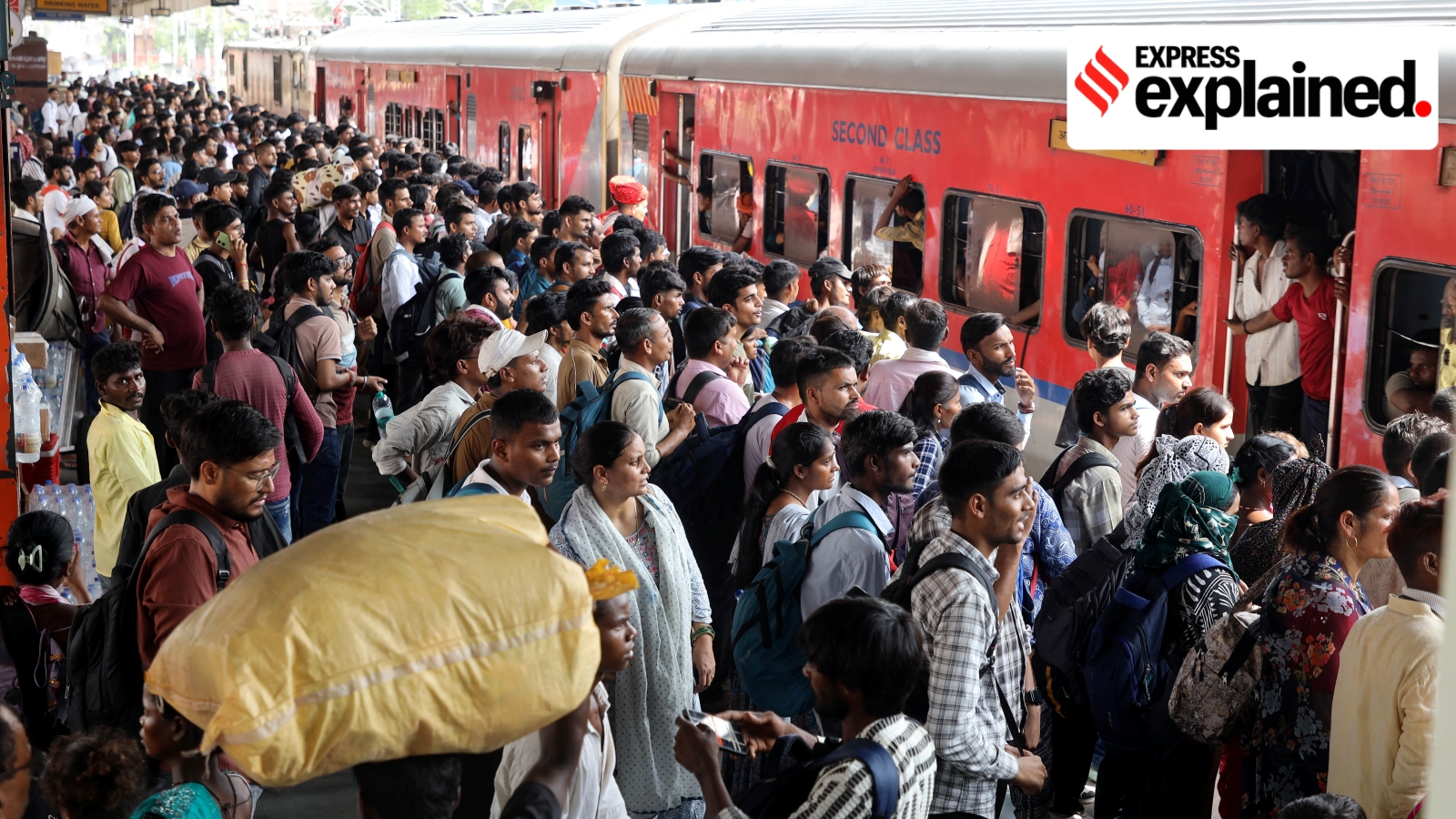
Like all modes of transport, the Indian Railways suffered a sharp collapse in passenger traffic during the Covid-19 pandemic. Although ridership gradually recovered over the years, it has not yet touched pre-pandemic levels.
On Monday, Railways Minister Ashwini Vaishnaw Monday said the national transporter was on track to return to that level in the current financial year, 2026-27. He also said that with the push for multi-tracking on the high density routes, around 2,500 new trains have been added to the system, which has increased passenger carrying capacity.
“We have been getting daily passenger ridership data and it is very encouraging. We are hopeful that we will reach the pre-Covid level of 800 crore passengers by the end of this financial year,” he said.
The recovery period has also seen a fundamental shift in travel preferences. While overall ridership remains below pre-Covid levels, the AC classes have witnessed significant growth, reshaping the broader perception of Indian Railways.
How many people travelled before the pandemic, how many travel now, which class carries the highest burden of passengers and what has been the impact on revenue? We explain.
New passengers
First, let’s get a broad overview. In Indian Railways, the highest number of passengers are carried by suburban trains. The data shows that more than 56% of all train journeys in India are made by short-distance commuters, with the Mumbai suburban network accounting for the largest share.
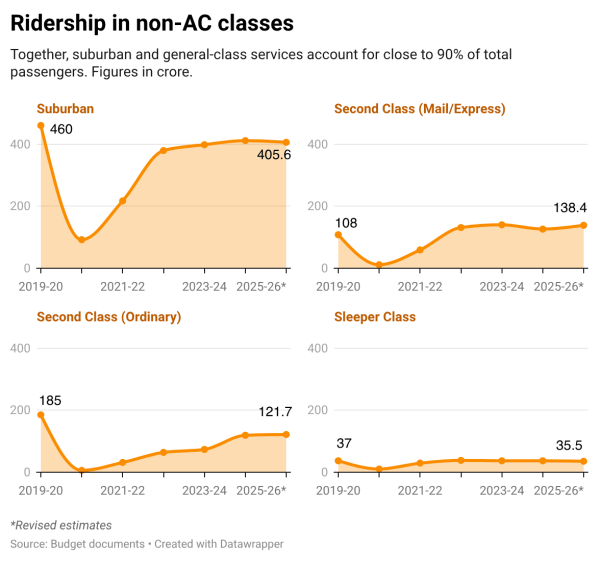 Ridership in non-AC classes.
This is followed by general coaches, which carry nearly 34% of railway passengers. Together, suburban and general-class services account for close to 90% of total passengers. The remaining share is accounted for by AC and sleeper classes.
During 2019-20, before the pandemic, a total of 808.6 crore passengers travelled by train, denoting an average of more than 2.2 crore passengers a day.
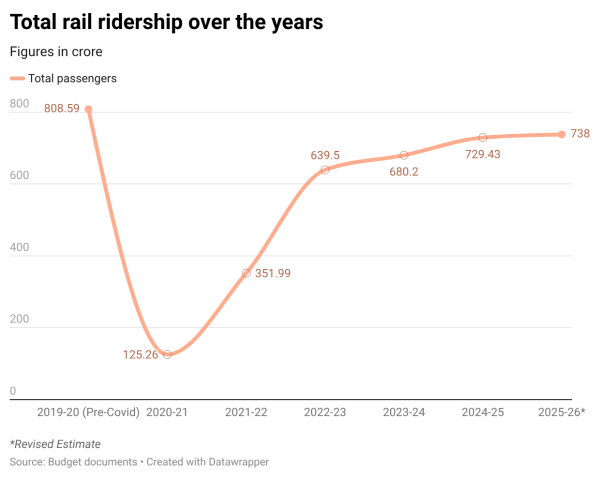 Overall passenger numbers are yet to return to pre-Covid levels.
This ridership figure fell by more than 84% to 125 crore in 2020-21 during the height of the pandemic. The recovery began in 2021-22, when passenger traffic touched around 352 crore. The Railways recorded approximately 640 crore passengers in 2022-23, 680 crore in 2023-24 and 729 crore in 2024-25. For 2025-26, it had set a target of 738 crore passengers.
While overall passenger numbers are yet to return to pre-Covid levels, largely due to suburban and second-class (ordinary) passengers — which primarily cater to short-distance commuters — remaining around 10% and 36% below their respective 2019-20 levels, passenger volumes across all AC classes combined have nearly doubled. Passengers in AC classes increased from 18 crore in 2019 to 35.51 crore in 2024-25. AC 3 Tier added the most passengers (12.12 crore), accounting for more than 69% of the total volume growth across all AC travel.
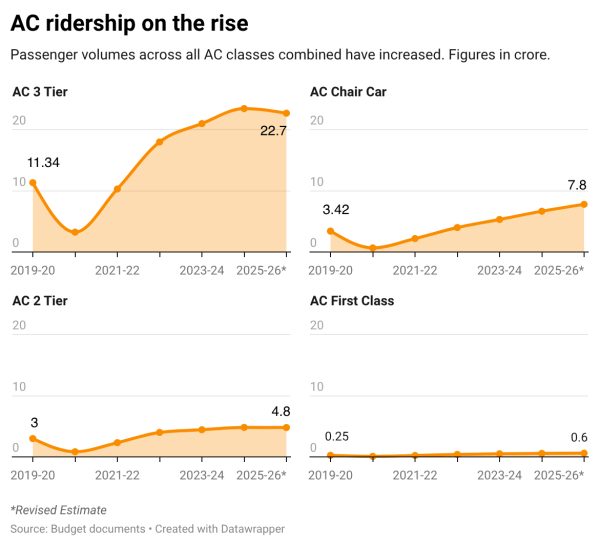 AC ridership is on the rise.
Apart from AC classes, the second class (mail/express), which is the general class of long-distance trains, also saw a significant increase in passengers. The data shows that passengers in this class grew by around 17% (an increase of 18 crore) between 2019-20 and 2024-25. The sleeper class has almost bounced back to its pre-Covid level.
Passenger revenue
The Railways did not face much difficulty in recovering passenger revenue, except during the two Covid years, 2020-21 and 2021-22. In fact, from 2022-23 onwards, the Railways surpassed its pre-Covid passenger revenue levels, largely driven by increased earnings from premium classes. Almost 54% of the total revenue came from the AC classes.
The data shows that total passenger revenue in 2019-20 stood at Rs 50,669 crore. It fell by nearly 70% to Rs 15,248 crore in 2020-21 before recovering to Rs 39,214 crore in 2021-22.
In 2022-23, passenger revenue rose to Rs 63,417 crore, surpassing pre-Covid levels. The Railways earned Rs 70,693 crore in 2023-24 and Rs 75,368 crore in 2024-25, with revenue projected to reach Rs 80,000 crore in 2025-26.
The revenue in other classes also increased. The sleeper class earnings in 2024-25 was Rs 14,847 crore, while it was Rs 13,641 crore in 2019-20. Similarly, the revenue of second class (mail/express) was Rs 12,563 crore in 2019-20, which increased to Rs 14,997 crore in 2024-25.
KioskNews shows a cleaned-up reading view extracted from the publisher’s page — the original always lives on their site, not ours.