‘Every moth is precious’: why are there so many bogong moths, and how can you safely remove them from your home?
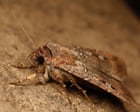
Skies over parts of New South Wales have been aflutter in recent days as swarms of bogong moths begin their annual migration, travelling up to 1,000 km from their breeding grounds in different parts of the country to a small number of cool caves in the Australian Alps.
Sightings of the endangered moth have increased over the last two years, but reports to the citizen science program Moth Tracker this September alone have exceeded 2025’s total figures, according to Zoos Victoria, which runs the platform.
What do the burgeoning insect numbers mean for their recovery, and what should you do if you find bogongs inside your home?
Why am I seeing so many bogong moths?
Spring marks the beginning of an annual migration: huge numbers of the bogong moths migrate to the Australian Alps, where they spend the summer escaping the heat.
“They breed and then migrate from their breeding grounds, which are in southern Queensland, in NSW, the ACT, even western Victoria and into South Australia,” said Dr Marissa Parrott, a reproductive biologist at Zoos Victoria.
An estimated 4 billion moths used to arrive in the Alps each year, until a catastrophic sudden population collapse – numbers dropped up to 99.5% between 2017 and 2019 – which was thought to have resulted from severe drought in the breeding grounds.
Favourable conditions this year – wetter, cooler weather – are thought to be behind the surge in sightings in NSW, in addition to strong winds which have blown the insects from their more typical inland migration routes towards major cities including Sydney and Canberra.
Linnea Emneby, project manager of the citizen science project Bogong Watch, run by Invertebrates Australia, said there were no certain estimates of their recent population, but “it does look like they’re on their way to recovery”.
The sightings are a promising hearkening back to pre-crash days, when bogongs descended en masse upon Parliament House in Canberra, and interrupted the 2000 Sydney Olympics closing ceremony.
“I think people just quickly forget what’s normal and think of this as an extreme occurrence rather than something that is just part of the Australian way,” Emneby said.
Newspaper articles from the early and mid-1900s include reports of lighthouse lights being obscured and trains being stopped or delayed by bogong moths, “whose oily bodies were crushed on the rails in thousands”.
Bogongs “are a boom and bust species to some extent but climate change makes it worse with prolonged drought seasons for several years, and bushfires where there didn’t used to be bushfires,” Emneby said. Their relative absence in recent years was “as far as we know, not normal”.
What do I do if I find bogong moths in my home or workplace?
If you encounter bogong moths on their migration, experts urge people to refrain from insecticide use, and to upload sightings to the Moth Tracker or Bogong Watch platforms.
“Turn off unnecessary outdoor lights, then they won’t be as drawn to buildings, to homes, to businesses,” Parrott said.
“If you can shut your vents that’s good … shake your laundry before you bring it in,” Emneby added.
For moths already inside buildings, she suggests turning off indoor lights and attracting them back out with one outdoor light. “If they’re close to a window, you can … wave your hand to herd them towards the open window,” Emneby said. “They’re quite skittish.”
Another method is to put a glass or container over the moth, sliding a piece of paper underneath to contain them.
“Just help them on their way by popping them outside in the safe location, turning off outside lights and they’ll move on,” Parrott said. “Every moth is precious, and we want to help them on their migration.”
How do the moths know where to go? How long do they travel for?
Young bogongs live underground, “coming up to feed on broad leaf plants before pupating and metamorphosing into the beautiful moths that we know,” Parrott said.
“On Moth Tracker we get [verified] reports coming in from almost every state and territory,” she said, adding that the Northern Territory was the only region without verified sightings.
The moths’ first migration occurs months after their parents have died, to mountainous caves in the Australian Alps where they have never travelled before. The nocturnal travellers use the Milky Way to guide their way – the only invertebrates known to use celestial navigation – as well as the Earth’s magnetic field.
“It could be days to weeks that the moths are migrating to get up to the Alps, but they do come in waves – they will likely be emerging at different times,” Parrott said.
“During things like storms and rain, they likely seek shelter, so they’ll be less visible, or they may have been able to move on, sensing its approach. We don’t know exactly how they do that – there’s a lot left that we still need to discover.”
After spending the summer months in the alpine caves, in autumn the moths return to their breeding grounds to reproduce and die.
KioskNews shows a cleaned-up reading view extracted from the publisher’s page — the original always lives on their site, not ours.