If convicted in impeachment trial, who will succeed Sara Duterte?
Already have Rappler+?
to listen to groundbreaking journalism.
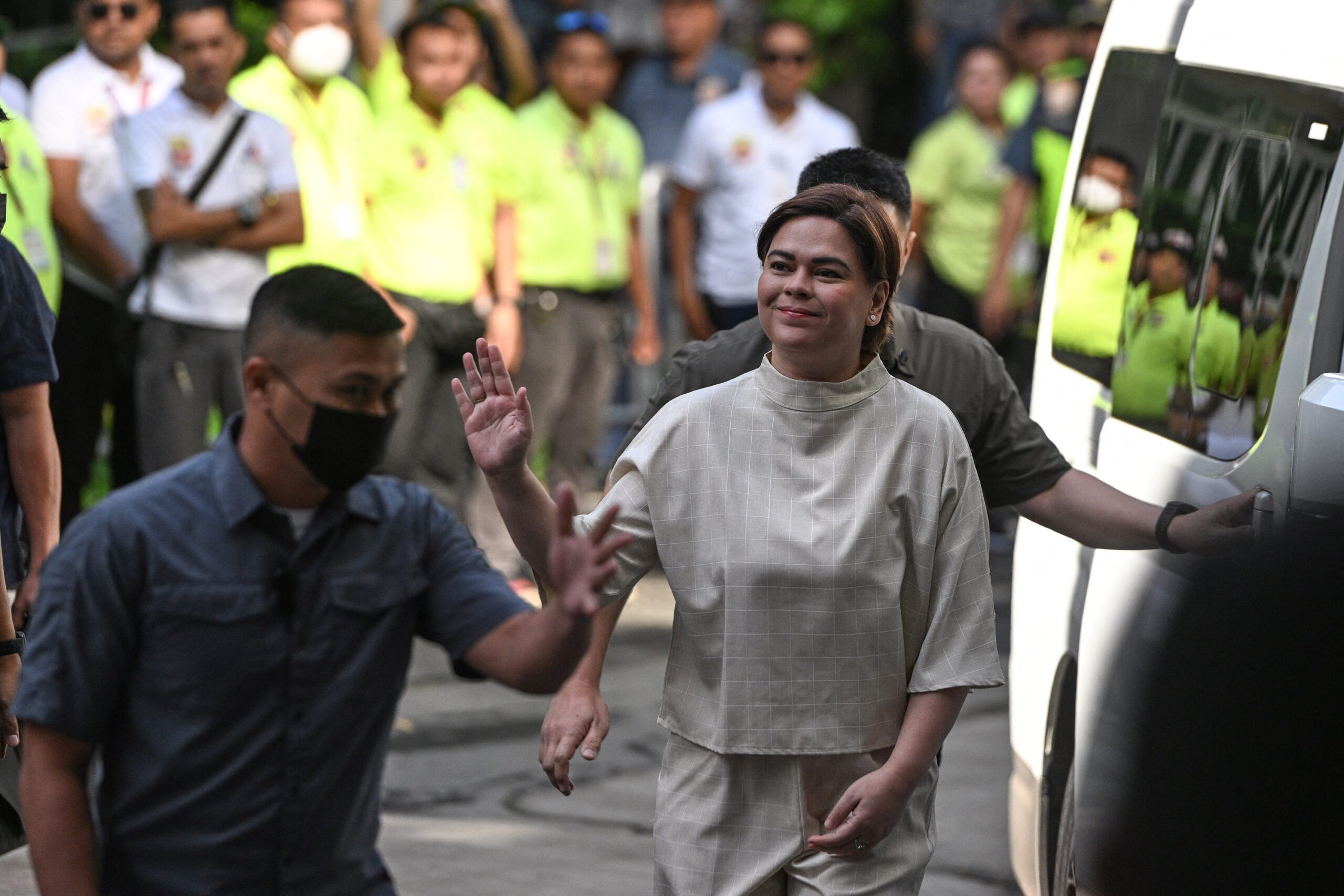
VEEP. Vice President Sara Duterte waves to supporters as she arrives at the Quezon City Regional Trial Court for the arraignment of her grave threats case, on October 9, 2026.
Noel Celis/Reuters
A political science professor says the choice of a successor will involve more than simply filling a vacancy
Even before Vice President Sara Duterte’s impeachment trial reaches a verdict, the question of who could replace her is already stirring debates among senator-judges.
Under the Constitution, President Ferdinand Marcos Jr. has the authority to nominate Duterte’s possible successor from among the sitting lawmakers but the decision will still be subject to congressional confirmation.
Article VII, Section 9 of the 1987 Constitution states: “Whenever there is a vacancy in the Office of the Vice President during the term for which he was elected, the President shall nominate a Vice-President from among the Members of the Senate and the House of Representatives who shall assume office upon confirmation by a majority vote of all the Members of both Houses of the Congress, voting separately.”
Over the weekend, Senate impeachment court presiding officer Francis “Chiz” Escudero explained that while Marcos has the authority to nominate Duterte’s possible successor, the nominee must also meet the constitutional qualifications for vice president, including the age requirement.
This narrows the pool of potential nominees to sitting members of Congress who meet the constitutional requirements, including Escudero himself.
“I have yet to receive offers but as I’ve said before, I would not accept it because of a simple reason: conflict of interest,” Escudero said in his podcast.
“We tried her case so personally, I don’t think accepting that would be proper,” he added.
Senate Minority Leader Alan Peter Cayetano lauded Escudero and urged other senator-judges to issue similar commitment to decline such proposals, citing the need to maintain political neutrality in the trial.
“It’s essential that in all impeachment proceedings, senator-judges are politically neutral and will have no incentive to convict except for evidence that proves the article/s of impeachment,” he said.
Cayetano’s remarks, however, did not sit well with Senator Panfilo “Ping” Lacson, who cautioned against preempting the decisions of other senator-judges.
“He should not preempt the decision of other senator-judges. Selecting the successor is under the prerogative of the President but of course, subject to the confirmation of the Congress,” Lacson said, adding he would decline if he would be offered such position.
“But I think [Cayetano’s statement] is uncalled for,” the senator added.
So what would Marcos look for in a successor? For political science professor Jean Franco of the University of the Philippines Diliman, the choice of a successor would involve more than simply filling a vacancy.
The President would have to consider the political implications of his nominee and whether that person could be trusted to assume the country’s highest office if necessary.
Franco identified several qualities Marcos might look for in a potential successor:
- Someone who can help elevate public trust in the administration
- Someone who can tell Marcos the truth
- Someone whom the First Lady [Liza Araneta-Marcos] likes and whom she can get a long with
- Most importantly, someone who is ready to be President
- Someone who is friendly to members of the House of Representatives and the Senate since they will concur with the appointment
Franco also said calls for senator-judges to declare they would refuse offers may not exactly paint a picture of impartiality.
“I think there is no need for that call actually, since in the first place, no senator in his right mind will publicly say that he/she wants to be vice president even if they secretly want to be one,” Franco told Rappler.
“Moreover, having this call amplifies the talk that the Vice President will be convicted, but at the same time, if she is convicted, it is not because she is guilty but because some senators are aiming for her position,” Franco added.
No names have publicly emerged as possible appointees, but as Senator JV Ejercito puts it, discussing who will succeed the Vice President — at this time — may still be too “premature”.
“I don’t think it is proper to discuss who will succeed the vice president because her trial remains ongoing. It’s still too premature,” said Ejercito. Who will likely be the President’s choice, is the big question. – Rappler.com
KioskNews shows a cleaned-up reading view extracted from the publisher’s page — the original always lives on their site, not ours.