It’s gambling dressed up as trading, and it’s taken over the US Open
New York: Logan Gornbein is very clear: his presence at the US Open is dependent on his ability to gamble.
“I would not be here if I did not have my Kalshi account,” the 23-year-old New Yorker says, naming the booming prediction market company that has just inked a multi-year deal with the US Tennis Association.
“I just love being able to watch live and watch my prediction. It makes it a lot more fun. I think that prediction markets are the future. If I was able to invest in a prediction market, I would.”
Sports betting has become increasingly popular in the US since the Supreme Court struck down a federal ban in 2018.
This is the reality of a major sporting event in 2026: betting is not some kind of tangent or afterthought. It is integral to the experience, for many fans. In the stands, plenty of people - young men, mostly - can be seen flicking through Kalshi or Polymarket, the other major US prediction market, monitoring trades and stats.
These platforms are now worth tens of billions of dollars and are growing exponentially. So far, they are not licensed to operate in Australia - in the case of Polymarket, it has been explicitly banned by the Australian Communications and Media Authority.
Prediction markets offer odds on future events: the results of sporting matches, whether or when something will occur, what Donald Trump will say in a speech. People buy contracts in the outcome, and the price - or perceived likelihood of something happening - is set by the market. The companies dress this up as a financial product, but it is effectively just wagering. Live betting is allowed, and it’s where the action happens.
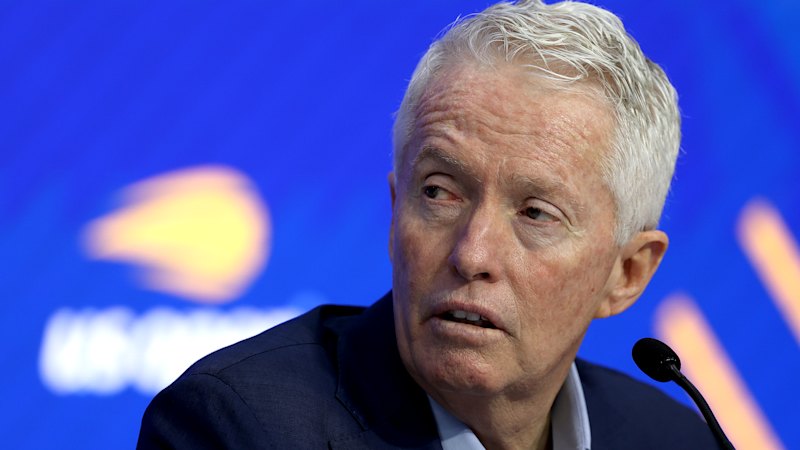
If that is the future, the future is already here in New York. As the tournament began, new USTA chief executive Craig Tiley - formerly the long-time boss of Tennis Australia and tournament director of the Australian Open - announced a multi-year partnership making Kalshi the official prediction market of the US Open.
“We’re relentless about keeping tennis at the cutting edge of global sports innovation and fan connection,” he said. “Partnering with Kalshi gives us an opportunity to pioneer that next generation of fan engagement while ensuring the integrity of our sport.”
Kalshi chief executive Tarek Mansour said tennis was one of the fastest growing sports on the platform.
In August, Polymarket became the official prediction market partner for the ATP, the body that runs the men’s tennis tour, covering about 20,000 matches per season. The deal includes exclusive streaming rights, meaning Polymarket users can watch matches live through that platform, along with real-time data, side-by-side with betting options (or “opportunities to trade”).
Polymarket’s head of sports business development, Ari Borod, noted tennis was a “natural fit” for prediction markets because of how momentum shifted point-by-point. That created “opportunities for expectations to change in real time.”
And prediction markets enable real-time wagering on highly specific outcomes: who wins a set, the exact match score, total number of games, you name it.
The US Open has even started sending push notifications to people’s phones about match predictions, “presented by Kalshi”.
On the grounds, it was not difficult to find prediction market enthusiasts in the throng. Outside centre court, a man was walking around with a Kalshi microphone and camera, interviewing punters. Among every group of young men that this masthead approached, at least one - typically most - were avid sports gamblers.
“It’s fantastic, absolutely fantastic,” said Jordan Levy, a 26-year-old New Yorker, who prefers the sports betting website DraftKings. “Tennis is honestly my favourite sport to bet on. You’re only betting on one guy … to me, you have a better chance of winning.”
Levy says he is up a few thousand dollars since the tournament began. He and his friend Josh Russ have bets on as we speak - for Jiri Lehecka to beat Stefanos Tsitsipas, and for Ben Shelton to prevail over Denis Shapovalov [Lehecka lost, but Shelton won].
Just because someone is betting does not mean they are gambling away their entire savings. Gornbein, who said he wouldn’t be here unless he could play the prediction markets, says he is down about $US12.50 (about $17.30). His friend Adam Meitus, also 23, says he has lost $5 - although he struggles to name the player he was just betting on.
But overall, the amount of money at stake is considerable, especially as prediction markets are still relatively new even in the US. Kalshi’s website shows just over $US11 million (about $15.3 million) was traded on the Lehecka-Tsitsipas match by the time it ended. As it entered a fifth set on Saturday, a match between Taylor Fritz and Francisco Cerundolo had eclipsed $US8 million ($11.1 million). People have already wagered $US21 million (almost $30 million) on the tournament’s eventual winner.
Most people bet responsibly and say it adds to their enjoyment of the experience. Obviously, the dangers of gambling addiction are well known. But there can also be impacts on the players from gamblers who turn ugly when things don’t go their way.
American world no. 3 Jessica Pegula said during a post-match press conference said it was a tricky matter. The International Tennis Integrity prohibits players from entering any sponsorship deals with betting companies. Tournaments have no such qualms.
“We get a lot of negativity from people that use stuff like that, bettors - whether you win or lose, it doesn’t even matter sometimes. We get a lot of hate for it on social media,” Pegula said. “So, it’s tough when you see that and they’re a big sponsor behind the court, or they’re on TV.
“I don’t really know the best way to deal with it just because it’s kind of the inevitable. It’s everywhere, it’s not really going away any time soon - especially when I look at other sports. Betting is a big pat of keeping fans engaged. I go back and forth with that one.”
Other players, or former players, are leaning in. Five-time grand slam winner Maria Sharapova, who retired in 2020, is fronting an advertising campaign for Polymarket.
The women’s tour, the WTA, has not yet announced an official prediction market partner. However, various US tournaments have expressed interest: the Cincinnati Open and BNP Paribas Open - known as Indian Wells - told Front Office Sports they were exploring options.
As long as prediction markets remain unlawful in Australia, don’t expect to see them at Melbourne Park. But Australians can easily deploy virtual private networks to use them, by appearing to be based in the US.
The US Open did not make Tiley available for an interview, and Tennis Australia did not respond to requests for comment before publication.
News, results and expert analysis from the weekend of sport sent every Monday. Sign up for our Sport newsletter.
KioskNews shows a cleaned-up reading view extracted from the publisher’s page — the original always lives on their site, not ours.