From dual timelines to time travel: How SS Rajamouli’s storytelling leapt towards Varanasi

Director SS Rajamouli does not repeat himself. Every major film in his career has introduced a storytelling technique that did not exist in the one before it. Each technique, once mastered, became part of his filmmaking vocabulary, helping shape his distinct directorial style. Magadheera saw him experiment with dual timelines, while Baahubali showcased his ability to build an entirely fictional world. With RRR, he ventured into alternate history, reimagining real-life historical figures and events through fiction. Varanasi, releasing on April 7, appears to be the film where all three come together. And a fourth dimension that Rajamouli has never attempted before: time travel.
If Rajamouli’s career has been a staircase, each film one step higher than the last, Varanasi is not the next step. It is the landing where every staircase in the building converges.
Magadheera: the first experiment with two timelines
In 2009, SS Rajamouli made a film about a man who remembers his previous life. Magadheera, starring Ram Charan, told two parallel stories: one set in the present day and one set 400 years earlier in a medieval kingdom. The two timelines were connected by reincarnation, with the same characters appearing in both periods, their fates repeating and resolving across centuries.
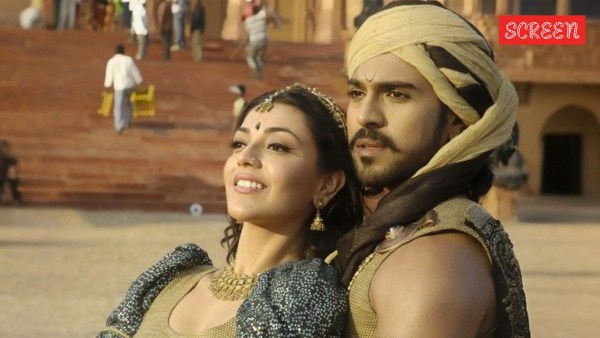 Ram Charan and Kajal Aggarwal from Magadheera
However, reincarnation dramas had existed for decades. What was new was how Rajamouli executed it. The historical timeline was not left as a brief flashback. It was a fully realised world with its own visual identity, its own colour palette, its own action choreography and its own emotional arc. The chariot race, which became the film’s signature sequence, was set entirely in the past timeline and was choreographed with a scale and physicality that Telugu cinema had never seen.
Magadheera taught Rajamouli two things. First, that audiences would accept stories told across two time periods if the emotional connection between the timelines was strong enough. Second, that the past could be as visually exciting as the present, perhaps more so, if the filmmaker is committed to building it with the same detail and resources.
Baahubali: building a world that does not exist
Six years later, SS Rajamouli built a world from nothing. Mahishmati, the kingdom at the centre of Baahubali was entirely invented: its architecture, its politics, its military formations, its waterfall, its people.
The two Baahubali films, The Beginning and The Conclusion, required Rajamouli to create a civilisation that felt ancient and lived in, not just a set that looked old. The production design, the costumes, the weapons, the social hierarchy, the religious iconography, all of it had to be internally consistent. If a character wore a particular style of armour, the audience needed to believe that armour was forged in the same world where the waterfall existed and the kingdom held court.
Story continues below this ad
World-building at Rajamouli’s level means creating rules, rules about how the world operates, what its values are, what its conflicts are, and then telling a story that both respects and tests those rules. Baahubali’s central question, “Why did Kattappa kill Baahubali?”, only works because the world is coherent enough for the audience to believe in the stakes. If the kingdom feels fake, the betrayal feels fake.
RRR: rewriting history without apology
RRR introduced yet another technique. SS Rajamouli took two real historical figures, Alluri Sitarama Raju and Komaram Bheem, and imagined a friendship between them that never happened. The film was set in 1920s colonial India, but the story was entirely fictional. The British officers were real types, not real people. The oppression was historically accurate, the resistance, however, was fantasised.
The skill here was different from both Magadheera and Baahubali. It was not about managing two timelines or building a world from scratch. It was about taking history as a canvas and painting fiction on top of it, convincingly enough that the audience does not question where fact ends and imagination begins.
Story continues below this ad
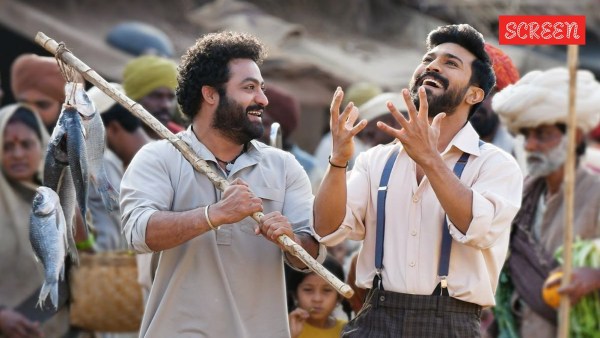 Jr NTR and Ram Charan from RRR
After RRR, Rajamouli had mastered three distinct narrative techniques: dual timelines (Magadheera), world-building (Baahubali) and alternate history (RRR). The question became: what happens when you combine all three? The answer is Varanasi.
Varanasi: where everything converges
Based on what has been revealed through the title launch teaser, leaked synopses, production reports and SS Rajamouli’s own comments, Varanasi operates on every storytelling technique Rajamouli has previously explored, plus one he has never attempted.
The film spans multiple timelines. Not two, as in Magadheera, but potentially several, ranging from ancient Vedic and Puranic periods to the present day. Reports indicate the narrative moves across thousands of years, connecting events in antiquity to a contemporary crisis involving an asteroid heading toward the city of Varanasi.
It builds a world from scratch. The production has recreated Varanasi on a massive scale in Hyderabad rather than shooting in the actual city, suggesting the film depicts versions of Varanasi across different historical periods that no longer exist and therefore cannot be filmed on location. According to multiple reports, the same set will be used to represent the city across multiple time periods, with modifications for each era. This is Baahubali-level world-building, except the world being built is based on a real city, reimagined across centuries.
Story continues below this ad
Mahesh Babu’s character Rudhra is reportedly an archaeologist and a Shiva devotee who embarks on a quest for a cosmic artefact. He is also described as “an avatar of Rama,” suggesting the film blends Hindu mythology with its historical and scientific narrative. The mythological elements are being treated not as religious iconography but as narrative material, the same way RRR treated the freedom struggle as material for an action bromance rather than a history lesson.
And then there is the new dimension: time travel.
What makes Varanasi different
The difference between Varanasi and everything SS Rajamouli has done before is complexity. Magadheera had two timelines, Varanasi may have more than two. Baahubali built one world, Varanasi is building the same world across multiple versions of itself. RRR took a single historical period and fictionalised it, Varanasi appears to take multiple periods, connect them through mythology, layer time travel on top, and then ask a modern character to make sense of all of it.
Varanasi releases worldwide on April 7, 2027. It will release in Telugu, Tamil, Hindi, Kannada, Malayalam and multiple international languages. It will be projected in IMAX.
Story continues below this ad
The question is not whether it will be big. The question now is whether bringing together all the storytelling techniques Rajamouli has mastered, from dual timelines and world-building to alternate history, time travel, fictional languages and mythology, on a scale spanning multiple continents, will result in his greatest film yet or prove too ambitious for its own good.
Also Read: SS Rajamouli is the ultimate ambassador of big-screen entertainment: Nani
Every step of the staircase has worked so far. If you look at it, Magadheera worked, Baahubali worked and RRR worked. Each was bigger, more complex and more ambitious than the last film. Each succeeded beyond what anyone thought possible.
Varanasi is the step where the staircase ends and the building begins. If it works, it will be the most complex narrative ever attempted in Indian cinema. If it does not, it will be the film where Rajamouli’s ambition finally exceeded his ability to execute.
KioskNews shows a cleaned-up reading view extracted from the publisher’s page — the original always lives on their site, not ours.