As US pursues mine deals, Xi warns African resources are not tools for ‘rivalry’
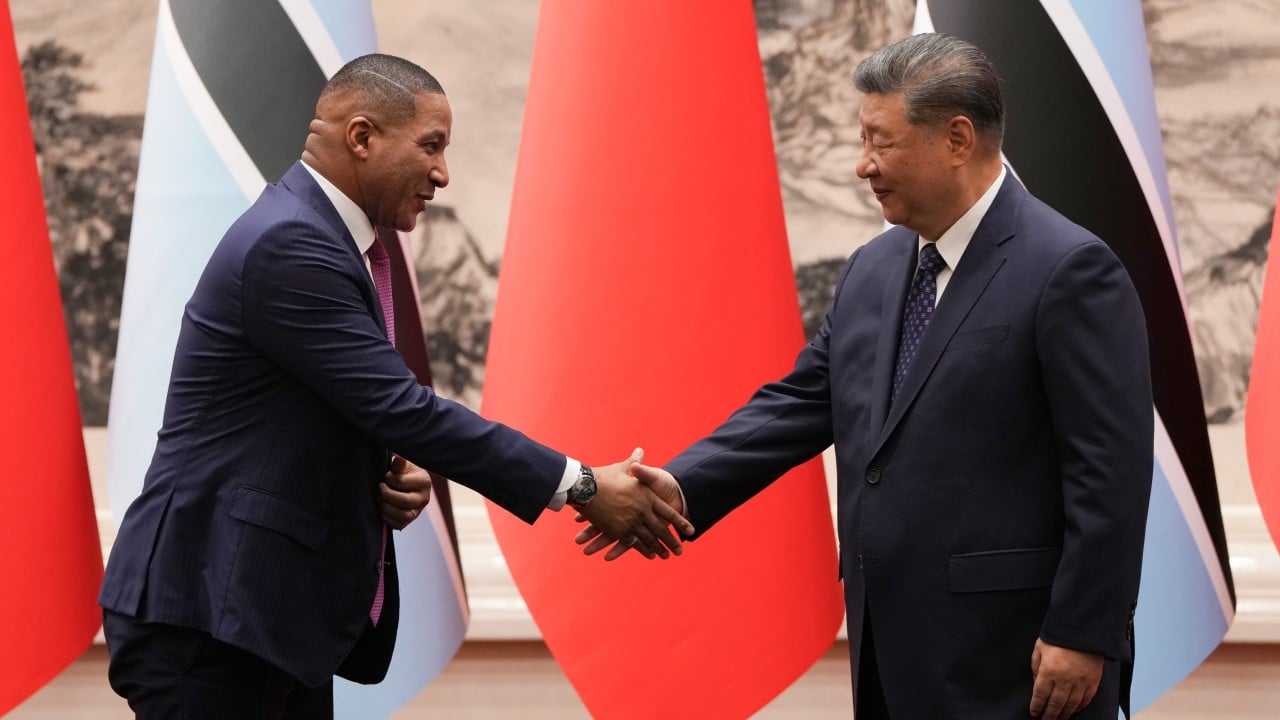
Chinese President Xi Jinping warned that Africa’s resources should not be used as a tool for geopolitical rivalry, as the United States steps up efforts to secure critical minerals on a continent where Chinese companies have major mining interests.
“Africa’s resources belong to Africa,” Xi told Botswana’s President Duma Boko in Beijing on Tuesday, according to Chinese state news agency Xinhua.
He said it was a “historical injustice” that an unfair international division of labour had left the continent at the bottom of industrial and value chains, according to state broadcaster CCTV, adding that China would help make development plans for Africa’s mining sector that involved greater added value.
Xi said China would be glad to see other parties providing genuine support for Africa’s development, and would work to create more favourable conditions for business investment and operation, Xinhua reported.
“A fair and open cooperation environment is crucial. Africa’s resources should not be used for geopolitical rivalry,” Xi said.
The Chinese president also proposed affordable, sustainable financing and the development of supportive logistics corridors, along with a promise to transfer green technology, create local jobs and train workers.
Kai Xue, a Beijing-based corporate lawyer who advises on foreign direct investment and cross-border financing, said Xi’s proposals reflected China’s interest in ensuring Africa remains a leading destination for its mining investment.
16:09
How China is reshaping its economic ties with Africa
“That depends on African countries gaining more value from their resources,” he said.
Chinese companies hold major mining stakes across Africa, including copper and cobalt mines in the Democratic Republic of Congo, copper mines in Zambia, lithium operations in Zimbabwe and bauxite mines in Guinea. They also have stakes in Guinea’s vast Simandou iron ore project, which is designed to produce 120 million tonnes a year at full capacity.
Africa was a major focus at last month’s China Mining Conference and Exhibition 2026 in Tianjin, Xue said.
“We want to keep it that way, and the long-term viability of the relationship depends on Africa gaining more value from its resources,” Xue said. “That goes beyond refining.”
He said presenters during the conference placed strong emphasis on geological surveys, showing that Chinese miners are also looking to expand their extraction efforts.
Xi’s remarks come as Washington seeks a larger share of Africa’s critical minerals.
In 2024, the Biden administration lobbied Congo to block the sale of Chemaf, a distressed copper and cobalt mining firm, to a mining subsidiary of China’s state-backed Norinco. In December last year, the US signed an agreement with the country giving American investors first right of offer on designated mining projects. After Congolese state miner Gecamines withheld approval for the Chemaf deal, US firm Virtus Minerals acquired the company’s assets instead earlier this year.
The US push extends beyond Congo. The US signed a mining-investment framework with Nigeria in September, and a US-backed consortium has been in talks over Tanzania’s Kabanga nickel project.
Xi’s call for higher-value industry echoes a push already under way in many African mining countries.
Namibia banned exports of unprocessed lithium and other critical minerals in 2023.
Zimbabwe banned raw lithium ore exports in 2022 and suspended lithium concentrate exports in February this year. Harare later set out quotas for resumed concentrate shipments, with commitments to build local processing plants among the conditions. A broader ban on concentrate exports is planned for January 2027.
In Zimbabwe, China’s Huayou Cobalt has built a US$400 million plant that turns lithium concentrate into lithium sulphate and shipped its first consignment in April. The sulphate still needs further refining to become battery-grade material. Other Chinese miners have announced plans for similar plants.
During their talks in Beijing, Xi and Boko upgraded China-Botswana ties to a comprehensive strategic cooperative partnership and singled out the Khoemacau copper mine among the projects they want to pursue together.
Chinese miner MMG bought the mine for US$1.9 billion and began expansion in February, including a new processing plant. MMG aims to raise capacity to 130,000 tonnes of copper in concentrate a year by 2028.
KioskNews shows a cleaned-up reading view extracted from the publisher’s page — the original always lives on their site, not ours.