Your governments are to blame for high gas prices: Benchmark Canada
Countries don’t typically get report cards, but there are hard facts that can be collated, assessed and compared. Enter Benchmark Canada, a new project from the Macdonald-Laurier Institute that brings together more than 40 different metrics that measure this nation’s performance. This fall, the National Post is examining many of those findings.
Sign In or Create an Account
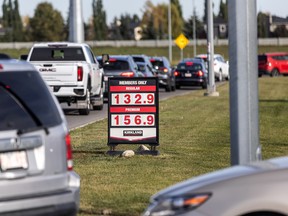
The next time you pull up to the gas pump and grumble about the soaring cost of filling up the tank, take solace you don’t live in Norway or Mexico.
Those two countries are among a number of energy-producing democratic nations whose gas prices are far higher than what Canadians pay, according to an analysis by Benchmark Canada, a Macdonald-Laurier Institute project that compares Canada with its peers.

Get a dash of perspective along with the trending news of the day in a very readable format.
By signing up you consent to receive the above newsletter from Postmedia Network Inc.
A welcome email is on its way. If you don't see it, please check your junk folder.
The next issue of NP Posted will soon be in your inbox.
We encountered an issue signing you up. Please try again
Which doesn’t make it cheap. Canadians paid an average of about $1.85 a litre for gas by mid-October, the Benchmark Canada data shows, but that’s less than Norway, the United Kingdom, Australia and Mexico. Only Americans, who pay the cheapest at roughly $1.57 a litre in equivalent Canadian dollars, and Brazilians pay less for gas.
In almost all the countries surveyed, government taxes and policy are driving higher prices.
“The underlying cost of the commodity is roughly the same,” said Patrick De Haan, head of petroleum analysis at GasBuddy. “It may vary slightly, but it’s all in taxes and potential rules and regulations.”
Taxes make up about 21 per cent of the Canadian pump price at normal rates (17 per cent if you take account of the federal excise tax, which is suspended until next January). In Norway, which has more oil per person than any other of the seven democracies highlighted by Benchmark Canada, they make up 51 per cent, the data showed. Again, American drivers enjoy the lowest gas tax at about 12 per cent.
Prices vary across the country due to various provincial taxes and regulations. Drivers in Alberta, which has suspended its provincial fuel tax, enjoy some of the cheapest gas in the country at $1.55 a litre, compared with $2.165 in Newfoundland and Labrador and $2.12 in Metro Vancouver, the Benchmark Canada data shows.
There are other variables too. Dan McTeague, a former Liberal MP and president of Canadians for Affordable Energy who has carved out a niche analyzing gas price movements since 2015, said Benchmark Canada’s finding that roughly 20 per cent of prices come from taxes doesn’t include federal clean fuel regulations. Those regulations encourage energy suppliers to reduce their carbon footprint, either by buying carbon credits or blending in more ethanol to gasoline.
“There’s no way you can consider that this isn’t a tax,” said McTeague, whose has long campaigned against carbon pricing. His back-of-the-envelope math puts taxes and carbon-policy costs at roughly a quarter of the pump price in Ontario and Vancouver.
Global pricing also explains why being a major oil producer doesn’t help Canadians get cheaper gas.
“It’s a global commodity, not just a Canadian commodity,” De Haan said. “Just because it’s produced in Canada doesn’t mean it stays there.”
Nowadays, the Canadian dollar threatens to trade below the 70-cent mark against the greenback, which makes it more expensive to buy from gas refiners, which typically sell in U.S. dollars. The currency impact comes even as global oil prices soar past the $100-per-barrel mark, which typically helps oil producers in Western Canada and generally helps Canada’s so-called “petro-dollar.”
“I’ve been doing this for a long time, and never have I seen the Canadian dollar not respond to an energy crunch,” said McTeague. “It did this time. It refused to move.”
Figures from fuel-pricing firm Kalibrate show the average Canadian price at the pump was $1.843 a litre at the end of September, about 40 cents higher than it was a year earlier. Diesel prices are up more than a dollar per litre from a year earlier.
“Regardless of whether you drive or not, you’re paying more for everything,” McTeague said.
Barring any major global currency developments or a seismic change in geopolitical events that would send oil prices to new lows, the best way Canadians should expect to see some gas price relief would be through lower taxation.
In Eastern Canada, getting rid of the HST would be “the biggest target” for potential relief, because it’s a percentage tax that grows with the price, McTeague said. “You’re actually turbocharging the higher cost of energy,” he said. “There’s no rhyme or reason why that should still be there.”
De Haan doesn’t necessarily buy that tax relief would be a salve on the wallets of Canadian drivers. An easing of tensions between the U.S. and Iran, and between Russia and Ukraine, would be “the biggest overnight improvement,” he said.
De Haan also warns that cutting fuel taxes while supply is tight could spur demand, and wouldn’t necessarily solve the pricing problem.
“That would be probably the wrong time to lower fuel taxes,” he said.
Blaming the gas station company itself may be misguided as well. Gas stations typically post profit margins of roughly a dime a litre that are often whittled down to a few cents by the end of the day, McTeague said. The real money, he noted, is through selling coffee, car washes and snacks like candy or beef jerky.
Our website is the place for the latest breaking news, exclusive scoops, longreads and provocative commentary. Please bookmark nationalpost.com and sign up for our newsletters here.
Join the Conversation
This website uses cookies to personalize your content (including ads), and allows us to analyze our traffic. Read more about cookies here. By continuing to use our site, you agree to our Terms of Use and Privacy Policy.
KioskNews shows a cleaned-up reading view extracted from the publisher’s page — the original always lives on their site, not ours.