Saudi Arabia vows firm response to attacks
Saudi Arabia yesterday vowed to respond “firmly” to attacks by Yemen’s Houthis, after the Iran-backed fighters wounded 13 people in the kingdom in an assault using ballistic missiles and drones.
The Houthis have been engaged in renewed fighting with Saudi-backed government forces since Yemen’s civil war reignited in July, when the group declared a maritime blockade on Riyadh and began targeting its ships in the Red Sea.
They seized control of Yemen’s Red Sea coast and the Bab al-Mandab Strait last week, which has become vital as the wider US-Iran war chokes the Strait of Hormuz.
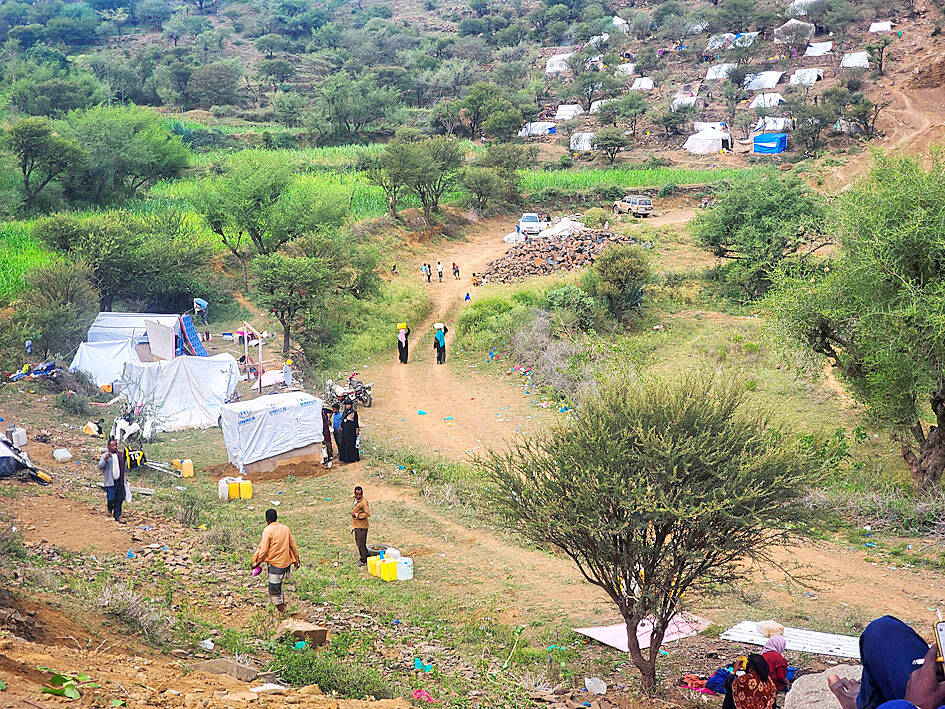
People walk through a makeshift camp for people displaced by clashes between Iran-aligned Houthi fighters and Saudi Arabia-backed Yemeni government forces in Yemen’s Taiz Governorate on Monday.
Photo: Reuters
Saudi Arabia yesterday issued attack alerts for Mecca — the holy city’s first of the Middle East war — and Jeddah and Taif governorates, before quickly canceling them.
The Saudi Civil Defense had earlier issued short-lived air-raid alerts in six regions.
The Houthis have also targeted the oil infrastructure of Saudi Arabia, the world’s leading crude exporter, pushing global oil prices above the US$100 threshold.
A Houthi strike in western Yemen on Monday killed eight government soldiers, two military sources said.
The group also claimed a new large-scale attack using “dozens of ballistic missiles and drones” against King Khalid Air Base in Khamis Mushait, in southern Saudi Arabia.
A Khamis Mushait resident said he heard “intense blasts” that left fires burning for a “long time.”
“Honestly, we couldn’t sleep at all,” they said.
The Riyadh-led coalition yesterday confirmed there had been missile and drone attacks the previous day on Khamis Mushait, Abha and Taif, reporting 13 civilians wounded and damage to seven houses and two vehicles.
Saudi Arabia responded with more than 50 strikes, as it had the day before, the Houthis said.
As the attacks continue, the UN Security Council was due to meet to discuss the Houthis’ offensive, diplomatic sources said.
The coalition said it would deal with the attacks “firmly to protect the sovereignty of the Kingdom” and would take “all necessary operational measures to deter this ... hostile and extremist approach.”
While Saudi Arabia has conducted dozens of airstrikes on Houthi-held areas, it has so far failed to deter the fighters’ lightning offensive.
Saudi Arabia’s de facto ruler Crown Prince Mohammad bin Salman was expected to hold talks with Egyptian President Abdel Fattah al-Sisi yesterday.
US media last week reported that US President Donald Trump had rejected a personal request from the crown prince to intervene in the war.
Trump on Saturday said the Houthis had called Washington and asked the US not to get involved.
Meanwhile, the US is facing a shortfall in ammunition as a result of its war against Iran, the US Department of Defense’s inspector general confirmed on Monday, contrasting with Trump’s assertions of full stocks.
In a first-of-its-kind mandatory report to the US Congress, the inspector said that between Feb. 28 and June 30, Operation Epic Fury (OEF) had an estimated cost of US$33.4 billion, including US$22.3 billion spent on expended munitions.
“The munitions expenditure on OEF has resulted in strategic inventory shortfalls and revealed industrial base bottlenecks for munitions resupply,” the report said.
KioskNews shows a cleaned-up reading view extracted from the publisher’s page — the original always lives on their site, not ours.