Surging gold drives up centenarian gifting costs
THE COST OF AGING: This year, the ministry spent more than NT$97 million on gold charms, compared to about NT$77 million last year, due to rising gold prices, it said
By Lo Pi and Jonathan Chin / Staff reporter, with staff writer


Taiwan’s aging population and soaring global gold prices are making the Double Ninth Festival’s tradition of gifting golden charms to centenarians more expensive, officials said.
The Ministry of Health and Welfare’s Social and Family Affairs Administration Director Chou Tao-chun (周道君) on Friday said that there are 6,489 Taiwanese aged 100 years or older this year, up from 5,749 last year.
He made the remarks ahead of this year’s festival on Oct. 18.
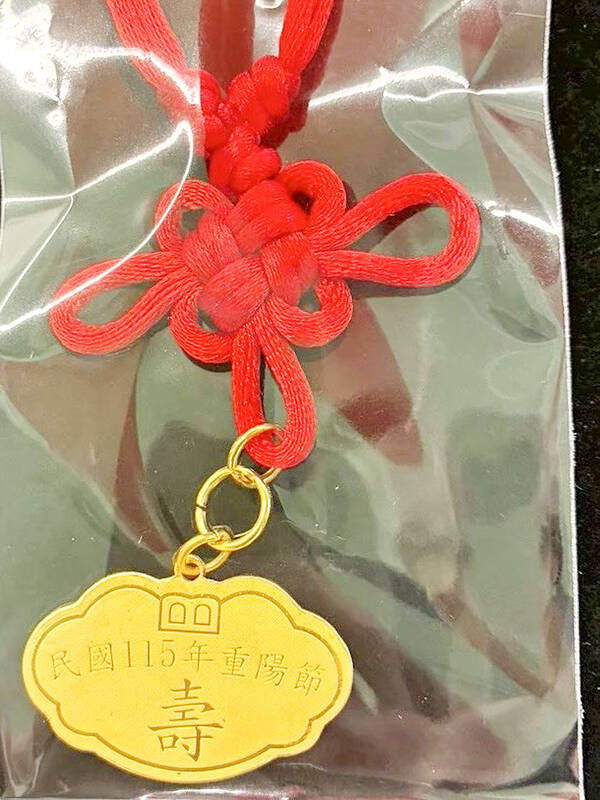
A golden charm prepared by the Ministry of Health and Welfare to gift to centenarians is pictured in an undated photograph.
Photo courtesy of the ministry’s Social and Family Affairs Administration
The figure includes 2,490 Taiwanese who became or are becoming centenarians this year, qualifying them for the ministry’s customary gift of golden lock-shaped charms, weighing about 5.6g apiece, he said.
With rising gold prices, the ministry spent NT$97,221,346 (US$3 million) on the charms, up from NT$76,990,000 last year, he said.
Officials had feared the expenses would exceed NT$100 million before gold prices fell from a high of NT$5,066 per gram, he added.
Giving charms to older people is a gesture in traditional culture of respect and expression of care for the elderly, whose welfare is being looked after by the agency, Chou said.
Officials organize activities in community centers to encourage older people who are active to eat together and engage in activities while those with declining faculties are placed under long-term care, he said.
The agency is working to include older people who are living alone in its care network to ensure their safety and wellbeing, he said.
On the same day, the ministry staged a Double Ninth celebration at Taipei Main Station that attracted a large crowd, including young and old.
The event featured games including tops and pinball machines, nostalgically styled general stores, a high-tech health screening station, an oral health clinic, financial management advisers and an information desk for elderly commuting needs.
Deputy Minister of Health and Welfare Lu Chien-te (呂建德) said that more than 4.8 million Taiwanese were 65 years old or older as of last count, or 20.7 percent of the total population.
The government is confronting the challenge of Taiwan’s aging demographics with the healthy Taiwan, Long Term Care 3.0 and elderly care initiatives, with the latter targeting senior citizens living alone, he said.
Taiwan’s NT$115.3 billion long-term care budget this year represents a significant increase more than the NT$92.7 billion last year, with an additional NT$6.25 billion to fund care for older Taiwanese who live alone over the next two years, he said.
The nation has more than 5,200 community-based care centers for senior citizens, which are operated by volunteers and older people in the area, he said.
KioskNews shows a cleaned-up reading view extracted from the publisher’s page — the original always lives on their site, not ours.