After A Quiet 2026, ISRO Targets Gaganyaan Lift-Off In Four Months
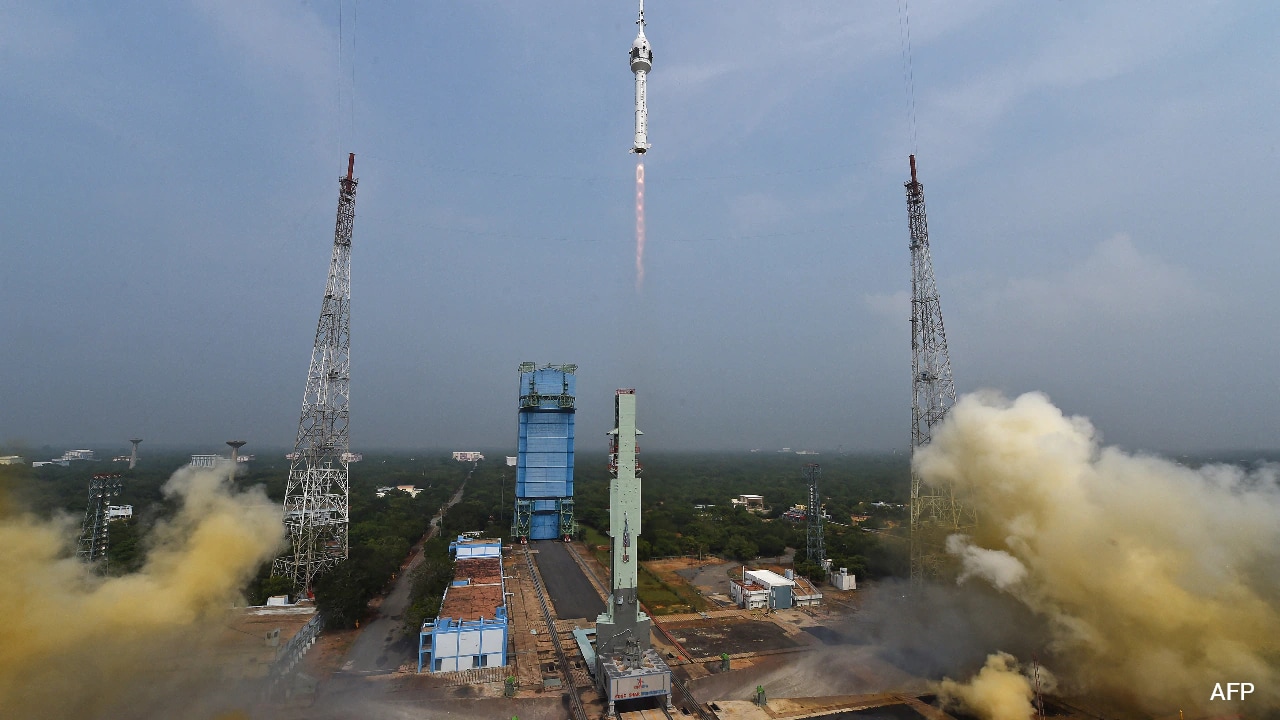
After a year in which ISRO is yet to record a successful launch, India's space agency is preparing for one of the most significant milestones in its history. ISRO Chairman Dr V Narayanan has announced that the first un-crewed mission of the Gaganyaan human spaceflight programme is expected to lift off within the next four months, marking the beginning of India's first push towards sending Indian astronauts into orbit aboard an Indian spacecraft.
Addressing the Third National Space Day celebrations in Ahmedabad, Dr Narayanan painted a picture of a nation that has transformed itself from launching rockets with components transported on bicycles and bullock carts to becoming a major space power with ambitions that stretch from the Moon to Venus and beyond.
"We are in the final leg," Dr Narayanan said while providing an update on Gaganyaan. "Eight thousand tests are successfully completed till today and we are in the final leg. We have to carry out the three un-crewed missions followed by the crewed mission. We are happy to inform that this year we are going to have the first un-crewed mission."
An un-crewed mission means, simulating a human space rocket launch but with no humans in the spacecraft, a test to understand how the rocket behaves without risking human life.
The announcement assumes added significance because Gaganyaan remains India's most complex technological undertaking. Developing a human rated launch vehicle, crew module, life support systems and ensuring the safe return of astronauts requires extraordinary reliability. The mission is viewed as the stepping stone towards a permanent Indian presence in space.
The ISRO Chairman laid out an ambitious roadmap for the current financial year. He said the organisation plans to realize 12 satellites and is targeting eight launch vehicle missions during this financial year. These missions are expected to support communication, navigation, Earth observation and scientific research while also preparing the ground for future human spaceflight and exploration programmes.
This despite the fact that India's Polar Satellite Launch Vehicle (PSLV) remains grounded by the Indian government pending several ground tests to be completed after two back-to-back failures of India work horse rocket.
Dr Narayanan stressed that India's space requirements have expanded dramatically and that much larger capacities will be needed in the coming years.
"Today after 64 years of space programme we are having 56 space assets. But what is required for the country is 200 to 300 satellites at least in a five year time frame," he said.
According to him, achieving such numbers would be impossible through the government sector alone. The demand for communications, Earth observation, weather forecasting, navigation and security applications requires extensive participation from private industry and start-ups.
The Chairman praised the space sector reforms introduced in 2020, saying they have transformed India's space ecosystem. At the time the reforms were announced, India had only a handful of start-ups in the sector. Today, he said, the country has around 440 space start-ups working across launch vehicles, satellites, applications and advanced technologies.
One of the achievements highlighted by Dr Narayanan was the successful orbital mission of Skyroot Aerospace's Vikram 1 rocket. He described it as a landmark moment for Indian private enterprise and credited the success to cooperation among start-ups, ISRO and IN-SPACe.
The speech was also a reminder of how far India's space programme has
progressed technologically. Dr Narayanan recalled that India once depended on foreign technologies and faced sanctions and denials from advanced spacefaring nations.
He pointed to the successful use of indigenous cryogenic technology as a symbol of that transformation. The very technology once denied to India now powers launches of sophisticated satellites from Indian soil.
Among the achievements he highlighted was the launch of a six tonne communications satellite built by an American company using India's Launch Vehicle Mark-3 or LVM3 rocket in a low Earth Orbit. According to him, the mission demonstrated international confidence in Indian capabilities and was secured purely on commercial merit.
"It is because of the strength, because of the innovative approach of India," he said while recalling the mission.
The Chairman also highlighted the NASA-ISRO Synthetic Aperture Radar mission, or NISAR, describing it as one of the most sophisticated Earth observation satellites ever built. He noted that Indian engineers developed the indigenous payload at substantially lower cost of 40% of NASA's while the entire satellite was conceived, realized and launched through a partnership between India and the United States.
Looking ahead, Dr Narayanan outlined a packed exploration agenda. India is preparing for Chandrayaan-4 and Chandrayaan-5, both expected to build on the success of Chandrayaan-3. Plans are also underway for a Venus mission and a future Mars landing mission.
He reiterated one of the most ambitious goals of India's long term space vision: establishing an Indian space station by 2035.
"We are going to build our own space station by 2035," he said, adding that India aims to launch more than 300 satellites in the next six to seven years with support from both industry and start-ups.
The Chairman also reflected on the achievements that have brought India to its current position. Chandrayaan-1 discovered evidence of water molecules on the Moon, while Chandrayaan-3 achieved a historic soft landing nearer the lunar south pole. Aditya L1 placed India among a select group of nations capable of operating dedicated solar observatories.
Yet for Dr Narayanan, perhaps the most important story was not technological but national. He repeatedly returned to the theme of India's remarkable journey over six decades.
"A country which started the space programme 64 years back with bicycles and bullock carts, I can tell you one thing, by 2040 when we land on the Moon India will be second to none," he declared.
He said India would stand on par with the world's leading spacefaring nations in launch vehicle technology, satellite technology, scientific missions, applications and infrastructure.
That confidence was a recurring theme throughout National Space Day celebrations. For ISRO, the immediate challenge is delivering the first Gaganyaan un-crewed mission within the next four months. For India, the mission represents much more than a launch. It is the next step in a journey that began with extraordinary humility and now aims for global leadership in space.
If the Gaganyaan test flight succeeds, it may not only end ISRO's wait for a successful 2026 mission but also bring India significantly closer to becoming the fourth nation capable of independently sending its own astronauts to space.
KioskNews shows a cleaned-up reading view extracted from the publisher’s page — the original always lives on their site, not ours.