Medical visits for flu and enterovirus climb: CDC
BACK TO SCHOOL: The centers said that medical visits for enterovirus rose to 10,203 last week, with the epidemic period expected to start this week
By Lee I-chia / Staff reporter


Medical visits for flu-like illnesses and enterovirus increased last week, while COVID-19 cases stayed at a high level, the Centers for Disease Control (CDC) said yesterday, while seven new cases of acute viral hepatitis C traced to a clinic in New Taipei City were also confirmed.
CDC Epidemic Intelligence Center Deputy Director Lee Chia-lin (李佳琳) said there were 136,796 medical visits for flu-like illnesses from Sept. 6 to Saturday last week, a 16.5 percent increase from the previous week.
As 12 percent of the cases were emergency room visits, the flu is still defined as in an epidemic period, Lee said.
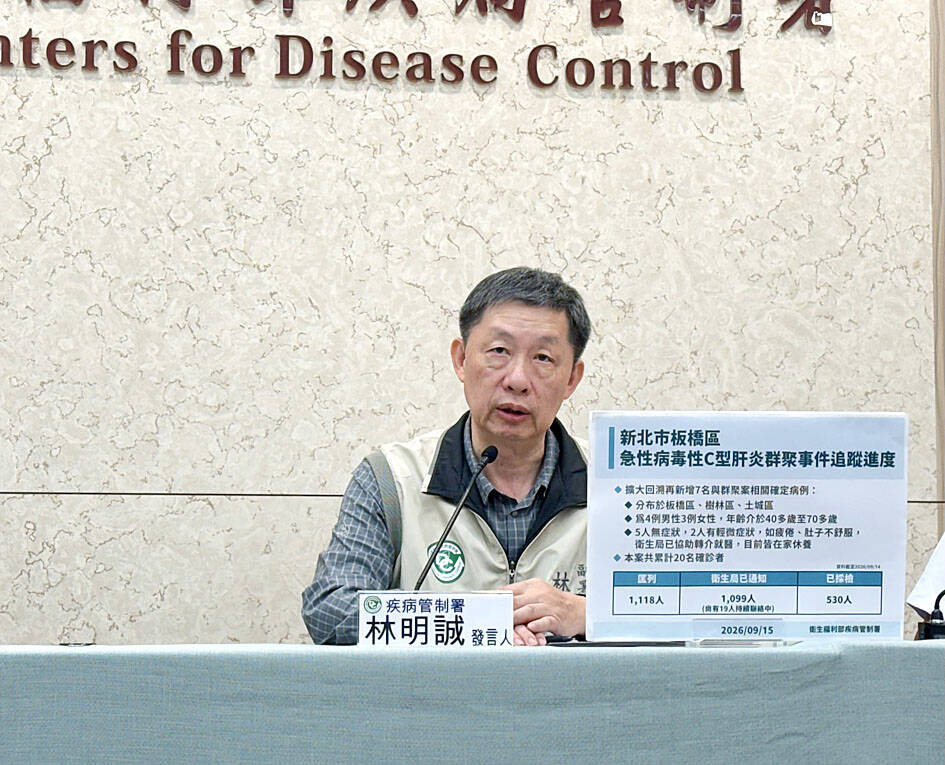
Centers for Disease Control Deputy Director-General Lin Ming-cheng speaks at a news conference in Taipei yesterday.
Photo: CNA
There were 92 severe flu cases and 21 flu-related deaths confirmed in the seven-day period, the highest weekly death count this flu season, which began in October last year, she said.
Influenza A(H1N1) is the dominant flu strain spreading in local communities, accounting for 82.2 percent of positive tests in the past four weeks, she said.
Medical visits for COVID-19 were down 13.3 percent to 17,847 last week, although COVID-19 activity remains at a high level and is still in the epidemic period, with 53 severe cases and 18 deaths confirmed, Lee said.
The dominant strains spreading locally are NB.1.8.1, accounting for 51.9 percent, and PQ.16.1.1 at 44.4 percent in the past four weeks, she added.
CDC physician Lin Yung-ching (林詠青) said the youngest severe flu case last week was a one-year-old boy who received a flu vaccine in October last year.
He began having upper respiratory symptoms including a fever, coughing and runny nose early this month, Lin said.
The boy was admitted to a hospital, where he developed convulsions and lethargy, Lin said, adding that the boy tested positive for influenza A.
The child was diagnosed with influenza-related encephalitis, or acute brain edema, and transferred to an intensive care unit, Lin said.
CDC Deputy Director-General Lin Min-cheng (林明誠) said the centers estimates that flu cases would continue to increase, reaching a weekly peak number around Mid-Autumn Festival on Friday next week, with an estimated 150,000 to 160,000 medical visits in a week.
Meanwhile, medical visits for enterovirus infection increased to 10,203 last week, with the new school semester starting this month, an 18.1 percent increase from the week before, Lee said.
The CDC predicts that enterovirus would enter its epidemic period this week, with cases continuing to rise, reaching a peak of about 12,000 to 14,000 weekly cases by the end of the month, Lin Min-cheng said.
In the next two to three weeks, the seasonal flu, enterovirus infections and respiratory syncytial virus (RSV) infections are expected to remain at high levels, while COVID-19 cases might gradually drop, he said.
As many people will be gathering with relatives and friends over the Mid-Autumn Festival, the CDC urges everyone to practice good hand hygiene and cough etiquette, as well as to pay attention to food hygiene by thoroughly cooking meat and seafood, and avoid cross contamination of raw and cooked food, he said.
Regarding a hepatitis C cluster associated with injections at Antai Songhe Clinic (安泰淞鶴診所), among 1,118 people who had injections at the clinic between January and last month, 530 had been tested as of Monday, Lin Min-cheng said.
Seven additional cases were confirmed — two with mild symptoms and five asymptomatic — bringing the total to 20, he said, adding that the centers estimate the positivity rate might range between 5 and 10 percent after the blood tests are completed.
KioskNews shows a cleaned-up reading view extracted from the publisher’s page — the original always lives on their site, not ours.