Korea’s seas are warming more than twice as fast as the global ocean

(Getty Images Bank)
The waters around South Korea are warming at one of the fastest rates in the world, with the number of marine heatwave days increasing 3.7-fold over the past decade, according to the country’s meteorological service.
Sea surface temperatures around the Korean Peninsula have risen by 0.7 degrees Celsius over the past 10 years — more than twice the global increase of 0.3 degrees.
The Korea Meteorological Administration on Wednesday released its analysis of climate trends and future projections for waters surrounding the Korean Peninsula. The study examined observations collected between 2016 and 2025 by the agency’s marine weather buoys, along with global sea surface temperature data. The findings were compared with the 1991-2020 climate averages for Korea and the world and used climate-change scenarios to project future changes.
Over the past decade, the average sea surface temperature around Korea was 18.1°C (64.58°F), 0.7°C above the 1991-2020 average. Globally, the average sea surface temperature during the same period was 18.5°C, or 0.3°C above the long-term average.
The warming trend has also accelerated. Since 1991, sea surface temperatures around Korea have increased by about 0.3°C per decade, but the increase reached 1.2°C over the most recent 10-year period.
The four years with the highest annual average sea surface temperatures — 2024, 2025, 2021 and 2023, in descending order — all occurred in the last five years.
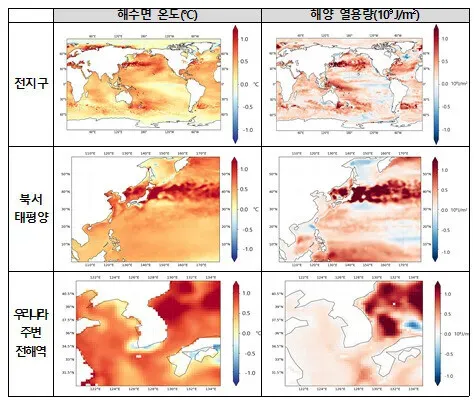
The Korea Meteorological Administration's analysis of climate trends and future projections for waters surrounding the Korean Peninsula. The left column shows sea surface temperatures for the global ocean (top), the northwestern Pacific (middle), and the seas around Korea (bottom), while the right column shows ocean heat content for the same regions. (courtesy of the KMA)
The amount of heat stored in the ocean, known as ocean heat content, has also increased more rapidly around the Korean Peninsula than across the global ocean.
A marine heatwave occurs when daily sea surface temperatures remain at or above the 90th percentile of historical temperatures for at least five consecutive days.
Over the past decade, marine heatwaves occurred for an average of 83.3 days per year around Korea, compared with 22.6 days under the 1991-2020 average — a roughly 3.7-fold increase. Their intensity also increased, with temperatures during heatwaves averaging 2.1°C above normal, compared with 1.9°C historically.
The East Sea, also known as the Sea of Japan, has experienced particularly pronounced warming. Its average sea surface temperature over the past decade was 0.8°C above the long-term average, while marine heatwaves occurred for an average of 96.1 days per year, with an intensity of 2.2°C above normal.
Ocean heat content in the East Sea increased by 0.56 gigajoules per square meter, more than twice the increase recorded across the global ocean.
The outlook is concerning even under scenarios in which greenhouse gas emissions are reduced. Because oceans continue to absorb the effects of greenhouse gases accumulated over decades, warming is expected to persist for a long time even if emissions decline.
Using regional climate-change projections based on the Intergovernmental Panel on Climate Change’s Sixth Assessment Report, the Korea Meteorological Administration found that sea surface temperatures around Korea are likely to rise further even under a low-emissions scenario.
Under SSP1-2.6, a low-carbon scenario in which global carbon neutrality is achieved in the latter part of the 21st century, sea surface temperatures around Korea are projected to be 1.5°C higher by the end of the century. Under SSP2-4.5, an intermediate scenario in which carbon neutrality is not achieved during the century, temperatures are projected to rise by 2.2°C.
The East Sea is expected to warm even more dramatically, with projected increases of 1.8°C under SSP1-2.6 and 2.5°C under SSP2-4.5.
Marine heatwave days are also projected to increase. Compared with the most recent decade, the number of days spent in a heatwave could rise by an additional 181 days under the low-carbon scenario and 231 days under the intermediate scenario. Heatwave intensity is projected to increase by 0.7°C and 0.9°C, respectively.
The findings come as global ocean temperatures are also reaching unprecedented levels.
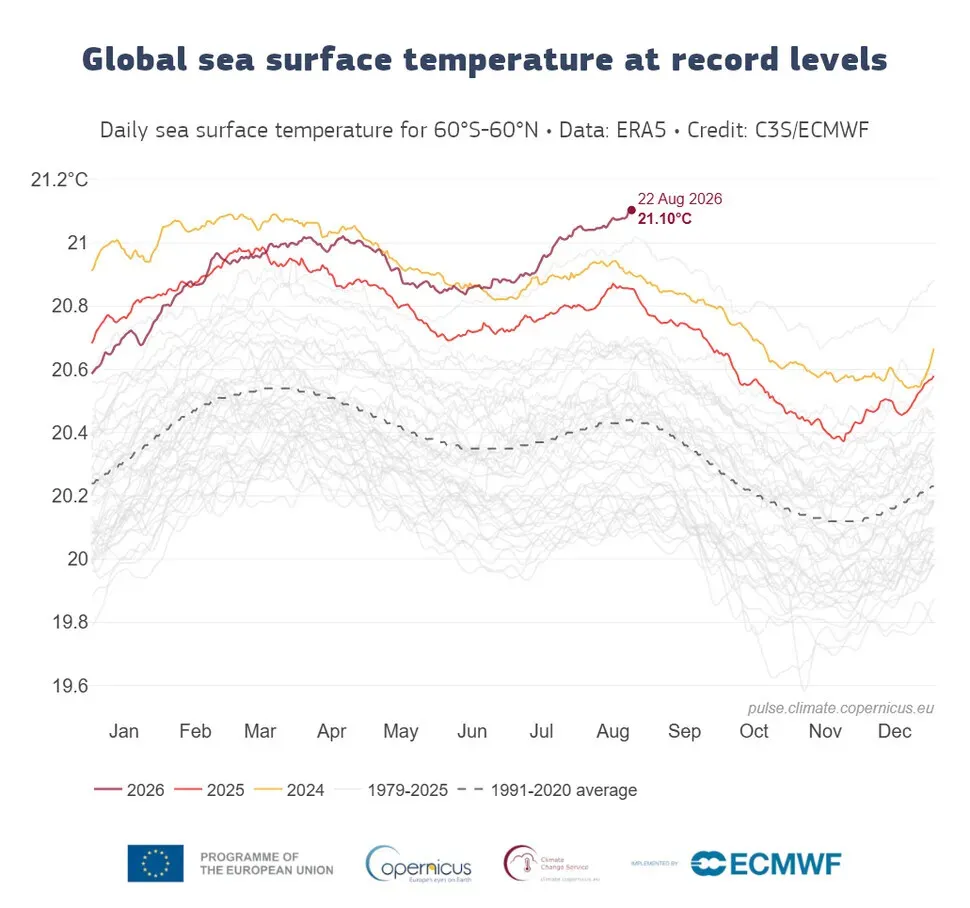
(courtesy of Copernicus Climate Change Service)
The European Union’s Copernicus Climate Change Service recently reported that the global daily average sea surface temperature reached 21.10°C on Aug. 22, surpassing the previous record of 21.09°C set in 2024.
Global sea surface temperatures typically peak in March and April, shortly after the ocean-dominated Southern Hemisphere emerges from summer. The fact that the new record was set in August is particularly notable, suggesting that the overall temperature of the world’s oceans has become high enough to overwhelm normal seasonal variations.
KioskNews shows a cleaned-up reading view extracted from the publisher’s page — the original always lives on their site, not ours.