U.S. mulling further trade sanctions after Canada’s retaliation: White House official
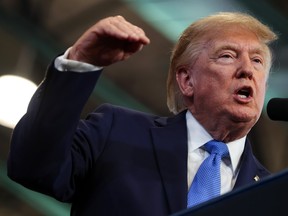
The Trump administration is discussing additional trade penalties against Canada after Prime Minister Mark Carney unveiled dollar-for-dollar retaliation to new tariffs imposed by the U.S. on Saturday.
Sign In or Create an Account
Additional U.S. escalation against its northern neighbour could include higher tariffs and other trade actions, according to a White House official, who spoke on the condition of anonymity to discuss internal deliberations. The official said that an administration response to the latest Canadian moves was expected.
The threat underscores the prospect of a spiralling trade war between the two nations.

Get a dash of perspective along with the trending news of the day in a very readable format.
By signing up you consent to receive the above newsletter from Postmedia Network Inc.
A welcome email is on its way. If you don't see it, please check your junk folder.
The next issue of NP Posted will soon be in your inbox.
We encountered an issue signing you up. Please try again
The official pointed out that President Donald Trump possesses an array of tools that can be deployed in the dispute that intensified after talks between the US and Canada broke down late last week.
Trump has already promised to double auto tariffs on Canada to 50 per cent and impose tariffs on auto parts, starting Jan. 1, as a result of Canada striking back.
Trump and Carney were close to a possible deal, but talks broke down late Friday, and 50 per cent tariffs on about $20 billion in Canadian goods came into effect just after midnight, under the never-before-used provision of the 1930 Tariff Act Section 338.
Since Saturday, the already-tense relationship has plunged into outright acrimony, with each side blaming the other for intransigence, unfair treatment and last-minute changes.
In Ottawa on Tuesday, the Canadian government announced that it would double its existing counter-tariffs on U.S. steel and aluminum products to 50 per cent. American-made milk, furniture, clothing and apparel will also have new 50 per cent duties applied, as will video-game consoles, smartphones and other electronics.
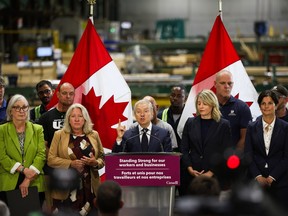
Overall, those retaliatory levies will affect US$20 billion worth of annual U.S. exports to Canada, roughly matching the dollar value of Canadian goods the White House imposed tariffs on Saturday. That is equal to about six per cent of U.S. exports to Canada last year.
The counter-tariffs, which are set to take effect on Sept. 8, mark a sharp reversal in Carney’s approach.
His predecessor, Justin Trudeau, implemented counter-tariffs on a long list of American items as soon as Trump started the trade conflict. Carney, however, lifted many of them in an effort to improve relations and made numerous other concessions — for instance, pulling a digital services tax — as part of an attempt to repair the relationship.
The new Canadian measures will hit the highest total value of northbound exports from Ohio, Illinois, Pennsylvania, Michigan and California, according to a preliminary analysis of the data by Bloomberg News.
That could present a political dilemma for Trump’s Republican Party as it defends its narrow majorities in the U.S. House and Senate. Democrats see midterm election opportunities in Michigan, Pennsylvania and even in Ohio, which has been firmly under Republican control. They will likely use the Canadian retaliation to bolster their attacks on Trump’s tariff policy, which polls have shown is unpopular with voters concerned about the cost of living.
One combatant in the escalating rift between the two nations, Ontario Premier Doug Ford, called for a truce in his acrimonious exchanges with Trump.
“Things got a little heated, Joe, yesterday between both of us. He was throwing insults,” Ford, a conservative populist, told host Joe Mathieu on Bloomberg Television. “And I hit back. But I think it’d be more productive if the prime minister and the president sit down and have a fair deal for everyone.”
As Canada’s manufacturing heartland, Ontario has been heavily affected by U.S. economic aggression. The province’s liquor agency is one of the world’s largest alcohol buyers, and Ford was among the first provincial premiers to remove American alcohol from shelves.
Ford told Mathieu that he supported Carney’s policy of retaliation.
— With assistance from Curtis Heinzl, Mario Baker Ramirez, Jon Herskovitz and Josh Wingrove.
Our website is the place for the latest breaking news, exclusive scoops, longreads and provocative commentary. Please bookmark nationalpost.com and sign up for our daily newsletter, Posted, here.
Join the Conversation
This website uses cookies to personalize your content (including ads), and allows us to analyze our traffic. Read more about cookies here. By continuing to use our site, you agree to our Terms of Use and Privacy Policy.
KioskNews shows a cleaned-up reading view extracted from the publisher’s page — the original always lives on their site, not ours.