Port sues to get control of tanker that hit cruise ship
Just hours after a tanker in New Orleans lost its steering and slammed into a docked river cruise boat, the city’s port sued to make sure federal investigators can seize the vessel that is owned by a subsidiary of a Chinese company.
All 197 passengers and crew on the American Heritage cruise ship survived on Friday as well as the crew on the tanker.
Thirty-two people were brought to the hospital, including two police officers thrown into the Mississippi River when the boat rolled, but none of the injuries were critical and eight remained hospitalized on Saturday, officials said.
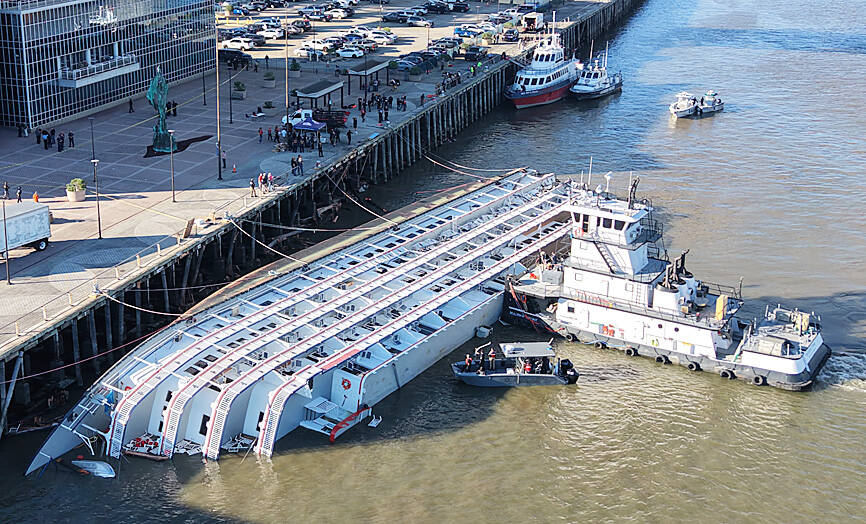
The American Heritage cruise ship floats on its side after being struck by the Atlantic Asphalt tanker in the Mississippi River in New Orleans on Friday.
Photo: AP
The US National Transportation Safety Board said the tanker’s voyage data recorder has been recovered.
Board member John DeLeeuw said the agency expects to release a preliminary report within 30 days, with the final investigation report expected in 18 to 24 months.
A 16-member team would spend a week in New Orleans investigating the incident, he said.
The lawsuit, filed by the Board of Commissioners of the Port of New Orleans, said the Atlantic Asphalt, a 160m-long Marshall Islands-flagged tanker, caused at least US$1 million in damage to its terminal. A judge issued a warrant on Friday giving federal officials control of the ship for now.
The tanker has been towed away from the site, but it could take weeks to move the cruise ship, which remains turned on its side against a terminal in the Mississippi River, US Coast Guard Captain Melanie Burnham told reporters on Saturday.
The first step is to make sure the 60,500 liters of fuel on the boat are removed safely, she said.
The tanker appeared to lose steering, but the exact cause of the crash is not known, Burnham said.
The ship is owned by a company called Nave Shipping SA, which is registered in Monrovia, Liberia, according to the International Maritime Organization and was one of the defendants in the lawsuit filed on Friday.
Nave Shipping is a subsidiary of the China State Shipbuilding Corp, a sprawling Chinese state-owned conglomerate, the live shipping tracker MarineTraffic said.
The first warning people on board the American Heritage had was the tanker blasting its horn several times as it floated toward the cruise ship, passenger Joe Knab told WDSU-TV.
The hit was hard, and the ship immediately started leaning.
The crew gathered everyone on the third deck to put on life vests and start getting them off the boat, but it suddenly rolled and sent Knab and about 100 other passengers and crew into the muddy Mississippi River, where the water was 19°C.
Tugboat operators, other cruise ship captains, nearby workers, police and other rescuers rushed to help.
“It’s fine now, but it was a little scary there at the time. I thought I was drowning because I kept bobbing underneath — and the water doesn’t taste very good,” Knab told the television station, still in the jeans he was wearing on the boat, now covered in mud.
Knab said he thinks he was in the water about 15 minutes. He laughed and said his 20 years in the US Navy likely helped him.
“They taught us not to drown,” he said.
Knab was wearing a shirt from a Hilton hotel where the passengers gathered. The rest of his belongings were in the river. Somehow his cellphone still worked.
He hoped to get on a plane soon back to Wichita, Kansas, but he was not sure how nationwide flight disruptions were going to affect him.
Putting the life vests on the passengers as they waited to get off the boat likely saved a number of lives when the boat suddenly turned into the water, New Orleans Harbor Police Chief Melanie Montroll said.
“Whether it’s 10 feet [3m] of water or 200 feet, having those vests, having that population put those vests on and kind of float upriver while we retrieve them — I think was the best factor of success,” Montroll said.
The American Heritage was finishing an eight-day cruise to several Mississippi River destinations.
KioskNews shows a cleaned-up reading view extracted from the publisher’s page — the original always lives on their site, not ours.