Wall Street’s wild Nvidia ride delivers big paydays and even bigger bruises
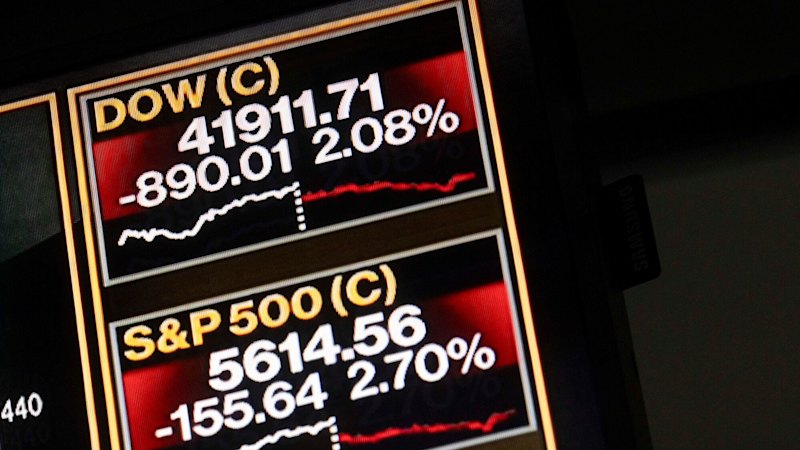
From Treasuries to turbocharged tech bets, almost nothing on Wall Street is escaping the whiplash. Investors keep pouring billions into the fray anyway.
Another rout in chipmakers dragged stocks lower on Friday (US time), even as inflation data eased fears of more aggressive Federal Reserve rate increases. It was the latest twist in weeks of violent reversals, with oil prices surging before dipping, bond yields lurching and the sudden downfall of Nvidia’s Jensen Huang shaking one of the bull market’s biggest bets.
Beneath the relative resilience of major stock benchmarks, the difference between a windfall and a painful loss has often come down to market timing. The S&P 500 has moved an average of 1.6 per cent a day so far in November and the Nasdaq 100 an even more bruising 2.4 per cent, the largest average daily moves for both since the tariff turmoil of April 2025.
Bonds have offered little refuge. The two-year Treasury yield had climbed nearly 28 basis points this month before Friday’s retreat, following similarly large moves in opposite directions over the previous two months. A popular long-term Treasury ETF has endured its own reversals, while volatility in an iShares fund tracking the classic 60/40 stock-and-bond portfolio has jumped. Professional trend-followers have been wrong-footed, suffering their biggest drawdown of the year.
Driving the tumult: inflation fears keep upending bets on the Fed, tensions with Iran won’t stop jolting oil prices, and confidence in the AI boom remains shaky.
For Chris Davis, chairman of Davis Advisors, the unsettling part is how readily investors seem to be shrugging it all off. “The uncertainty is enormous, the fragility, the things that can go wrong very suddenly, enormous – combined with a tremendous amount of complacency in the market,” he said.
Investors are embracing two distinct playbooks: buying the whole market through tried-and-tested index funds, or doubling down on the kind of speculative wagers that have delivered both spectacular gains and crushing losses this year.
Vanguard’s flagship S&P 500 fund attracted nearly $US24 billion ($35.5 billion) in October, while a triple-leveraged semiconductor ETF pulled in $US9 billion despite losing half its value. Even as Nvidia’s upheaval rattles the artificial intelligence trade, demand for Anthropic’s planned blockbuster initial public offering has exceeded the shares available several times over.
The S&P 500, with a 2.5 per cent rally, staged its first weekly advance since early October, even as just a small group of its members is trading at their 52-week highs. The Nasdaq 100 added 3.5 per cent in the five-day stretch.
For some professional investors, the message from the bond market is reason enough to stay cautious. Skyler Weinand, chief investment officer of the $US4.5 billion shop Regan Capital in Dallas, says 10-year Treasury yields could stay above 5 per cent for the foreseeable future, and the Federal Reserve will continue to increase interest rates.
“We are staying in higher-quality, defensive names that aren’t taking on additional debt and are producing ample cash flows,” he said. “We are in the same camp of running minimal leverage and staying defensive until we see better downstream gains from AI.”
Retail buyers have poured tens of billions of dollars into equity funds over the past two weeks. They’ve also been snapping up leveraged funds after sharp declines in assets at the start of November, raising the possibility that dip buying could help stabilise the battered technology trade.
Among the more aggressive wagers, a group of double-leveraged Nvidia ETFs have attracted roughly $US900 million over the past week, even as the chipmaker’s shares lost 13 per cent following the departure of its longtime chief executive officer.
For Joseph Crow, a 35-year-old retail investor from Connecticut, the turmoil offered a chance for a quick payday. On Tuesday, he says he wagered $US3000 on call options expiring in three days on the triple-levered Direxion Daily Semiconductor Bull 3X ETF (SOXL), betting on a fast rebound in chip stocks. The conviction paid off the next day — Crow says he sold for roughly $US23,000.
“It was definitely a lotto purchase,” he said. “Seeing Nvidia so beaten down, it was like, ‘Man, something’s gotta lift eventually.’”
For all the money chasing quick fortunes, the familiar index funds continue to exert a powerful pull. Vanguard’s VOO and VTI, iShares’ IVV, State Street’s SPY and SPYM and Invesco’s QQQ have captured about 30 per cent of all equity ETF flows this year, a share that’s been rising sharply since 2023, according to Athanasios Psarofagis at Bloomberg Intelligence. VOO alone has absorbed about $140 billion in 2026, a sum that puts it on pace for a record annual inflow.
All told, the market’s violent swings have created booms and busts for those trying to ride them, while reinforcing the appeal of a simpler approach: owning the market rather than trying to pick winners and losers.
“Every year, there’s a new single-stock story — Nvidia is the latest,” he said. “Each time, it reminds investors the risk that comes with concentration ...”
Bloomberg
The Business Briefing newsletter delivers major stories, exclusive coverage and expert opinion. Sign up to get it every weekday morning.
More:
KioskNews shows a cleaned-up reading view extracted from the publisher’s page — the original always lives on their site, not ours.