2026 Elections: Kaohsiung debate focuses on 205th Arsenal, donations
A mayoral debate was on Friday evening held in Kaohsiung, with the two leading candidates — the Democratic Progressive Party’s (DPP) Lai Jui-lung (賴瑞隆) and Chinese Nationalist Party’s (KMT) Ko Chih-en (柯志恩) — focusing largely on the redevelopment of the site of the 205th Arsenal and political donations.
The relocation of the 205th Arsenal, under the Armaments Bureau, from downtown Kaohsiung to the city’s Dashu District (大樹) was completed last year. Plans for the redevelopment of the 57-hectare site have since drawn considerable public attention.
Founded in 1945, the 205th Arsenal has been responsible for producing small arms with calibers of less than 40mm for the armed forces.
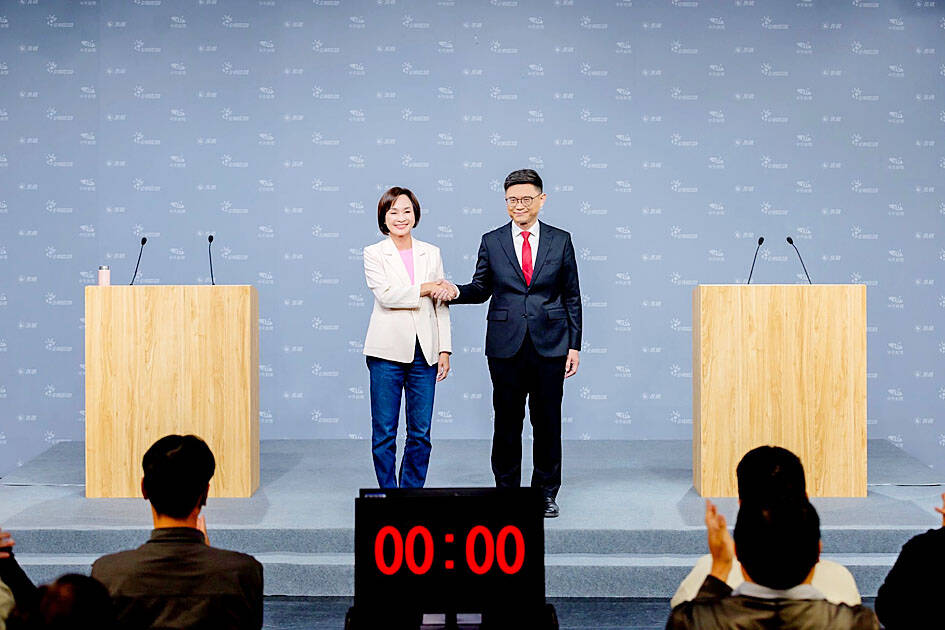
The Democratic Progressive Party’s Kaohsiung mayoral candidate, Lai Jui-lung, on stage, right, shakes hands with the Chinese Nationalist Party’s (KMT) Kaohsiung mayoral candidate, Ko Chih-en, before their debate in Kaohsiung on Friday evening.
Photo: CNA
The arsenal is near Asia New Bay Area, which the city has developed into a major commercial and industrial hub, Lai said, adding that the site should therefore be reserved for future industrial development.
He criticized Ko’s proposal to relocate Kaohsiung City Hall and the Kaohsiung City Council to the former arsenal site, saying that the plan would impose a heavy financial burden on the city.
Ko said Lai had no clear idea how to redevelop the vast site.
He only offered incomplete proposals without careful consideration, such as seeking to attract Nvidia Corp to the area or turning it into an artificial intelligence park, she said.
The former arsenal is in the heart of the city and a comprehensive redevelopment plan is needed, Ko said.
She suggested transforming the site into a special district similar to New York City’s Manhattan, with the ambition of making it surpass Taipei’s Xinyi (信義) commercial district.
Ko, a legislator, questioned Lai, also a legislator, over donations he had received from solar energy developers and his arrangement of legislative hearings that allegedly benefited their business interests.
Lai said he had always declared political donations according to law.
The hearings were organized to seek expert opinions from government officials, academics and business representatives on the direction of Taiwan’s energy development, rather than to promote the interests of particular companies, he said.
Lai also criticized the KMT for introducing a proposal to increase the government’s revenue allocation to Taipei by 3 percent when the legislature amended the Act Governing the Allocation of Government Revenues and Expenditures (財政收支劃分法) in 2024.
Ko said the amendment passed by the legislature contained no provision for a 3 percent increase in Taipei’s revenue allocation, accusing Lai of spreading rumors and making personal attacks against her.
Lai said Ko did not know Kaohsiung well enough, urging voters to vote for him, so he could work for the city, arguing that Kaohsiung could not afford development policies that favored northern Taiwan over the south.
He accused Ko of claiming to put Kaohsiung first while prioritizing the KMT’s interests.
Ko responded that, as a legislator-at-large, her work in politics and policy proposals covered national issues, including energy, education and school council reform.
KioskNews shows a cleaned-up reading view extracted from the publisher’s page — the original always lives on their site, not ours.