‘Should we go home?’ Workers, traders at marble market anxious over construction ban
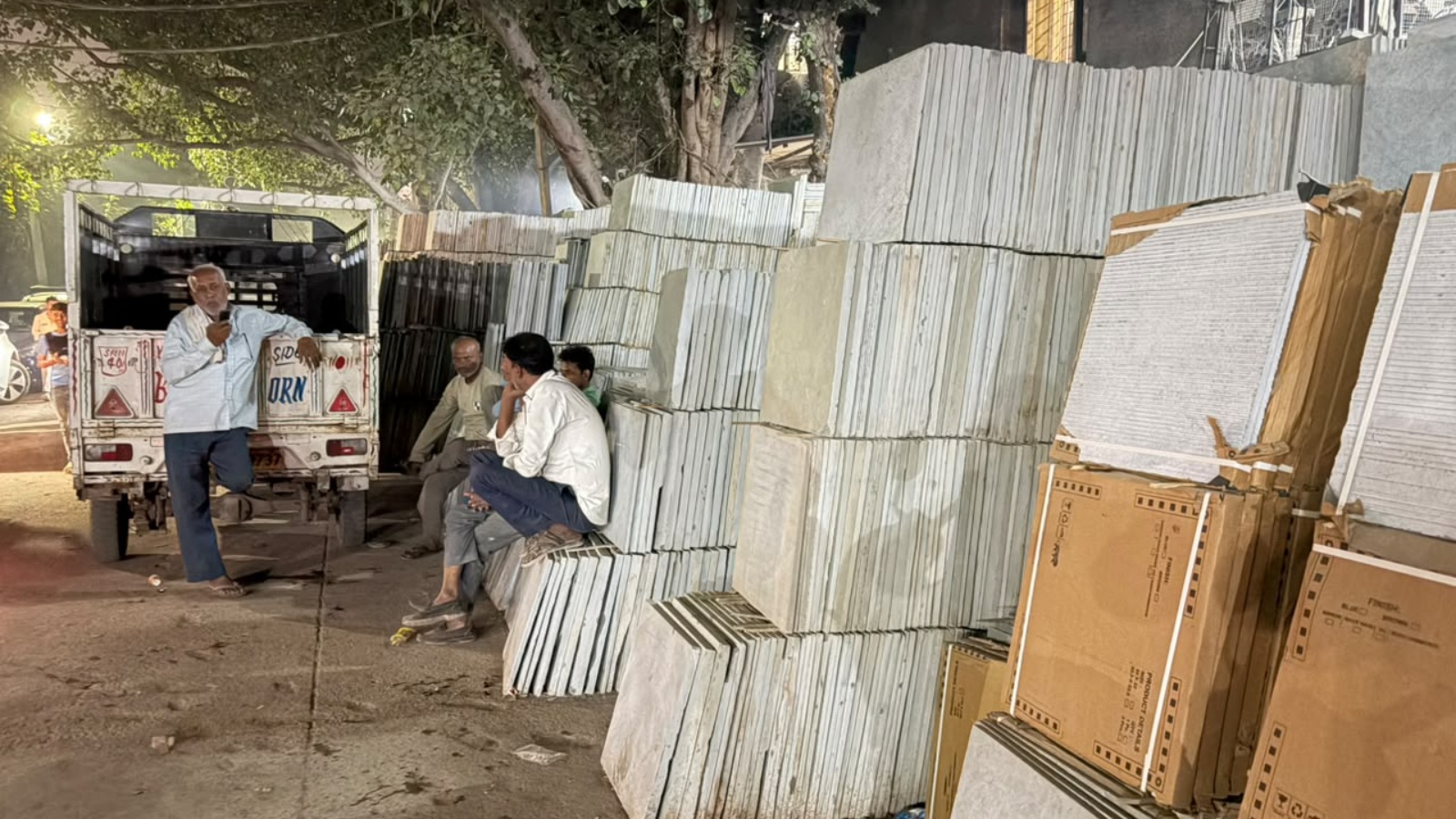
Marble-cutting machines are whirring, labourers are hauling massive slabs off trucks, and the familiar smell of freshly cut timber is drifting in from Kirti Nagar’s neighbouring lakkad mandi. On the surface, the marble market is bustling with activity as the festive season approaches.
But inside the shops, traders are bracing for a prolonged shutdown and migrant labourers leaving for their homes.
Some of marble trader Randeep Bhardwaj’s labourers have already approached him with a question he dreads: “Babuji, ab teen mahine kaam band hai, toh hum ghar jaaye? (Now that there is no work for three months, should we go back home?)”
Delhi government’s Winter Action Plan, which has come into effect from November 1, has made marble traders in Kirti Nagar fear a collapse in business, loss of skilled labour, and mounting financial liabilities.
Under the plan, dust-generating demolition and outdoor civil construction will be prohibited from November 1 to January 31, followed by a complete halt to all construction and demolition activity from December 10 to January 20. Adding to the uncertainty, the Commission for Air Quality Management (CAQM) on October 31 ordered a 15-day ban on demolition and outdoor construction across the National Capital Region from November 5.
Construction accounts for around 21% of the PM10 emissions in the city, according to a 2018 TERI study, and 8.4% of the PM2.5 emissions.
Many traders in the market claim that their business will completely collapse if construction is banned. “If people don’t build new offices or houses, where will demand come from?” asks Bhardwaj.
Story continues below this ad
“Sales to markets outside Delhi have already declined over the years. Earlier, traders supplied marble across much of North India, but now regional markets have since developed in Mohali, Dehradun, Srinagar and Ayodhya,” he adds.
Rahul Monga, another trader, says that most of the orders he is still getting are small, from those who are getting final touches done to their houses.
Rajiv Gupta, who heads the Delhi Marble Dealers’ Association (DMDA), says that to undertake marble works, other types of building material are also needed. “For marble to be fixed, builders require concrete and mortar. Work can’t continue as usual even if the supply of one material gets disrupted,” he adds.
According to the traders, restrictions on the entry of non-BS-VI vehicles into Delhi have impacted the supply chain. “If a customer asks me for 4,000 sq ft of a particular marble variety and I have only 2,000 sq ft available, I can’t tell him that I will send the rest after three months, can I?” a trader says.
Story continues below this ad
While the market has faced winter disruptions due to pollution curbs for several years, traders say the situation is worse this time. The Winter Action Plan marks a shift from the earlier system, under which construction restrictions were imposed largely in response to air quality levels under the Graded Response Action Plan (GRAP).
Even when GRAP Stages 3 and 4 were in force, certain non-dust-generating interior activities, including plumbing, electrical wiring, carpentry and elevator installations, were allowed. That is not the case under the Winter Action Plan.
“Earlier, it was unpredictable, but at least some work could happen in certain weeks or days. Labourers would stay back, hoping that if not this week, they would get work the next week,” says Lokesh Monga, a a marble trader and president of Kirti Nagar Marble Dealers’ Association.
According to him, with workers now aware that much of the work will stop for three months, many are likely to return to their villages or seek employment in other states. “This ban is for three months, but getting the labourers back will take us around six months,” he says.
Story continues below this ad
Also, the workforce is under threat. Monga and Bhardwaj employ around 10 people each and estimate that they may have to let go of seven each. According to traders, businesses will retain some experienced workers and senior administrative staff, even without generating any revenue. The DMDA estimates that around 30,000 people might be dependent on the marble industry for their livelihoods.
They add that even if operations cease, shop and warehouse rents, bank EMIs, interest payments, salaries, electricity bills, GST and insurance premiums will continue to pile up. These recurring liabilities could threaten the survival of smaller traders, they claim.
Many question why marble-related work should face the same restrictions as dust-intensive activities such as demolition and excavation. Marble is generally cut using the wet-cutting method, in which water suppresses dust at the source. Traders argue that cutting, fixing and polishing should be treated differently from activities that generate large quantities of dust.
KioskNews shows a cleaned-up reading view extracted from the publisher’s page — the original always lives on their site, not ours.