Low water: And suddenly there is a bazooka on the bank
Auto-translated to English. Show original
Status: 13.08.2026 • 17:30
Water levels in the Rhine are reaching historic lows. Where water usually flows, ordnance, ammunition remnants, and unexploded ordnance from the Second World War are coming to light. The ordnance disposal service is in constant operation.

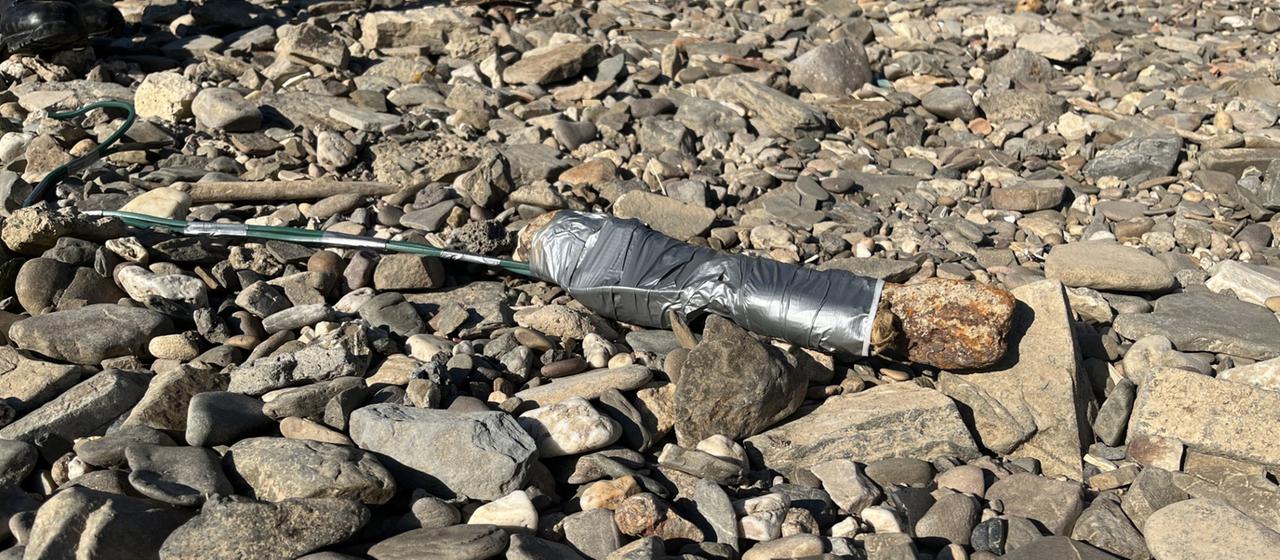
"I am relaxed," says Sascha Hummrich and smiles. In a moment, he will step into the Rhine in a wetsuit to place a bazooka on the riverbed. The anti-tank weapon is to be detonated in the water.
Hummrich and his colleague Marco Ofenstein from the Rhineland-Palatinate Ordnance Disposal Service (KMRD) have packed the bazooka, which walkers had found on the banks of the Rhine in Koblenz-Wallersheim, secured it with sand, and fitted it with a detonator.
What looks like a rusted pipe is still highly dangerous even 81 years after the end of the war, explains Ofenstein: "If handled improperly, the ordnance can detonate again, which specifically means: if you are there, you will not survive it."
Ofenstein and his colleagues at the ordnance disposal service are currently in constant operation.
Houses evacuated for detonation in the Rhine
The collateral damage caused by this accidental explosive find on the banks of the Rhine near Koblenz: twelve houses within a radius of 100 meters were evacuated for the detonation. Residents of an old people's and nursing home on the edge of the danger zone did not have to leave, but were not allowed to leave the building. Rhine shipping was temporarily suspended in the affected area.
For the two men from the ordnance disposal service, the operation is routine, the level of their concentration always the same: "Whether we are defusing a large aerial bomb in the city center or a hand grenade, it makes no difference to us." However, there is a special challenge on the banks of the Rhine: "There is gravel everywhere here, and when you detonate here, you have to be careful that you don't accelerate these stones as well and that they then fly through the area," says Ofenstein.
Ordnance disposal service in constant operation
The employees of the Rhineland-Palatinate ordnance disposal service currently have operations like this several times a day - and also at night. "It is really extreme this summer," says the Technical Director of the KMRD, Sven Rasehorn, "new reports are constantly coming in, our employees are on duty 24/7. People are out and about on the banks of the Rhine a lot during low water and find all sorts of things. Hand grenades, mortar shells, ammunition remnants - but of course also a lot of scrap."
The fact that finds are detonated is the exception, explains Rasehorn. Evacuation actions like the one in Koblenz-Wallersheim are to be avoided if possible. "As a rule, our experts make the weapon finds harmless and bring them in safe ammunition boxes to a bunker at our office. From there, they are then picked up, brought to the Bundeswehr Service Center in Munster, and destroyed there," Rasehorn describes the procedure.
Sven Rasehorn is the Technical Director of the Ordnance Disposal Service.
Weapon finds in other federal states
Even outside of Rhineland-Palatinate, ordnance finds are appearing more frequently these days: in Trebur, Hesse, for example, a walker discovered a smoking phosphorus grenade on the banks of the Rhine on Wednesday. It appeared due to the low water level of the Rhine - and came into contact with air. This led to a chemical reaction between phosphorus and oxygen, as the police report.
The Brandenburg Ministry of the Interior and for Municipal Affairs in Potsdam warns: "If found ammunition is discovered, the following applies: Avoid the object, mark the location of the find, and report the find to the police," says a ministry spokesperson.
And the Bavarian Ministry of the Interior is also aware of the dangers in dried-up bodies of water: "After the end of the Second World War, bombs, grenades, and ammunition remnants were deliberately sunk. Due to the time that has since elapsed, such ordnance is regularly hidden under sediments in lakes and rivers and cannot be easily located," says a spokesperson.
"Many soldiers wanted to get rid of their weapons"
Markus Pöhlmann is a historian and head of the research area "Military History until 1945" at the Center for Military History and Social Sciences of the Bundeswehr in Potsdam. He explains that in the final phase of the Second World War from January 1945, there were "signs of dissolution" among the German troops, especially along the Rhine front. "Much happened in this completely chaotic and also dangerous phase in an uncoordinated and spontaneous manner; many soldiers deserted and wanted to get rid of their weapons," says the historian.
They proceeded according to the principle of 'out of sight, out of mind' and threw masses of war material into rivers, especially the Rhine. After the German surrender in May 1945, finally, "vast amounts of weapons and ammunition remained."
"There were literally mountains of thousands of rifles or 20,000 rounds of ammunition just lying around," says Pöhlmann. The Allies faced the challenge of having to dispose of these weapons: "Also for security reasons, the Allies decided to dispose of weapons in the easiest way, namely to 'dump' them into rivers."
In the final phase of the Second World War, "vast amounts" of weapons and ammunition ended up in the Rhine, among other places.
No figures on disposed ordnance
How many weapons were disposed of in German inland waters cannot be traced. "There are no figures on this," says Pöhlmann. However, it is clear that mainly ammunition, mines, and chemical warfare agents were disposed of in the sea, i.e., in the Baltic and North Seas. This has also been documented. In rivers, on the other hand, thousands of grenades, rifles, explosives, and heavy war equipment such as tanks are presumably still lying there today.
Sven Rasehorn from the Rhineland-Palatinate Ordnance Disposal Service also knows this. "We cannot, of course, clean the entire river," he says. As long as the Rhine carries enough water, however, there is little danger from this ordnance.
The bazooka on the banks of the Rhine in Koblenz-Wallersheim is not a major problem for the ordnance disposal experts. After Sascha Hummrich has placed it in the water, a loud bang can be heard after ten minutes - the detonation can still be felt a hundred meters away. "Everything went well," explains Marco Ofenstein shortly afterwards. While he and his colleague were busy with the detonation, new reports had already come in.
KioskNews shows a cleaned-up reading view extracted from the publisher’s page — the original always lives on their site, not ours.