Cambodia ‘playing the victim,’ Thailand says
SEEKING AN AGREEMENT: The Cambodian foreign minister said Phnom Penh aimed to build trust through the mediation process, not further escalate tensions
Thailand yesterday said that Cambodia was playing the victim in a dispute over maritime resources, as the Southeast Asian neighbors took their feud to international mediators a year after deadly clashes over their land border.
Cambodia, which initiated the case before the Permanent Court of Arbitration (PCA) in Singapore, said it hoped the hearings would yield a peaceful resolution for both countries.
In May, Thailand unilaterally pulled out of a bilateral framework agreement that aimed to resolve overlapping maritime border claims, but denied any link to their land dispute.
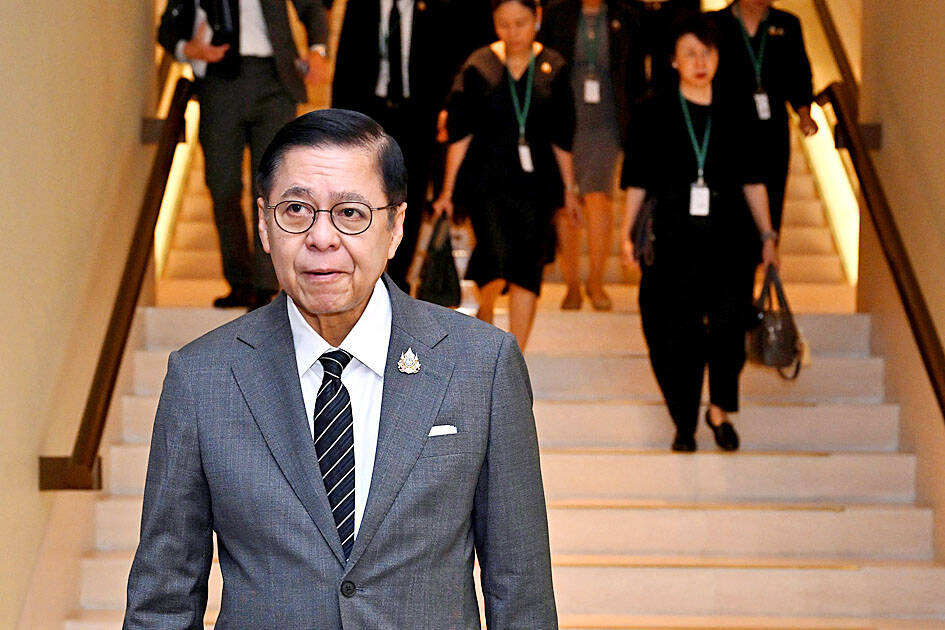
Thai Minister of Foreign Affairs Sihasak Phuangketkeow arrives to meet with Cambodian Minister of Foreign Affairs Prak Sokhonn for the first meeting of a conciliation commission in Singapore yesterday.
Photo: Reuters
Cambodia subsequently initiated a UN-backed conciliation process at the PCA, saying it hoped to return to constructive negotiations.
Presenting Bangkok’s case before a five-member panel of international legal experts, Thai Minister of Foreign Affairs Sihasak Phuangketkeow said Cambodia sought to “vilify Thailand through false narratives, distortion of facts and unfounded accusations... including at international forums.”
“It does this by playing the role of a victim with a sense of self-righteousness aimed at claiming the moral high ground,” he said.
Last year’s clashes in July and December left dozens of people dead and displaced more than a million before a truce was agreed.
Thailand has said it withdrew from the framework agreement, called “MOU 44,” because “no progress had been made” in implementing it.
Thai Prime Minister Anutin Charnvirakul denied the move was linked to the fighting.
The 2001 memorandum of understanding covers a resource-rich maritime territory of about 27,000km2 to which both Cambodia and Thailand lay claim.
Cambodia said last week that it had resorted to conciliation “after Thailand unilaterally terminated the agreed bilateral framework” through which the two nations had “negotiated their overlapping maritime claims for more than two decades”.
Cambodian Prime Minister Hun Manet in June said that the move was also to “protect Cambodia’s sovereignty and maritime rights in accordance with international law.”
Cambodian Minister of Foreign Affairs Prak Sokhonn yesterday told the PCA panel that Phnom Penh saw the process “as a means to rebuild trust, not as a form of escalation.”
Cambodia’s goal was to agree with Thailand on a “single, all-purpose maritime boundary,” or alternatively agree to jointly develop and equitably share resources until a boundary is drawn, he said.
“Our overriding objective is to achieve a resolution that serves the people of both nations and contribute to peace, cooperation and share prosperity in the region,” Prak Sokhonn said.
“Cambodia sincerely hopes that Thailand will engage constructively in this process,” he added.
Despite his rhetoric, Sihasak said Thailand was also seeking maritime delimitation and to rebuild trust.
“Thailand stands ready to engage in this process constructively with the aim of achieving with the commission’s assistance a negotiated and equitable solution,” he said.
Analysts have said that Thailand’s withdrawal from the 2001 agreement and Cambodia’s conciliation case were driven by domestic political calculations.
Set up in 1899, the PCA is the world’s oldest intergovernmental dispute-resolution body and resolves issues between countries and private parties by referring to contracts, special agreements and various treaties, such as the UN Convention on the Law of the Sea.
KioskNews shows a cleaned-up reading view extracted from the publisher’s page — the original always lives on their site, not ours.