Canada-U.S. trade talks collapsed over disputed deal terms, Carney’s envoy says
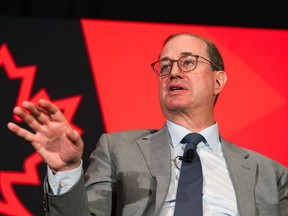
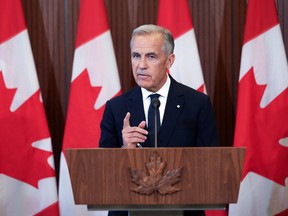
U.S.-Canada trade talks collapsed over a range of issues where the written text of a potential deal was at odds with what the Canadian side believed it had agreed to, Prime Minister Mark Carney’s top U.S. envoy says.
Sign In or Create an Account
Mark Wiseman, Canada’s ambassador to the U.S., said in an interview Sunday that there was no one issue that led talks to collapse late Friday, a development that triggered new tariffs and a potentially escalating trade fight.
Wiseman likened the negotiations to a handshake deal to buy a house — only for the prospective buyer to learn appliances weren’t included, the furnace had no warranty and neither the garage nor yard is on the same property, and ultimately walk away.

Get a dash of perspective along with the trending news of the day in a very readable format.
By signing up you consent to receive the above newsletter from Postmedia Network Inc.
A welcome email is on its way. If you don't see it, please check your junk folder.
The next issue of NP Posted will soon be in your inbox.
We encountered an issue signing you up. Please try again
“As we drilled down, what we discovered was that what our understanding of what had been agreed to was quite different from what was showing up in the documents,” he said. “When that kind of happens once or twice, it’s kind of understandable, but when it happens consistently, and every interpretation is the most negative interpretation” then it “got to a point” where they walked away.
Wiseman’s comments come as the countries grapple with the sudden, jarring collapse of trade talks on Friday. The U.S. proceeded to apply a 50 per cent tariff on about US$20 billion in Canadian goods, and Carney announced retaliation that will take effect on Sept. 8. The U.S. is pledging to escalate if he proceeds.
The Canadian dollar was quoted as much as 0.5 per cent weaker as currency markets reopened in Asia, underperforming major peers. The move pared last week’s 0.8 per cent rally that stemmed from a weaker greenback and indications that the two sides were nearing a deal.
“News over the weekend is certainly CAD negative and I think we will see plenty of volatility in the currency, especially once North America comes in and we get further expected comments from both sides,” said Nick Twidale, chief market analyst at AT Global Markets.
“However, moves won’t be too excessive as we’ve all seen this movie before over the last couple of years, so I’m expecting some sort of a deal or resumption of trade talks to be announced during the week,” he said.
It’s not clear whether negotiations will take place between now and then, but Wiseman said the timeline is not about creating an overtime period for talks. “I don’t think it should be viewed that way,” he said.
Talks were bogged down in particular on a dispute over tariff treatment of medium and heavy vehicles, on which the U.S. was resisting cutting tariffs. Wiseman said Canada “needed medium and heavy duty vehicles to be included” in tariff relief. The issue affects General Motors Co. and Ford Motor Co., two U.S. automakers operating in Canada, he said.
“That’s just something we could not accept because we want to protect the existence of an automotive assembly industry in Canada for cars, light trucks, you know, medium trucks and heavy-duty trucks.”
But he added: “This is not why the deal fell apart. That is a very specific example of one of a number of things where, you know, as the interpretation of the details became clear, it became obvious that there wasn’t going to be a meeting of the minds.”
U.S. Trade Representative Jamieson Greer said the deal would have offered Canada tariff reductions in steel, aluminum, automobiles and lumber, but blamed Canada for walking away. Carney said he walked away when the U.S. demands became too great.

Greer told the New York Times on Saturday that the deal would have cut the “majority” of Canadian steel exports to a 25 per cent tariff up to a quota, with anything above that remaining at 50 per cent. The U.S. would have lowered the aluminum tariff to 25 per cent without a quota. It would also have cut the tariff on passenger vehicles, suspended the since-enacted tariffs and eliminated a lumber tariff. Wiseman, asked to confirm that, declined to get into details but called it “broadly accurate.”
“We’re disappointed,” he said. “We worked hard, but at the end of the day, the terms that were put forward on a deadline — that was created by the United States — it didn’t work for us.”
Carney said the U.S. demanded that Canada constrain its ability to do separate trade deals with other nations. Wiseman declined to fully elaborate, saying that the matter was not with any one country, such as China, but broader.
The U.S. “has changed its view of economic partnership” and “in the face of that, Canada, among other things, has said that we will look to diversify,” he said. “So we have to ensure that any agreement we would come to with the United States does not constrain our ability to create trading relationships, open and free trading relationships with other jurisdictions. But to be clear, this was not an issue about China.”
Language issue
Carney also said the administration was looking to curtail the use of French, one of Canada’s two official languages and a political lightning rod. Wiseman said that dispute pertained to digital services and U.S.-based streaming services and levels of French-language content.
Wiseman cast the matter as a red line.
“It is non-negotiable, in terms of our ability to protect — and to not just protect, but to be able to enhance and grow the French language in Canada, in Quebec and in the rest of Canada,” he said. “Those that want to do business in Canada, be it digital or anything else, must respect that fundamental reality.”
Carney also said the U.S. administration was not united in its approach, signalling that Canadians were getting different and dizzying messages from Greer, who is Trump’s top trade official, and Commerce Secretary Howard Lutnick, who oversees the so-called Section 232 sectoral tariffs that were a core part of talks.
U.S.-Canada ties have frayed substantially during Trump’s second term, with the president pressuring Canada to become the 51st state and applying tariffs that fly in the face of the trade deal he signed in the first term and related side letters that contained pledges Trump has since abandoned.
Trump said in a social media post early Sunday that Canada “wants the benefits of being a State, without being one,” but has otherwise said nothing since the collapse of talks. One of his cabinet officials, Transportation Secretary Sean Duffy, said on Fox News that Canada is “foolish” to think it can win a trade war with the U.S., but Trump’s former vice president criticized the measure.
Pence critical
“American businesses and American consumers pay American tariffs,” Mike Pence said on CNN’s State of the Union. “The last thing we need right now, as our economy is getting back on its feet, is a trade war with Canada.”
Pence, who fell out with the president after the Jan. 6, 2021 riot by Trump’s supporters at the U.S. Capitol, said his advice would be: “Drive a hard bargain, but let’s pursue free trade with free nations, most especially our trading partners to the north.”
Wiseman declined to say whether Canada was open to restarting talks, but said communications with the administration continue and that the talks were cordial throughout. Wiseman was hosting guests at the embassy in Washington Sunday to watch the Freedom 250 Grand Prix race taking place along Pennsylvania Avenue.
“We’re just not willing, at the end of the day, to accept terms that were unfair, uneconomic and actually, you know, called into question the reliability of the deal,” Wiseman said. “Because you know one of the things that you’d hate to see happen is you agree on something and then, after agreeing to it, it gets undermined.”
— With assistance from Matthew Burgess.
Our website is the place for the latest breaking news, exclusive scoops, longreads and provocative commentary. Please bookmark nationalpost.com and sign up for our daily newsletter, Posted, here.
Join the Conversation
This website uses cookies to personalize your content (including ads), and allows us to analyze our traffic. Read more about cookies here. By continuing to use our site, you agree to our Terms of Use and Privacy Policy.
KioskNews shows a cleaned-up reading view extracted from the publisher’s page — the original always lives on their site, not ours.