‘You need the power of all your votes’: Bedouin women secure success for Arab parties in Israeli election
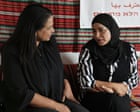
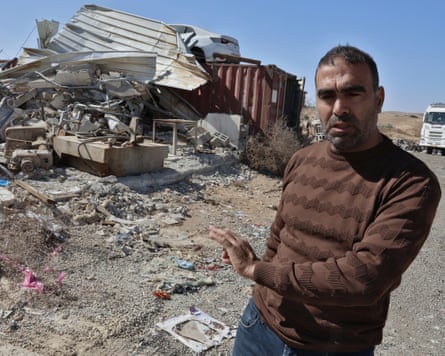
Last year, Umm Khaled Fatoum returned from volunteering in a Jewish-Arab support centre for victims of war to find bulldozers tearing into her son’s house in the Bedouin village of Azzarnug.
The demolition crew, who arrived under police escort, did not even allow them to remove furniture or solar panels before reducing the home and its contents to a pile of rubble.
This week, she took action of her own at the ballot box, targeting the extremist national security minister who ordered – and boasts about – the mass destruction of Palestinian and Arab homes.
“I had one goal, to send [Itamar] Ben-Gvir home,” Fatoum said. “There isn’t a single family in the Bedouin community that hasn’t been hurt by his campaign against us.”
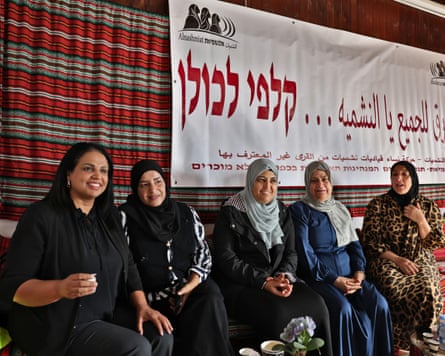
In the weeks before election day, she joined a grassroots campaign to educate other Bedouin women about their rights and potential power.
It had spectacular results, with voting rates tripling in some Bedouin villages in the southern Negev region in Tuesday’s election, amid a broader surge in turnout among Bedouin voters.
Years of violent, racist government opened the door for change in conservative communities, said Hanan Alsanah, a lawyer and activist whose Alnashmiat network led the grassroots programme.
“We said that even if all the men go to vote, it is only half the community. You need the power of all your votes, because Ben-Gvir has a lot of power.”
The rise in Bedouin votes came amid historically high turnout among Arab citizens of Israel. Their votes secured an unprecedented 19 seats in the Knesset for Palestinian-led parties and were critical to stripping the prime minister, Benjamin Netanyahu, and his allies of their governing majority.
This year, the lowest turnout in any Bedouin community was 62%. The highest was more than 93%. With an estimated 180,000 eligible voters, their turnout was key to the Islamist Ra’am party beating polling expectations.
Netanyahu has repeatedly used racist fearmongering to try to boost voter turnout among his own base. This year, his attacks included an AI-generated image purporting to show a crowded polling station in a Palestinian area and Bedouin female voters.
In an apparent attempt to undermine the surge in votes for Palestinian-led parties, Netanyahu accused them of fraud and foreign support.
“The increase in voter turnout in the Bedouin community in particular, and the Arab community in general, is unprecedented in the history of the state,” said Amit Segal, a pundit and close confidant of the prime minister.
The allegations have been rejected by opposition leaders, election organisers, and the activists in the Negev.
“I am very proud of our turnout. They are talking about ‘corruption’ [as the reason for high voter turnout]. The correct word is ‘awareness’,” said Amira Habdoubi, an organiser from the village of Abu Talul.
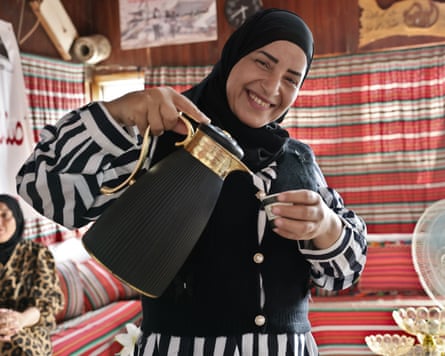
For a community whose civil rights are policed by racist authorities, the election was a rare opportunity for political expression, she added. “We can’t protest, because they will arrest us. Voting is the only opportunity we have to make a political protest.”
The Muslim Bedouin are part of a marginalised minority inside Israel. Before the state was created, they roamed widely across the Negev desert.
Now, although their villages take up only 2.5% of the land in the region, many are deemed “unrecognised”, targeted by the state for demolition and left without basic services including electricity and water supplies. The majority of the Negev has been designated as military training grounds and firing ranges.
More than 100,000 people live in about 30 unrecognised communities in the Negev. Another 200,000 live in official towns, or places with some level of recognition.
Netanyahu’s pursuit of open-ended regional conflicts also drove Bedouin turnout. War is particularly terrifying in unrecognised villages because the state does not provide them with bomb shelters or warning sirens ahead of rocket, drone and missile attacks.
Rockets that hit Bedouin villages without shelters killed six of the 36 child victims of the 7 October attacks. Several adults were also killed that day in the villages and at least four people have been seriously injured by Iranian missiles.
Organised crime is another concern, rising almost unchecked under the current government.
“We had clear goals. Stop the home demolitions, stop the hatred, stop the war. Ben-Gvir talks all the time about security, but we feel no security and no one cares about us,” said Mayada Abu Khweida.
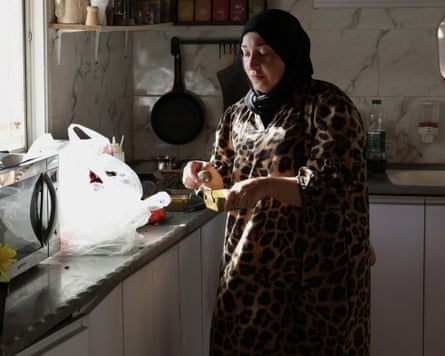
The activists worked to help women understand their rights and tackle logistical and practical obstacles to voting, as well as cultural ones.
“Because [residents of unrecognised villages] can’t vote in the municipal elections, a lot of women don’t know they have a right to vote in national elections,” said Abu Khweida. “We told them: ‘There is a legal way to express your anger and raise your voice.’”
For similar bureaucratic reasons, there are no polling stations in unrecognised villages, so voters have to travel to nearby towns. Men went any way they could, including on camel, horse, donkey and bike, on journeys that took up to an hour in each direction.
Jewish women offered lifts to Bedouin women, but because in 2019 Israel’s election committee ruled that organising transport volunteers was illegal, voters and drivers connected individually.
“Hundreds of women volunteers went to help Bedouin women to access the polls, and at the same time about 150 men went to do protective presence at the polling stations,” said Raluca Ganea, the founding executive director of the Jewish-Arab community action group Zazim.
“We wanted to have Jewish men standing there to de-escalate, in case there was a rightwing provocation of some kind. So it would not be the Bedouin men in front of the provocateurs, because if the police come or there is violence, they are much more likely to be arrested or worse.”
Netanyahu’s racist get-out-the-vote campaign on social media included photos of Bedouin women with their faces covered.
Some of these women covered their faces to avoid being seen by strangers from outside their own community. In recognised towns, where women could vote in their communities, most did not cover their faces, Alsanah said.
Others hid themselves to avoid becoming fodder for Ben-Gvir’s extremist social media feed, which regularly features humiliation of Arab citizens.
“The women were worried the extremists would take photos at the polling stations and covered their faces to protect themselves from being exploited on social media,” Abu Khweida said, adding that his campaign of humiliation has affected all of Bedouin society.
The grassroots mobilisation of Bedouin voters aimed in part to give children back their dreams, one reason why women responded so strongly.
“In the last election in 2022, turnout among women was around 20%. Now in the unrecognised villages, informal data shows more than 60% turnout among women,” Alsanah said, adding that Israel does not break down voting statistics by gender.
The project built on more than a decade of work with Alnashmiat, based in Arab and Jewish solidarity, that could set an example for a new government, Alsanah said.
“We learned an important lesson from this election campaign. We should work together, men and women, Arab and Jewish citizens, and we should bring this approach to the Israeli parliament to rebuild the state.”
KioskNews shows a cleaned-up reading view extracted from the publisher’s page — the original always lives on their site, not ours.