Snowy Hydro 2.0 is costing $25bn – 12 times more than its initial estimate. How did we get here?
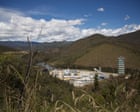
The cost of the publicly owned Snowy 2.0 hydroelectricity project has blown out extraordinarily – to as much as $25bn. That’s more than 12 times the initial estimate when the development was first promised nearly a decade ago.
What happened? Adam Morton and Petra Stock explain.
A quick recap: how did we get here?
The project known as Snowy 2.0 was announced by then prime minister, Malcolm Turnbull, in March 2017. After a number of coal-power plants closed, and amid a highly politicised fight over a black out in South Australia caused by extreme weather but blamed on windfarms, he proposed a $2bn expansion of the historic Snowy Hydro scheme to create what is effectively a national-scale, long-duration battery.
The idea is to pump water uphill to a higher storage area when electricity is cheap and release it downhill to flow through huge turbines to generate power for the grid when it is needed. This is most likely to be during times of high demand and when solar and wind generation is low.
The project – an effective 50% expansion of the Snowy scheme – involves linking two Snowy reservoirs with tunnels about 27km long to create a 2,200 megawatt capacity pumped hydro development that can provide 350,000 megawatt-hours of storage.
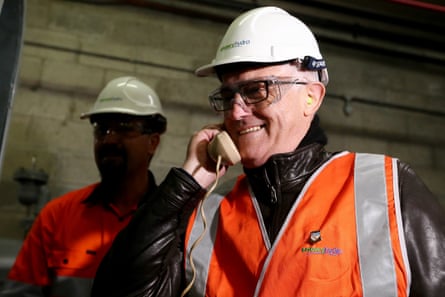
Beyond the basics, few details were released at the time of the announcement. The idea dated back to the 1980s, but the specific proposal had been put to Turnbull just two weeks before by then Snowy Hydro chief, Paul Broad. Estimates of how long it would take to build varied from about four to seven years.
What went wrong?
What didn’t? In 2017, a feasibility study put the cost at between $5.4bn and $6.9bn. A final investment decision on an expected cost of $6.1bn followed a year later, before geological studies had been finished, or approval for environmental works or transmission lines had been granted.
Then energy minister, now opposition leader, Angus Taylor, said the development would be a “fundamental part of our future energy needs for many generations”. Turnbull’s successor, Scott Morrison, announced the development had been approved during a 2020 byelection campaign for the local federal seat of Eden-Monaro.
Three tunnel-boring machines were commissioned, but progress was slow. One machine, named Florence, became stuck after hitting unforeseen soft ground just 150 metres into a 15 kilometre excavation. The 143-metre long machine didn’t move for nearly a year. It became stuck on more occasions after it began to move.
The expected cost continued to blow out. By 2023, with the project well behind schedule, the new Labor government had replaced Broad with Dennis Barnes, a longtime energy industry executive. It “reset” the development, including a new, incentivised contract-structure for Italian industrial company Webuild to deliver the project. Tunnel workers went on strike over pay and working conditions.
By August 2023, the projected cost had doubled to $12bn, with a forecast finish date of 2028. By this week, it had reached $22.6bn, and possibly $25bn, with completion not expected until late 2029 – and more than a third of tunnelling still to go.
These problems weren’t a shock. In 2020, 30 engineers, economists, energy specialists and environmentalists called for an independent review into the development, arguing it would cost far more and deliver far less than promised. Neither the Coalition nor Labor agreed.
Do we really need it?
Expert views differ, and have from the start.
The argument for Snowy 2.0 is that the power grid is moving towards running mostly on solar and wind energy that need to be backed up – “firmed”, in energy lingo – to ensure a constant electricity supply. A significant part of the firming will come from batteries, which are effective at filling short-term gaps in supply. But batteries are less effective at filling the longer duration gaps that can occur in winter when there is less sun, especially when combined with a period of low wind.
Pumped hydro developments, and particularly Snowy 2.0, can fill these longer gaps. Andrew Blakers, a professor of renewable energy at the Australian National University, said the energy storage expected from the mountain scheme was “humongous” – about nine times more than the government’s home battery subsidy program. Other solutions to help address times of greater demand are more transmission lines, which in theory allow electricity to be more easily moved to where it is needed across the country, and fast-start gas-fired peakers.
Each has problems. Pumped hydro is proving difficult. Several private developments have failed to progress. Transmission lines are expensive and hard to get built. Gas plants rely on expensive fuel and release greenhouse gas emissions.
Tristan Edis, the chief executive at Green Energy Markets, said the equation had changed since 2017, and “if we had our time again, the answer wouldn’t be Snowy Hydro.”
He said batteries had developed at an extraordinary pace and while gas plants came with obvious problems, they would provide only about 5% of total generation as a backup option. He said emissions would be relatively limited and gas may eventually be replaced with cleaner fuels.
But both Edis and Blakers said it would make little sense to abandon Snowy 2.0 this far in. Edis said he imagined Snowy 2.0 would be used, and could be important to cover gaps created by the closure of some major coal plants in NSW and Victoria over the next few years – and as demand grows due to datacentres.
“But it’s just a really expensive thing for what it will get used for,” Edis said.
Asked on Friday if $25bn was a good use of taxpayers’ money, the climate change and energy minister, Chris Bowen, told News24 it was a “fair question” but he believed the development would “provide net benefits to the Australian people”.
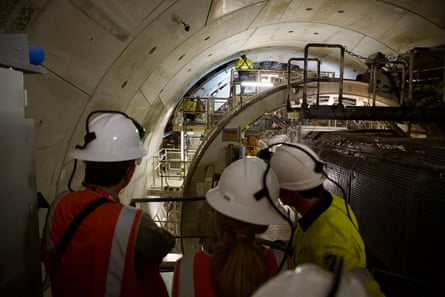
He stressed the scale of the development – a power station the size of the Sydney Opera House a kilometre underground, with tunnelling in terrain that wasn’t properly understood from the start – and declared Snowy 2.0 would last 150 years, much longer than other energy plants.
Taylor blamed Bowen for the blowout and said he should resign. But when asked if it would be scrapped under a Coalition government he repeatedly ignored the question.
How confident can we be that it will be delivered by 2029?
Given the delays so far, not particularly.
An analysis of the project’s benefits by consultants GHD – commissioned and released by Snowy Hydro – acknowledged that much about the project, including the starting date, could still change.
Bowen said the date from the Snowy board was the “best estimate in one of the most complicated engineering projects going on around the world at the moment”, but added: “I am not here to say to you that anything is locked in stone when it comes to a project like this.”
Who will pay for it?
Australians, through a combination of energy bills and taxes. Given the political incentive to keep bills as low as possible, probably mostly the latter.
The country needs new energy infrastructure to replace ageing and polluting coal plants. That comes at a cost, whatever is built. Pumped hydro energy helps avoid the often hidden cost of damage from emissions released by burning fossil fuels. The question is whether it is the most cost effective way to provide what is needed.
GHD modelling suggested Snowy 2.0 could reduce national wholesale electricity costs by about $7bn – but over 45 years.
KioskNews shows a cleaned-up reading view extracted from the publisher’s page — the original always lives on their site, not ours.