From ‘political orphan’ to probable premier, Paul St-Pierre Plamondon is going ‘all-in’ on separatism
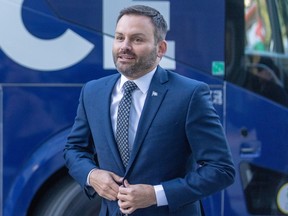
QUEBEC CITY — “To the sovereigntists, I say this: your obsession with holding and winning a referendum harms the progressive cause and feels like psychological harassment to a majority of the population. Many voters share my view.”
Sign In or Create an Account
These words may seem like they would come out of the mouth of a federalist politician in Quebec, but they were written by Parti Québécois Leader Paul St-Pierre Plamondon in his book Les Orphelins politiques (The Political Orphans) published in 2014.
Twelve years later, St-Pierre Plamondon has become the leader of the sovereignty movement in Quebec, promising to hold the referendum that he once deplored.
Should he become premier on Oct. 5, that is exactly what he plans to do, according to current and former PQ colleagues and even one of his detractors.
St-Pierre Plamondon has pulled off a stunning political metamorphosis. He claims to have voted “Yes” in the 1995 referendum when he turned 18 but decamped to federalist circles when he attended law school at McGill University and when he was a young lawyer.
In fact, the PQ leader was friends with Sacha Trudeau and even attended his wedding in 2009. St-Pierre Plamondon also co-founded Génération d’idées, a think tank dedicated to young people aged 20 to 35, with now Industry Minister Mélanie Joly.
St-Pierre Plamondon also donated $2,300 to the Liberal Party of Canada between 2004 and 2008, when working as a junior lawyer at the Montreal firm Stikeman Elliott.
Asked by National Post if he was once a federalist, the PQ leader replied: “Yes, I guess you can say that.”
But he added it is not an anomaly for leaders of the sovereigntist party to have a change of heart. PQ founder René Lévesque was once a federalist, as was Jacques Parizeau, he said. Both men still ended up becoming the face of the 1980 and 1995 referendums.
“Our greatest leaders have all been (federalists),” said Claude Villeneuve, a former speechwriter for the last PQ premier, Pauline Marois, and who is now running as a candidate for St-Pierre Plamondon’s team in Quebec City.
Like Lévesque and Parizeau, the PQ leader experienced a “rupture” with federalism, said Villeneuve.
St-Pierre Plamondon has claimed it was his work at Stikeman for Groupe Polygone — one of the firms involved in what came to be known as the sponsorship scandal — that helped revive the sovereigntist political convictions he had as a young adult.
Frédéric Bérard, a constitutional lawyer who is one of St-Pierre Plamondon’s fiercest critics, was working at the firm at the time. He said the math does not add up.
He noted that St-Pierre Plamondon donated to the federal Liberals until 2008, years after the start of the Gomery Inquiry.
“It’s funny, actually. The sovereigntists I know don’t donate money to the Liberal Party of Canada. It’s crazy like that,” Bérard said.
It is unclear what led to the falling out between St-Pierre Plamondon and Joly, although one rumour is that Joly accepted an invitation to go to one of Quebec’s biggest talk shows in 2008 to talk about Génération d’idées without first informing her co-founder.
Joly did not respond to a request for comment for this article, nor did Sacha Trudeau.
As a “political orphan” circa 2014, St-Pierre Plamondon spent his time lambasting the traditional political parties in Quebec that, according to him, had nothing new to offer.
He was critical of the PQ for its “obsession” about holding another referendum, which he said alienated many progressives in the province, and said many Quebecers, allergic to corruption and cronyism, wanted nothing to do with the Quebec Liberals.
So, it was a surprise to many when, in 2016, St-Pierre Plamondon decided to first run for the leadership of the PQ. “The orphan-in-chief has found himself a foster family,” wrote at the time Vincent Marissal, then a columnist at La Presse.
In this leadership bid, the young politician described himself as a “disappointed federalist.” He proposed to hold a third referendum only in a second mandate, and only if 20 per cent of the population of Quebec signed a register demanding it.
St-Pierre Plamondon ended the race with seven per cent of the vote, which was considered a fair result for a political rookie who was a relatively unknown figure.
The winner of the 2016 PQ leadership race, Jean-François Lisée, decided to task the young recruit with holding consultations on the state of the party. St-Pierre Plamondon took that task to heart, criss-crossing the province, and delivering his report in 2017.
“Osez repenser le PQ” (“Dare to Rethink the PQ”) was a scathing assessment of the party that was too old and too white. The internal reaction to the report was terrible, to say the least, and its author reportedly got a dressing-down from the PQ caucus.
After failing to win a seat in the 2018 election, St-Pierre Plamondon left the political scene to go back to practicing law in a small firm in the Outaouais region.
Louis Lyonnais was part of a small group of supporters who would drive to St-Pierre Plamondon’s home in Buckingham, Quebec, to try to convince him to consider running again to become PQ leader. Lisée had resigned the night of the election.
“He didn’t say yes right away, but the idea simmered,” said Lyonnais.
“Finally, we convinced him.”
St-Pierre Plamondon ran for leader a second time. But this time, he would promise to hold a referendum in a first mandate. And he hasn’t changed his mind since.
He published another book, “Rebâtir le camp du OUI” (“Rebuilding the Yes camp”) during that race in which he explained that Quebec separating from the rest of Canada in a first mandate is “a matter of linguistic and cultural survival for Quebec.”
“Quebec’s independence is not only legitimate but necessary, because Canada condemns us to decline — linguistically, culturally, and economically. It also condemns us to a culture of dishonesty, as well as to chronic instability,” he wrote.
I think people told themselves, ‘This guy won’t bullsh-t us’
Lyonnais, who now acts as one of St-Pierre Plamondon’s most trusted aides, said the change of heart on the timing of a referendum was in part because of the perceived setbacks in terms of language and culture under the Trudeau years.
St-Pierre Plamondon, even though he was polling third at the start of the race, became leader of the party in 2020. And because it took place during the pandemic, he pronounced his victory speech without an audience.
He was elected in the eastern Montreal riding of Camille-Laurin in 2022, in part thanks to a Québec Solidaire candidate who withdrew after she was caught stealing PQ flyers from mailboxes to replace them with flyers of her own party.
St-Pierre Plamondon was one of three members of his party who won seats in that election, the worst score in the party’s history. But that didn’t stop him.
He made his mark immediately in the National Assembly of Quebec when he and the other elected members of his party refused to swear allegiance to King Charles.
Lyonnais said that moment “unlocked” something for the new leader.
“It gave him, I think, credibility in front of Quebecers,” he said. “I think people told themselves, ‘This guy won’t bullsh-t us. If he says something, he will see his idea through to the end.’”
A former PQ staffer, who spoke on a not-for-attribution basis, said that when St-Pierre Plamondon has an idea in mind, he cannot take his eyes off the ball.
“Paul can’t be told that something is impossible.”
It could be a good or a bad thing in a premier, said the staffer. He will be the type of person who can break the mould and do things differently. But the government is a slow machine, resistant to changes, and he might come up against challenges.
If he becomes premier on Monday, St-Pierre Plamondon is promising to hold a referendum in a first mandate that a majority of Quebecers don’t want. But only after U.S. President Donald Trump leaves office, he said, which would push it to 2029 at the soonest.
Lyonnais admits that it would have been easier to drop that promise and that the party would probably have had better poll numbers if that were the case.
“But we’re not doing that because it would not be responsible.”
Bérard said he also thinks St-Pierre Plamondon will go “all in” with his promise.
“The problem with guys like him is that it’s never enough. So, becoming president of the Republic of Quebec, succeeding where Parizeau and Lévesque have failed?”
“Of course he’ll do it.”
National Post
calevesque@postmedia.com
Our website is the place for the latest breaking news, exclusive scoops, longreads and provocative commentary. Please bookmark nationalpost.com and sign up for our newsletters here.
Join the Conversation
This website uses cookies to personalize your content (including ads), and allows us to analyze our traffic. Read more about cookies here. By continuing to use our site, you agree to our Terms of Use and Privacy Policy.
KioskNews shows a cleaned-up reading view extracted from the publisher’s page — the original always lives on their site, not ours.