Agricultural exports to energy transition: States, Finance Ministry discuss Viksit Bharat goal
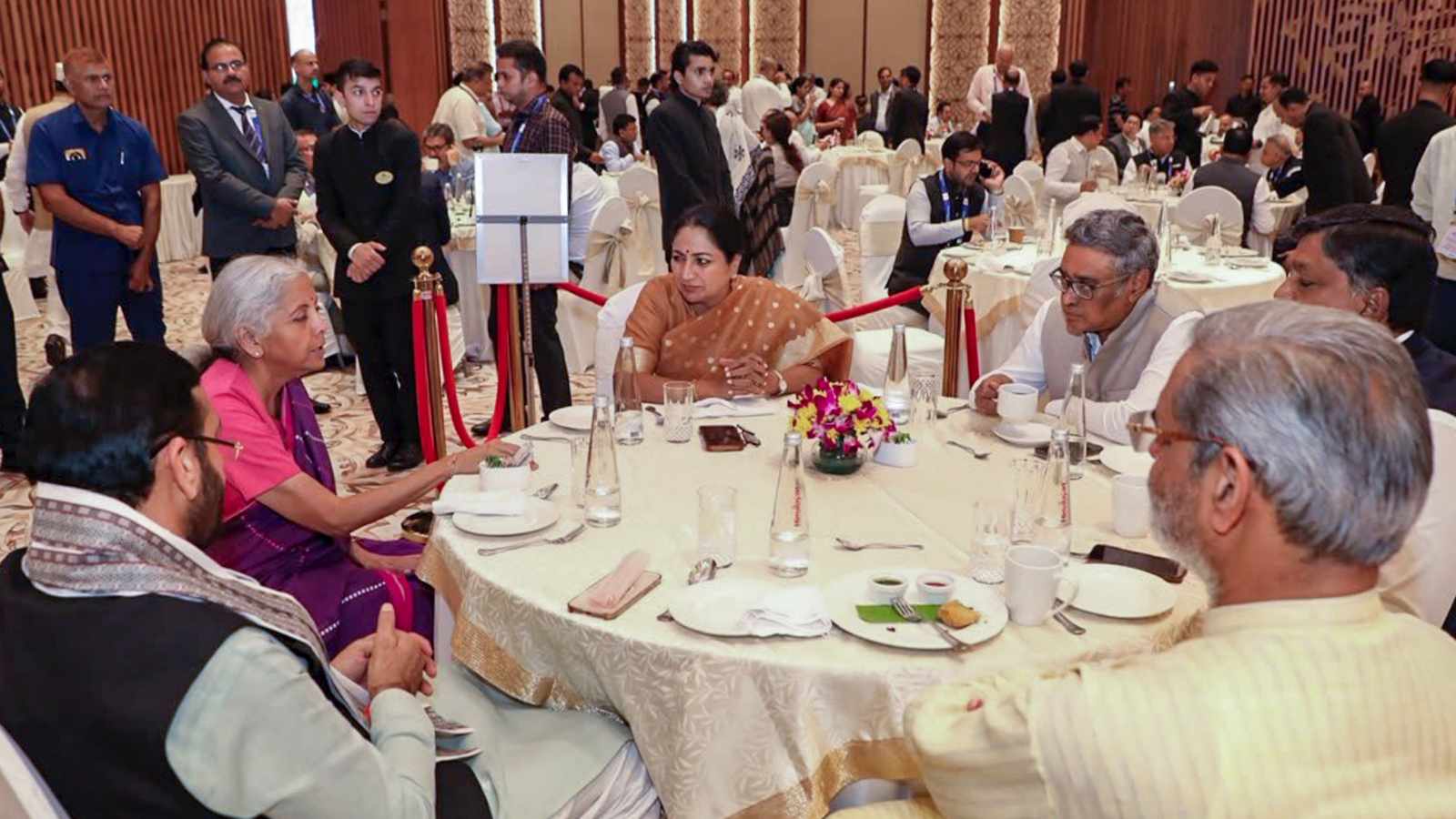
In this image posted on Sept. 18, 2026, Finance Minister Nirmala Sitharaman, Delhi Chief Minister Rekha Gupta and others during a conference on 'Financing India's Journey towards Viksit Bharat', in New Delhi. (@CMODelhi/X via PTI Photo)
Meghalaya grows the same flowers as Vietnam, but for wedding decoration in India, the orders for flowers are placed from Vietnam instead of the north-eastern state. Reason: A gap in logistical connectivity from the state results in traders giving a tentative timeline of, say, 5PM or 7PM, instead of a timely delivery by sharp 6PM from Vietnam.
India is a major producer of sesame seeds. But Japan exports more sesame oil despite not being a major sesame seeds producer and primarily relying on imports of the seeds. The gains are mainly from value addition.
These were among several examples cited to highlight the export and growth potential that India has during the two-day conference of the Union Ministry of Finance with state finance ministers and finance secretaries on ‘Financing India’s Journey towards Viksit Bharat’ in Delhi.
Segmented land holdings, potential for higher agricultural exports, strain from gold holdings and imports, issues with logistical connectivity, focus on state-specific data collection and supply-chain constraints, also featured in the discussions as states and experts from academia and industry sat down for a brainstorming session on the journey ahead for the next two decades, three people aware of the discussions told The Indian Express.
The conference, a first-of-its-kind, focussed on discussing issues centred around agricultural transformation, energy transition with several state finance ministers putting forth their ground-level experiences in managing investments, logistics and efforts to boost exports in an open house session.
Union Finance Minister Nirmala Sitharaman was present in all the sessions.
Several state finance ministers and chief ministers talked about their state’s development plans and focus on energy transition.
Story continues below this ad
For instance, Uttar Pradesh is learnt to have raised the high cost of the transition towards renewable energy and the need for more funds, while for West Bengal, which primarily relies on thermal power, the key concern was regarding the electricity tariff rates for industry players that cannot be lower than its neighbouring state that may be relying more on renewable power and offering a better tariff to the industry due to lower operational cost, a person aware of the discussions said.
Even as India is picking up pace with new global export destinations, the larger export share pie remains with China and this is learnt to have been underlined in the conference.
It was also discussed that to boost exports, the focus needs to be on specialised products and ensuring quality, a state government official who attended the meeting said.
There was also a discussion regarding the huge potential for raising farmer incomes and creating jobs. An example was provided of
how the French-fry potato farmers in Mehsana, Gujarat earn around Rs 1-3 lakh per hectare, while shrimp farmers earn Rs 5-8 lakh per hectare.
Story continues below this ad
“There is room to scale up low-skill jobs for packers, sorters, graders and workers in the transport sector. It was discussed that mid-skill jobs can be targeted for ITI degree or food science degree holders, focusing on young men and women mostly from villages within 50-100 km of the factory,” another official said.
Financing of key infrastructure projects in states through private sector capital remained in focus. On the first day of the conference on Friday, Economic Affairs Secretary Anuradha Thakur had talked about the need for significant private sector investment to achieve India’s Viksit Bharat vision as government spending alone cannot meet the country’s massive financing requirements.
“We know that we meet today in the backdrop of ongoing global difficulties. Under these circumstances, and because of the scale of transformation we envisage towards ourselves to reach our shared goal, it needs to be borne in mind that this scale cannot be met solely by government budgets, and that private sector financing will need to play a critical role,” Thakur had said.
Going ahead, working groups, with participation from states, will take forward the thematic deliberations and identify sectoral financing requirements and actionable recommendations, the Secretary was quoted as saying in an official release.
Story continues below this ad
Chief Economic Adviser V Anantha Nageswaran said while India’s savings base was substantial and would need to grow further, significantly greater participation by private capital would be essential to mobilise the investment required for Viksit Bharat.
NK Singh, President and Life Trustee, Institute of Economic Growth, and Fifteenth Finance Commission Chairman had stressed on the need for India’s gross domestic savings rate to rise to 38-40% from around 34% of GDP at present to sustain the 7-8% growth required for Viksit Bharat. He also called for state-wise debt sustainability assessments, and stressed greater fiscal transparency, including accounting for off-budget borrowings, guarantees, arrears and borrowings through state-owned entities.
© The Indian Express Pvt Ltd

Aanchal Magazine is a Deputy Associate Editor with The Indian Express, serving as a leading voice on the macroeconomy and fiscal policy. With 15 years of newsroom experience, she is recognized for her ability to decode complex economic data and government policy for a wider audience. Expertise & Focus Areas: Magazine’s reporting is rooted in "fiscal arithmetic" and economic science. Her work provides critical insights into the financial health of the nation, focusing on: Macroeconomic Policy: Detailed tracking of GDP growth, inflation trends, and central bank policy actions. Fiscal Metrics: Analysis of taxation, revenue collection, and government spending. Labour & Society: Reporting on labour trends and the intersection of economic policy with employment. Her expertise lies in interpreting high-frequency economic indicators to explain the broader trajectory of the Indian economy. Personal Interests: Beyond the world of finance and statistics, Aanchal maintains a deep personal interest in the history of her homeland, Kashmir. In her spare time, she reads extensively about the region's culture and traditions and works to map the complex journeys of displacement associated with it. Find all stories by Aanchal Magazine here ... Read More
KioskNews shows a cleaned-up reading view extracted from the publisher’s page — the original always lives on their site, not ours.