Countries commit to get nature goals back on track
A STEP FORWARD: Draft texts invited countries outside developed-country donors to join the group and urged nations to accelerate efforts to tackle biodiversity loss
Nearly 200 nations on Friday struck hard-fought agreements at a UN biodiversity summit, but the outcome was accompanied by disappointment over missed opportunities to address humanity’s destructive toll on nature.
Delegates cheered as crucial texts were approved in overtime, but the celebrations were tempered by acrimonious debates and regret over limited progress on some of the most contentious issues.
The COP17 summit in Armenia sought to revive a landmark commitment to halt and reverse the destruction of nature by 2030 after global efforts to meet that goal fell short.
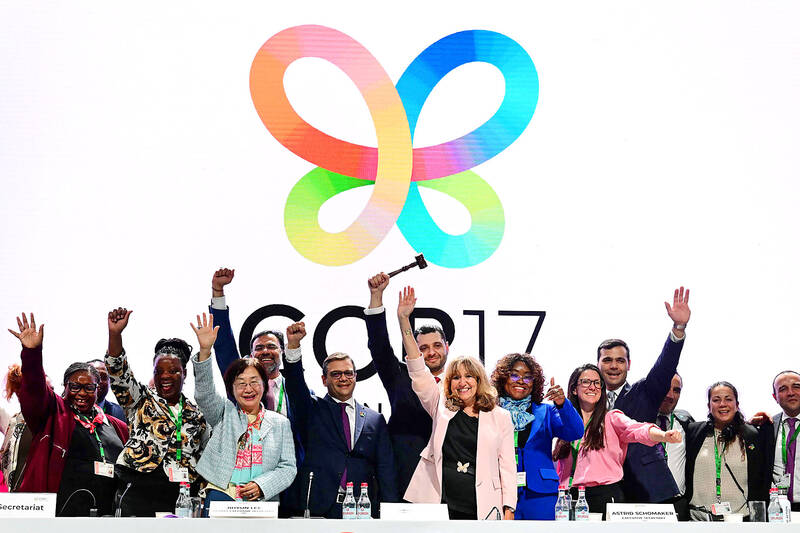
UN Convention on Biological Diversity (UNCBD) Executive Secretary Astrid Schomaker, center right, COP17 president and Armenian Minister of Environment Hambardzum Matevosyan, center left, UNCBD Deputy Executive Secretary Jihyun Lee, third left, and other members of the secretariat react during the closing session of the COP17 summit in Yerevan yesterday.
Photo: AFP
Over two bruising weeks in Yerevan, nations were urged to correct course to keep the pact alive and protect the plants, animals and ecosystems that sustain life on Earth.
The UN had warned that progress was insufficient to meet the goals of the 2030 target including protecting 30 percent of Earth’s land and oceans, tackling pollution and invasive species, and boosting money for conservation.
“And that’s it. Perfect,” COP17 president and Armenian Minister of Environment Hambardzum Matevosyan said as he brought down the gavel on two major texts, the final versions of which were still not available early yesterday.
However, the outcome was “not commensurate” with the crisis engulfing the natural world, French Minister of Ecological Transition Monique Barbut said.
“The progress we failed to achieve here is a series of missed opportunities to speed up our response to the loss of biodiversity,” Barbut said, adding that “nature will not wait for the pace of our negotiations.”
The final plenary stretched through Friday night and well into yesterday morning, with negotiations turning sour as the hours dragged on. Even as some delegates left to catch flights, others stayed behind to argue technical points.
UN Convention on Biological Diversity Executive Secretary Astrid Schomaker said the summit had achieved some “quite remarkable things at a moment when multilateralism is supposedly not functioning.”
“Some of these more difficult subjects, we could not expect to have strong negotiated commitments. That was never the plan,” she said.
A draft agreement said nations were urged to “accelerate” their efforts and warned that “increased action” was needed to tackle the forces driving biodiversity loss.
This “represents a positive outcome... and though there are weaknesses, particularly on harmful subsidies, it does represent a step forward,” Guido Broekhoven from WWF International said.
Tackling subsidies and other incentives that encourage activities harmful to nature — such as fossil fuels, intensive agriculture and overfishing — was one of the most politically fraught agenda items at the summit.
A rare fight over science cast a pall over the summit, with a number of countries accused of undermining efforts to approve key reports in scenes that shocked even seasoned negotiators.
“We regret the increasing instances in which scientific evidence and its uptake has been challenged or constrained” by politics, Swiss negotiator Gabriela Blatter said. “Our delegations fully respect every state’s right to safeguard national interest, but science is not negotiable.”
A separate row revolved around finding new cash sources to fund conservation efforts — another hot-button issue with public budgets under strain amid an energy crisis and conflicts in Ukraine and the Middle East.
The EU led a charge for wealthy emerging economies such as China to contribute to global conservation efforts, a contentious issue at COP17.
In a sign of a possible compromise, another draft text invited countries outside the developed-country donors to voluntarily join the group.
Outstanding questions over the design of the Cali Fund — a UN mechanism that hoped to attract billions of dollars in corporate contributions, but is close to empty — were left unresolved.
The COP17 summit has decided that Ecuador would host the next biodiversity talks in 2028 after the South American nation defeated Panama in a secret vote.
KioskNews shows a cleaned-up reading view extracted from the publisher’s page — the original always lives on their site, not ours.