Pigs in muck: Wallabies forwards have a field day against Japan
There is a beloved story in Wallaby circles about a speech made by stand-in manager Ross Turnbull on the morning of the Auckland Bledisloe Test in 1978, which began by asking the backs – whoever they were – to leave the room. The door shut, and it was just Turnbull with the pigs.
“Look,” he said, waving an airy hand at those who had just departed, “these Phantom comic swappers and Mintie eaters, these blond-headed fly-weights are one thing, and we will need them after the hard work’s done. But the real stuff’s got to be done right here by you blokes.”
And it was! The Wallabies went on to a famous victory, and the tale is so often repeated – at least among Australian forwards – because it makes a central point. It is the forwards who decide who wins the match, while the backs’ only role is to decide by how much.
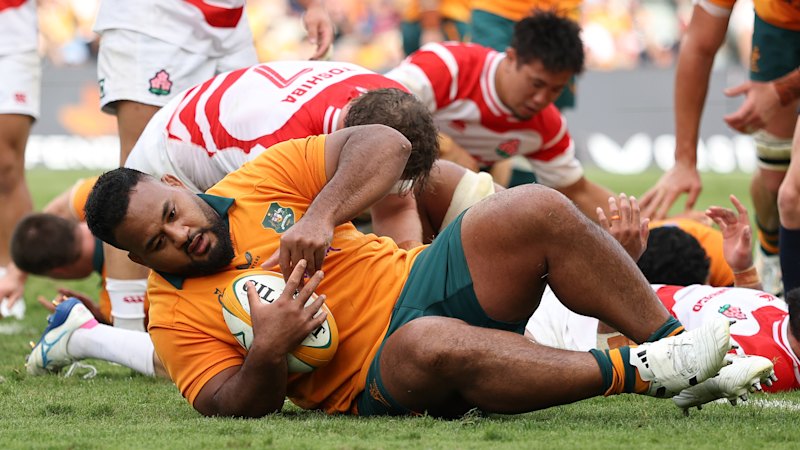
But this Test match against Japan was the reverse. It was the backs who did so much of the hard work of victory, getting territory, while the forwards decided by how much – HEAPS, with a wonderful 56-17 victory.
For the true revelation of this match was that, for once, the Wallaby backs worked! They were dangerous. They made ground. They cut through. They sliced and diced, they thrusted and busted, were as decisive as they were incisive. Passes stuck. Runarounds worked. Sidesteps left valiant Japanese defenders grasping for air, gasping in wake of departing Wallaby boots; attacking up-and-unders were recovered against all odds, double-pump-no-look-flick-passes from the top of the back of the hand were gifted to the free man. And all that was just Max Jorgensen.
In the centres, Isaac Henry saw more ball in the first 20 minutes than Joseph-Aukuso Suaalii has seen in a year, and was a wonder to behold.
What made the difference? What saw the backs so unleashed?
To my eyes, it looked a lot like the difference was made by Carter Gordon being back in the saddle at fly-half. The first time he turned out for the Wallabies, in the 2023 World Cup, even your humble correspondent – with much to be humble about when it comes to understanding back-line play – could see that Gordon, as I described him, “showed glimpses of genius”.
After a disastrous hiatus in rugby league, where he was badly injured, Gordon has returned to home and hearth, and was immediately stunning against Ireland in July, guiding the Wallabies to within an ace of victory before being injured again.
But here he was again, dangerous every time he touched the ball, with a wonderful step, a slick pass and, most crucially, the capacity to liberate those outside him. The combination he has with our equally impressive halfback, Ryan Lonergan, may well mean that the long struggle to find a great halves combination for the Wallabies in the modern era has been solved.
And yes, I know, glorying in the backs might be odd both on principle and in a match when the forwards scored every try, but I stand by it. The huge advances made by the backs put the Wallaby forwards close enough to do what they do best: pound the line from two inches out until something breaks.
This saw six – count’em SIX - tries from front-rowers, the first to Josh Nasser, two to Taniela Tupou, and one each to the always excellent Angus Bell, who manages to break the line with every touch, the 1000th capped Wallaby, Massimo De Lutiis, and a final one to reserve hooker Brandon Paenga-Amosa. Great tries to Charlie Cale and skipper Harry Wilson completed a great day all round.
All up, it saw the Wallabies post their third consecutive victory, allowing new coach Les Kiss to be off to an unblemished start. It feels like the Wallabies are at last building, both to the coming Bledisloe series and, most importantly, next year’s World Cup.
Congratulations to them. Onwards to the Promised Land!
News, results and expert analysis from the weekend of sport sent every Monday. Sign up for our Sport newsletter.

KioskNews shows a cleaned-up reading view extracted from the publisher’s page — the original always lives on their site, not ours.