Hashim Thaci's second conviction in The Hague reignites debate in Kosovo about justice and the Kosovo Specialist Chambers
A court in The Hague on Tuesday convicted former Kosovo President Hashim Thaci of obstructing justice and attempting to influence witnesses during his recent war crimes trial and sentenced him to 17 months in prison.
This term will be added to his 25-year sentence for war crimes, which was handed down by the same court, the Kosovo Specialist Chambers, on September 16.
According to the indictment of the Specialist Prosecutor's Office, Thaci had provided visitors at the detention facility in The Hague with confidential information about witnesses in his war crimes trial and had instructed them on how to influence their testimony.
Three other men — former head of the Kosovo Intelligence Agency Bashkim Smakaj, former Minister of Justice Hajredin Kuci, and Fadil Fazliu — were also convicted.
Swift response from government
Thaci, who was the former political leader of the Kosovo Liberation Army (KLA) during the 1998-1999 Kosovo War, is viewed by many in his home country as a hero. His war crimes conviction in September was greeted in Kosovo with anger and dismay.
Thaci has vowed to appeal the war crimes conviction.
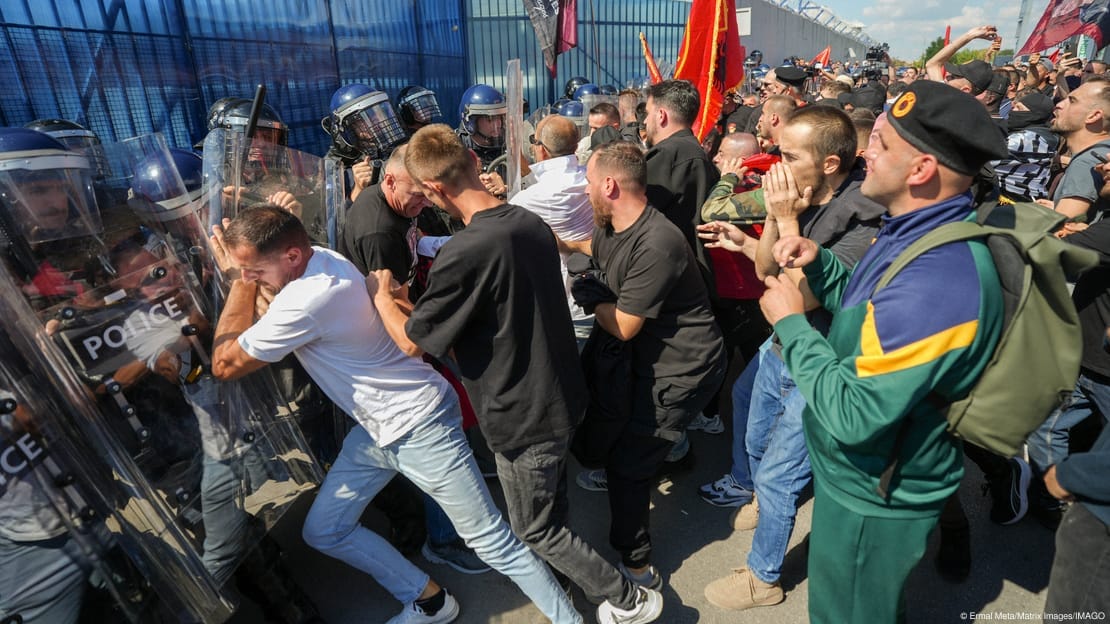
His two convictions touch deep sensitivities in Kosovo society. Tuesday's ruling brings renewed attention to the war that ended 27 years ago, the role played by its former leaders, and the continuing debate over justice, individual or collective responsibility for the KLA's war to liberate Kosovo from Serbia, and trust in judicial institutions.
The response from the government of Kosovo was swift.
In a statement issued on Tuesday, the government said, "Trust in justice is built not only on the decisions that are made, but also on the manner in which they are reached. Therefore, our commitment to the rule of law and our insistence on the full respect of rights and procedural guarantees are part of the same principled position: Justice must not only be done, but must also be fair, transparent, and credible."
What is the Kosovo Specialist Chambers?
The Kosovo Specialist Chambers was established in 2015 by the parliament of Kosovo at the instigation of the European Union and the United States.
The court was created to investigate serious crimes allegedly committed by members of the KLA during and after the Kosovo War.
For security reasons, including concerns about witness intimidation, the court was located in The Hague in the Netherlands.
Government set up working group
After Thaci and three others were convicted of war crimes in first instance in September, Kosovo's state authorities established a working group to draft a strategy regarding the appeal proceedings before the Kosovo Specialist Chambers.
The group is chaired by Foreign Minister Glauk Konjufca and includes members of Kosovo's parliament.
Prime Minister Albin Kurti has stated that the working group continues to believe that "the first-instance judgment of the Specialist Chambers is unjust, both legally and morally," and that as a result, "the government is working to secure a correction at the appeals level before the Specialist Chambers."
Parliament considers amending law
In addition, the parliament of Kosovo is currently considering amendments to the law governing the Kosovo Specialist Chambers.
The draft law, which is expected to be adopted, envisages narrowing the court's mandate in several areas, including the time period covered by its jurisdiction, limiting the maximum prison sentence to 15 years, allowing sentences to be served in Kosovo, and introducing the possibility of presidential pardons for persons convicted by final court decisions.
How do political analysts and legal experts view the parliament's attempt to amend the law on the Kosovo Specialist Chambers before the judicial process involving the four men convicted of war crimes has reached a final verdict?
"From an international perspective, at first glance, this initiative could even be interpreted as an attempt to interfere in the judicial process," said political analyst and university professor Artan Muhaxheri.
"Precisely for this reason, it is essential that Kosovo's political spectrum and its legal experts demonstrate beyond any doubt that this measure does not conflict with Kosovo's international obligations toward the European Union," Muhaxheri told DW, adding that this is the only way to ensure that the desired outcome is achieved and that the initiative does not produce the opposite effect.
"Issues relating to jurisdiction, statutory limits on maximum sentences, and other similar matters must be argued professionally and rigorously, demonstrating that they fully guarantee judicial independence and enjoy solid support within Kosovo's legal system, the same legal system that, first and foremost, established the Specialist Chambers," he said.
'Room for criticism of both sides'
Ehat Miftaraj, executive director of the Kosovo Law Institute (IKD), told DW that although the Kosovo Specialist Chambers were established by the Republic of Kosovo itself, "the way the judicial process has unfolded has created the impression that judges, prosecutors and certain international actors have treated not only the accused but also Kosovo itself with distrust, prejudice, and an often condescending approach."
Miftaraj went on to say that reactions and objections in Kosovo to the decisions of the Specialist Chambers are also interpreted and judged in the historical and emotional context of the war and what Kosovo's citizens experienced during and after it.
"In a democratic society, every citizen, including political and institutional representatives, has the right to criticize judicial decisions," he said. "However, there is a fundamental distinction between criticism based on legal arguments and attempts to delegitimize courts or exert influence over judicial proceedings. And here, there is room for criticism of both sides."
KioskNews shows a cleaned-up reading view extracted from the publisher’s page — the original always lives on their site, not ours.