People enter cages, animals seem free at Art Zoo museum
Look up as you enter Amsterdam’s new Art Zoo museum, and a 3.66m crocodile stares down at you, mouth open, ready to chomp.
The taxidermic reptile is one of hundreds of preserved creatures on display, alongside artfully arranged piles of bones, illuminated tulips encased in apothecary jars and a cabinet of grotesque fish.
While it is not a Halloween-themed museum, the show should appeal to anybody looking for something a little dark this spooky season.
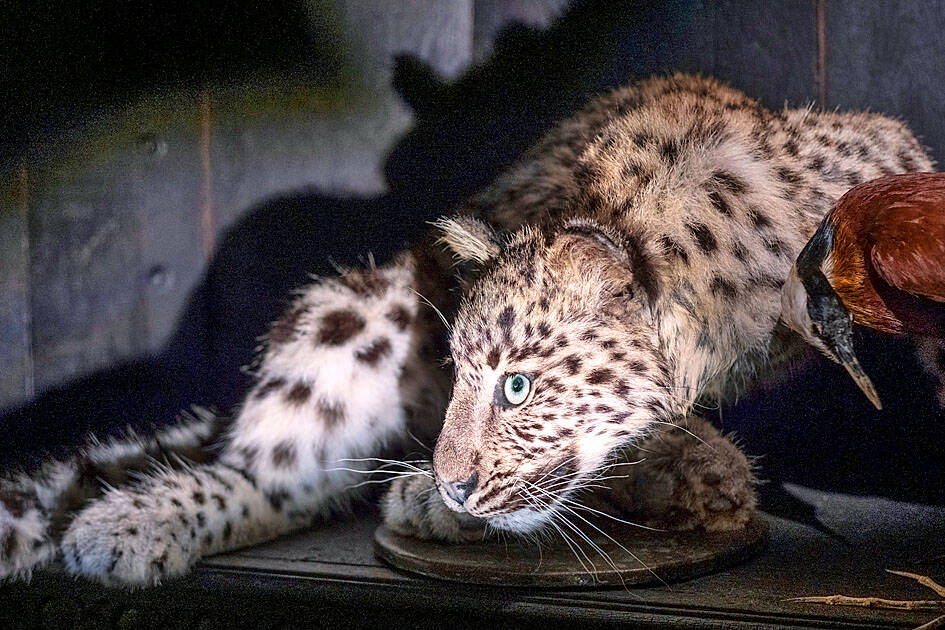
A cheetah slouches in an alcove at the Art Zoo in Amsterdam, the Netherlands, on Wednesday.
Photo: AP
“It was a little creepy,” Tomas Vasko, a Slovak living in the Dutch capital, said after touring the museum.
Art Zoo is the creation of Dutch artists Jaap Sinke and Ferry van Tongeren, who draw inspiration from “wunderkammers,” or curiosity cabinets collected by wealthy Europeans in the 16th and 17th centuries to showcase objects from the natural world.
“The main thing is that we like storytelling with the animals,” Van Tongeren said. “We like to add drama. We add an attitude to the animals, where traditional taxidermists just want to mimic nature.”
Behind him, a cheetah slouched in an alcove under the watchful eye of a cassowary.
In natural history museums, animals are posed as they could be seen in the wild. At the Art Zoo, a Japanese giant spider crab stretches its 1.83m legs above a doorway beside the leg bones of a mastodon that nearly reaches the ceiling.
The duo rose to fame in 2015 after shark-pickling artist Damien Hirst purchased their entire exhibition from a London art show.
Unlike at a traditional zoo, the human visitors are confined, not the animals. The display rooms in the 17th-century canal house where the Art Zoo is located are enclosed by brooding, black metal cages.
“We really like the concept of having all the people in a cage and then all the animals free,” Van Tongeren said. “In that way, the whole building becomes one artwork.”
None of the animals in the eclectic collection were taken from the wild.
“All our animals come from zoos where they died of natural causes,” Sinke said.
However, the paperwork can be challenging, he said.
The pair primarily obtained specimens from Europe to ensure they know the history of the animals.
Sinke and Van Tongeren consider themselves an artistic trio, crediting naturalist Charles Darwin as the third contributor to their work. They pitched the concept of the museum as the return of Darwin’s wonder.
In a nod to the man who developed the first scientific theory of evolution, one wall display contains a series of Darwin busts. Sinke and Van Tongeren see an amusing irony in honoring Darwin inside a building that once housed the Biblical Museum.
Not everything in the collection is a real animal. Underneath the crocodile suspended from the ceiling is a wall of Jenny Hanivers, ray carcasses modified into grotesque creatures by 16th-century sailors who presented the macabre beasts as real sea monsters to gullible collectors.
Their misshapen faces appear to keep an eye on guests as they move from room to room.
KioskNews shows a cleaned-up reading view extracted from the publisher’s page — the original always lives on their site, not ours.