Troy Jackson defeats GOP Sen. Susan Collins in Maine, padding Democrats’ majority

Democrat Troy Jackson has defeated longtime GOP Sen. Susan Collins in Maine, NBC News projects, padding the Senate majority his party won in the midterm elections.
Collins was a top target as the only Republican representing a state Donald Trump lost two years ago, even though she has won re-election in Democratic-leaning Maine for decades.
Jackson and his allies worked to tie Collins to Trump, who has never won Maine, amid his sinking approval ratings. And Jackson had only a few months to make his case, having become the Democratic nominee in late July after Graham Platner’s exit from the race amid a sexual assault allegation, which he denied.
Follow live updates on the midterm elections
“Sen. Collins votes with Trump 96% of the time. The billionaire class is who she’s been fighting for,” Jackson said at one of their debates. Collins has challenged that percentage.
Collins, meanwhile, stressed that she was instrumental in bringing federal dollars to the state as chairwoman of the powerful Appropriations Committee.
“To be effective in the Senate, you need knowledge, experience, seniority and relationships,” Collins said in one of the debates, later adding, “I have secured $1.5 billion for 672 projects all over the state of Maine during the past five years.”
But Jackson argued that Collins’ power had not served Mainers, suggesting she could have used her sway to block some of Trump’s major policies, like tariffs and the war with Iran.
Jackson also slammed Collins for voting to advance Trump’s sweeping tax cut and spending package, known as the “big, beautiful bill,” although Collins ultimately voted against final passage because of the measure’s Medicaid cuts.
“Tonight, Sen. Collins has told us how powerful she is. But power means nothing if you won’t use it when the people in Maine need it,” Jackson said at a debate.
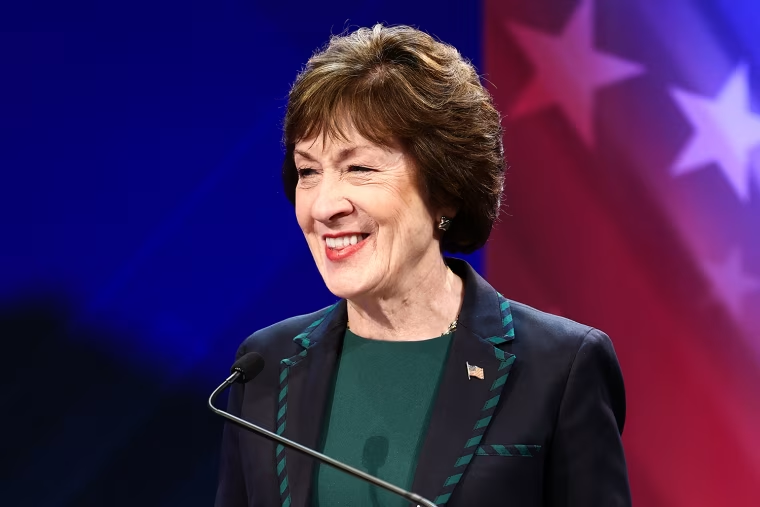
Jackson also sought to make a working-class pitch as a former logger from northern Maine, and he was the first challenger from Collins’ home county to take her on. Both Collins and Jackson hail from Aroostook County, a remote area of the state. Republicans tried to undermine Jackson’s pitch by casting him as a career politician who raised taxes.
Republicans also initially tried to tie Jackson to Platner, even though Jackson called on Platner to step aside as the nominee when the sexual assault allegation came to light.
But, like Platner, Jackson staked out liberal positions, including support for “Medicare for All” and abolishing ICE. He campaigned with left-wing Sen. Bernie Sanders, I-Vt., in the closing weeks of the race.
While Jackson is a staunch progressive today, he has evolved since he entered politics more than two decades ago.
Jackson decided to run for office after he helped lead a logger blockade at the northern border in 1998 to protest the hiring of Canadian workers. In 2000, he ran unsuccessfully for the state House as a Republican, but he won a legislative seat as an independent in 2002. He later became a Democrat and went on to serve in the state Senate, including as the chamber’s president from 2018 to 2024.
Representing a rural area of the state, Jackson held some conservative positions, particularly on abortion. But he has said he evolved on the issue when he learned more about how “not having abortion care could hold people back and hold them down economically.”
While some of Jackson’s stances have evolved, his supporters say he has consistently kept his focus on supporting working-class Mainers, dating to his own hardscrabble upbringing in Allagash. Jackson has deep ties to many unions in the state, which helped him organize and capture the Senate nomination after he lost the primary for governor this year.
Jackson was also helped by a political environment that strongly favored Democrats as voters voiced concerns about Trump and his policies.
Collins had built a unique political brand in the state. In 2020, she won re-election by 9 percentage points even as Trump lost the state by 9 points that year. But this year, she could not overcome the strong gravitational pull of anti-Trump sentiment even as she tried to distance herself from Trump, who did endorse her re-election.
Collins specifically criticized Trump’s trade war with bordering Canada. In 2021, she was one of seven Senate Republicans who voted to convict Trump during his impeachment trial after the Jan. 6 Capitol riot.
“I have opposed the president when I think he’s wrong, and I’ve supported him when I think that he’s right. And that independent approach has been the approach that I’ve always followed,” she told NBC News while she was campaigning over the summer.
But it was not enough to persuade Mainers that she should return to the Senate, where she has served since 1997.
KioskNews shows a cleaned-up reading view extracted from the publisher’s page — the original always lives on their site, not ours.