The Takeaway: UN General Assembly debate Day 2
Global perspective Human stories
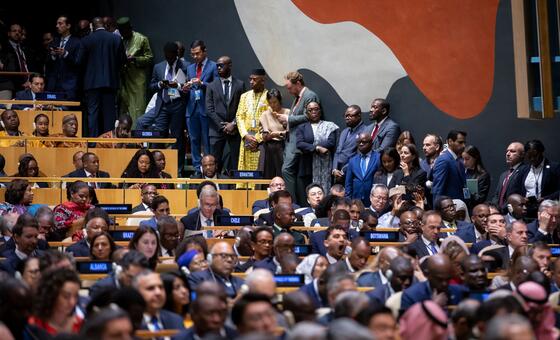
This edition of UN News's The Takeaway recaps key highlghts at the UN General Assembly on Wednesday, including focus on the war in Ukraine and a renewed push by African countries for Security Council reform.
Conflicts test the UN’s ability to deliver peace
Why it matters: World leaders offered sharply different assessments of the United Nations as conflicts, geopolitical tensions and economic shocks increasingly extend beyond national borders.
- Argentina’s President Javier Milei accused the UN of failing to guarantee collective security.
- Czechia’s President Petr Pavel described the Organization as indispensable, particularly as a forum for dialogue between adversaries.
- Spain’s Prime Minister Pedro Sánchez called for renewed nuclear non-proliferation efforts and strict regulation of AI.
War in Ukraine poses a major test
The big picture: Leaders warned that Moscow’s full-scale invasion of Ukraine threatens regional security, global food supplies and contravenes the principles of the UN Charter.
- Ukraine’s President Volodymyr Zelenskyy said Russia had lost nearly 250,000 troops on the battlefield between January and August this year.
- Estonia’s President Alar Karis called the aggression “one of the biggest tests for the UN’s relevance”, pointing to attacks on Black Sea ports and the resulting threat to global food security.
- Latvia’s President Edgars Rinkēvičs stressed the risk of regional instability: “What happens in Ukraine does not stay in Ukraine.”
Distant conflicts bring local consequences
Reality check: Leaders from several regions described how wars and instability affect countries far from the fighting.
- The President of the Dominican Republic, Luis Abinader stressed that conflicts in Europe and the Middle East directly affect food and energy prices in his country.
- He also warned that criminal networks controlling territory and trafficking arms and people in Haiti threaten regional peace and security.
- Iran’s President Masoud Pezeshkian condemned attacks on his country and accused the international community of applying double standards to Iran’s nuclear activities and Israel’s nuclear capabilities and actions in Gaza.
- Rwanda and the Democratic Republic of the Congo presented opposing accounts of the conflict in eastern DRC, where Rwanda-backed M23 fighters have seized and held key cities such as Goma and Bukavu, while both emphasized the need for progress towards peace.
From conflict and division to recovery
One bright spot: Some leaders highlighted efforts to move beyond years of destruction, displacement and political division.
- Syria’s President Ahmad Al-Sharaa declared that “Syria is rising”, pointing to reconstruction, transitional justice and the return of 3.5 million refugees and internally displaced persons.
- Libya’s Presidential Council President Mohamed Al-Menfi called for a unified, sovereign State and for the Mediterranean to become a bridge for development, trade, investment and security.
- Saida Mirziyoyeva of Uzbekistan said that Central Asian countries had begun to see one another as partners rather than as sources of threat.
- Cyprus President Nikos Christodoulides called for substantive negotiations on the island’s future within a UN-agreed framework.
Africa renews its call for Security Council reform
What was said: African leaders again argued that the Security Council no longer reflects current global realities.
- Kenya’s President William Ruto noted that Africa’s 54 countries represent almost one quarter of UN membership but have no permanent Council seat.
- “That imbalance might have reflected the world of 1945; it does not reflect the world of today,” he said.
King Mswati III of Eswatini called for fair African representation and greater international support for African-led peace and stability initiatives.
♦ Receive daily updates directly in your inbox - Subscribe here to a topic.
KioskNews shows a cleaned-up reading view extracted from the publisher’s page — the original always lives on their site, not ours.