Trump may propose Pyongyang summit with Kim Jong-un, says former US envoy for N. Korea
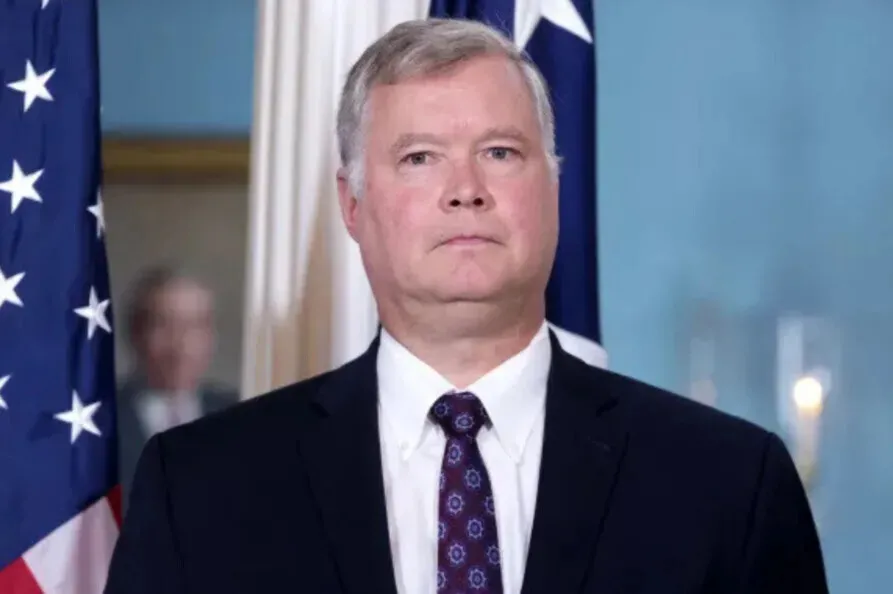
Stephen Biegun, the former US special representative for North Korea. (Hankyoreh file photo)
US President Donald Trump could propose talks with North Korean leader Kim Jong-un in Pyongyang, according to Stephen Biegun, who served as deputy US secretary of state from 2018 to 2019 and Washington’s point man for North Korea under the first Trump administration. If that dialogue resumes, he urged, South Korea should play a central role in the process.
NK News, a Seoul-based American news outlet specializing in North Korea, quoted him as saying on Thursday at a conference in Incheon hosted by the medium’s parent Korea Risk Group.
“President Trump is publicly signaling to Chairman Kim that he wants to engage, and Chairman Kim is not closing the door,” he said, adding that the initial silence and later a statement from Kim Yo-jong, the sister of Kim Jong-un who serves as a high-ranking member of the Workers’ Party of Korea in Pyongyang, did not explicitly rule out contact between the two sides.
But Biegun, who led summit-level diplomacy with North Korea from 2018-19, said “there is certainly no evidence of letters or back channels” to substantiate Trump’s claim that he has been in contact with Kim.
He raised the possibility of Trump considering talks with Kim following the Asia-Pacific Economic Cooperation (APEC) summit in November in China, saying it “would not be a surprise at all” if Trump proposed the meeting in Pyongyang.
Yet Biegun downplayed the prospects of the resumption of such dialogue. Unlike in 2018-19, he said, North Korea has greatly expanded its nuclear and conventional weapons arsenal and bolstered its economic and military standing with support from Russia and China.
Because the North supplies Russia with ammunition, ballistic missiles and troops in exchange for cash and missile technology, the former diplomat said Pyongyang has little incentive to readily enter negotiations with Washington since the latter could demand reduced aid for Moscow.
Biegun stressed that Seoul should play a key role in ensuring lasting peace on the Korean Peninsula, saying, “Whatever might happen, whatever might be agreed, first and foremost involves the security and welfare of a free, democratic South Korean people.”
His argument was that South Korea’s responsibility is needed in diplomatic efforts given Russia’s “outright” abandonment of the North’s denuclearization, China’s silence on the matter and Japan’s possession of “the least leverage of any interested party.”
On handling diplomacy with North Korea, Biegun said a “performative summit” alone will offer little value and urged “quiet, sustained diplomacy” comprising “incentives and tradeoffs.” He mentioned denuclearization, relief from sanctions, extended US deterrence commitments and the future of regional alliance as key agenda items.
While keeping denuclearization as a long-term goal, he said a realistic solution over the short term could be slowing or freezing the expansion of the North’s nuclear capabilities. He also emphasized that such diplomacy must be backed by Washington’s strong commitment to defending its allies to prevent wider nuclear proliferation.
In a news briefing Thursday, the Washington-based Center for Strategic and International Studies (CSIS) mentioned the possibility of talks between Trump and Kim ahead of next week’s bilateral summit between Trump and Chinese President Xi Jinping in the American capital.
Bonny Lin, the director of the China Power Project and senior fellow for Asian security at CSIS, noted the recent attendance of a high-level North Korean delegation led by Vice Defense Minister Kim Kang-il — the first since 2019 — at the Xiangshan Forum in China.
She mentioned growing military ties between Pyongyang and Beijing, saying that in comments reported by Chinese media, Kim Kang-il expressed the intent to bolster strategic exchange and cooperation with the Chinese People’s Liberation Army “to abide by the guidance” of the countries’ two leaders.
Lin highlighted the connection between this development and the November APEC event. With speculation rising that China might use this summit to invite Kim Jong-un to China and arrange a meeting with Trump, she said China “would be quite interested in having more of a role in facilitating US-North Korea communications.”
“There’s also, of course, the possibility that after APEC or before APEC, President Trump could meet with Kim,” she added.
“I think China is dangling a number of carrots in front of President Trump in order to discourage President Trump to not provide arm[s] sales [to Taiwan], at least before the APEC meeting,” Lin said, adding that the incentives include a potential summit with Kim.
“What I’ve been hearing is if President Trump goes to the APEC meeting, it’s very likely Xi Jinping is going to come to the G20 meeting, which then pushes the calendar for the next smaller arms sales delivery to basically the end of this year, if not next year,” she added.
KioskNews shows a cleaned-up reading view extracted from the publisher’s page — the original always lives on their site, not ours.