Who are the Antideutsche, Germany's pro-Israel anti-fascist left-wing group? - explainer
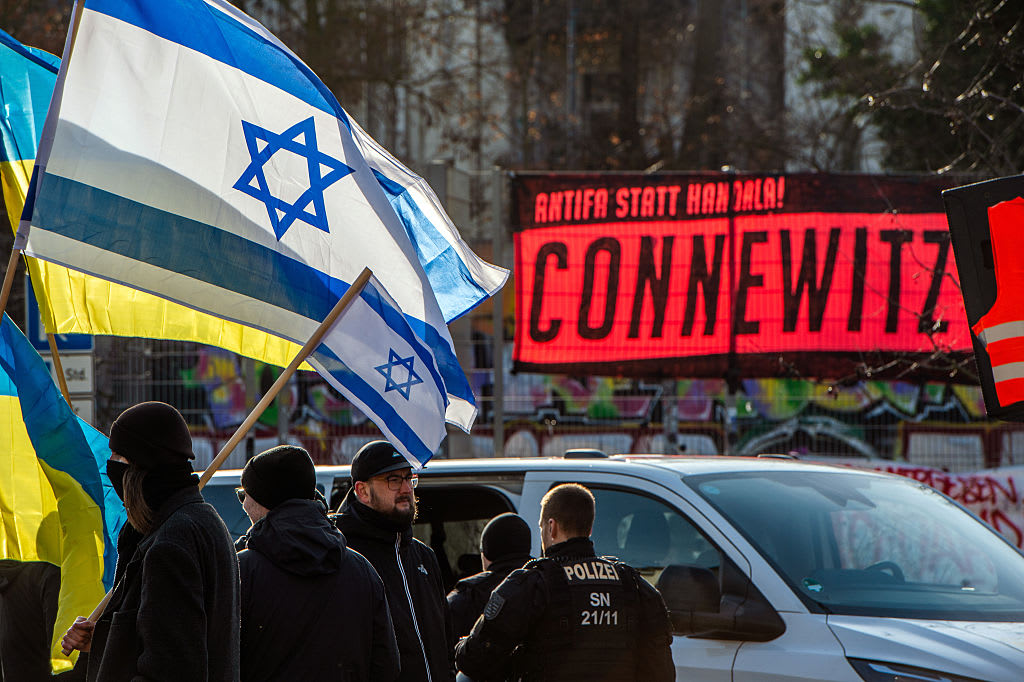
In January 2026, two rival groups of German anti-fascists prepared to face each other on the streets of Leipzig. Both claimed to be fighting fascism. One planned to “liberate” the Connewitz district from “Antideutsche”, while the other intended to protect pro-Israel organizations from their political opponents. Calls for mobilization spread on social media, preparatory meetings were scheduled, and joint trips from neighboring cities were organized.
“No peace with antisemites!” declared the group AG Antifa Halle. In a statement published on January 10, the activists specified the exact departure time of the train from Halle: 10:52 a.m., line S5. The meeting place was the Zoo station. Four days before the demonstration, they planned to discuss the route and upcoming actions at the local left-wing centre VL.
On the other side, a march was being organized under the slogan “Antifa means Free Palestine”. Among those mobilizing was the group Handala Leipzig, which the State Office for the Protection of the Constitution Saxony (Verfassungsschutz) classifies as part of an extremist milieu. Posts by supporters of the march called for ridding Connewitz of “ultra-Germans” – the term opponents used to describe the local pro-Israel left-wing scene.
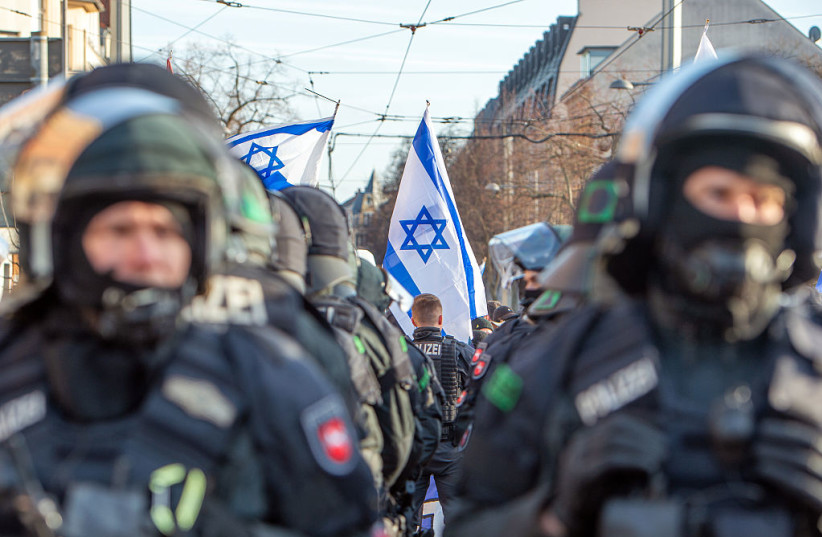
On January 17, about 1,400 people took part in the pro-Palestinian demonstration. Between 1,600 and 2,000 people attended the protest in solidarity with Israel. Over 1,400 police officers were deployed to maintain order.
The “Antideutsche”, literally “anti-Germans”, emerged within Germany’s radical left-wing movement more than thirty years ago. They oppose German nationalism, criticize antisemitism among the left, and consider the defense of Israel a necessary part of anti-fascist politics. They use images of a Merkava tank alongside a threat directed at antisemites on their stickers; other merchandise features the Iron Dome missile defense system or the Mossad emblem.
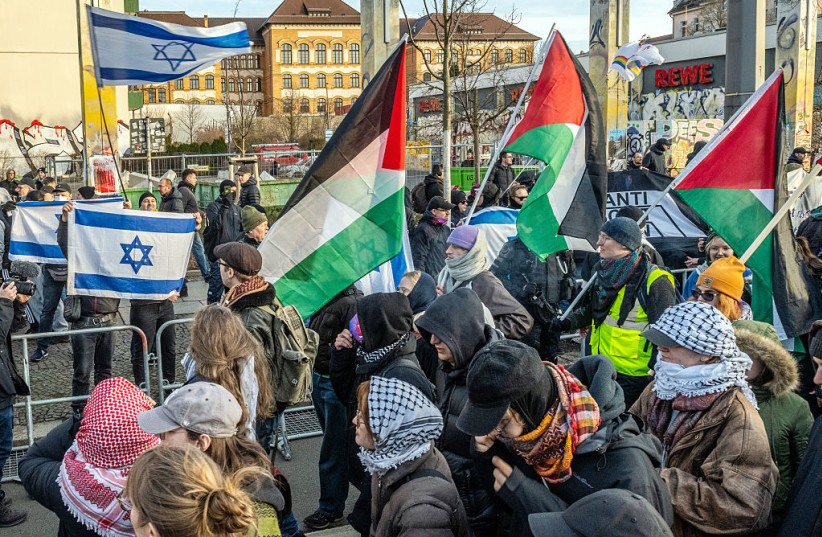
Following the Hamas attack on October 7, this position became a source of particularly fierce conflict. People who once might have marched together in demonstrations against neo-Nazis are now taking part in opposing rallies, accusing one another of betraying leftist principles, and arguing over who actually has the right to call themselves an anti-fascist.
In 1990, as Germany prepared for reunification, some on the radical left marched under the slogan “Nie Wieder Deutschland!” – “Never again Germany!”
For most Germans, reunification signaled the end of the country’s postwar division. For opponents of the new nation-state, it raised fears of a resurgence of German nationalism and the strengthening of a country responsible for the Holocaust.
At one of the most famous demonstrations against German reunification, held on May 12, 1990, in Frankfurt am Main, left-wing and Green politicians marched in the front ranks. Among them was Claudia Roth, known in Israel for the Documenta 15 conflict.
On November 6, 2026, a new scandal erupted involving Claudia Roth following an interview on the Jung & Naiv podcast. The former culture minister called her previous criticism of the directors of the film No Other Land – who had made accusations against Israel at the 2024 Berlinale – a mistake. Explaining her previous position, Roth mentioned “incredible pressure” from the Central Council of Jews in Germany and recounted the words of friends abroad who had asked when she would be freed from the “guilt of history.”
But Israel did not immediately become a central theme for the Antideutsche. In 1991, during the Gulf War, Iraq fired missiles at Israel. The German left protested against the military operation by the US and its allies. The future Antideutsche criticized the anti-war movement for the fact that the threat to the Israeli population was barely on its agenda.
Anti-imperialists viewed Israel primarily as an ally of the US. The Antideutsche argued that this position ignored the history of antisemitism and the reasons for the creation of a state in which Jews could ensure their own security.
In the years that followed, the disagreements only intensified. During the 2003 Iraq War, some Antideutsche groups supported the US intervention. Israeli and American flags at radical left-wing events became a source of open conflict.
However, by no means did all Antideutsche share this position. Among them were opponents of capitalism and American foreign policy, supporters of Western democracies, and groups focused almost exclusively on combating antisemitism.
'Pro-Zionist, anti-fascist' group includes communists
One member of the pro-Israel anti-fascist scene spoke to The Jerusalem Post about his experience on the condition of anonymity. Z. lives in northern Germany and was in Leipzig on January 17.
Z. prefers to call his group “pro-Zionist anti-fascists”. His own political awakening took place in the early 2000s. “There are communists among us,” he says, but clarifies that the leftists close to him are guided by Marx and Adorno, not by Stalin or Lenin. He attributes this stance to a rejection of authoritarian regimes.
Z. joined left-wing circles as a teenager. He participated in anti-fascist protests, was involved in animal rights activism, and was part of the squatter scene. He has Jewish roots, and his comrade from his early days of activism was Jewish. They encountered antisemitic remarks even among their political allies. Later, he became acquainted with the German pro-Israel anti-fascist scene.
He describes the term “Antideutsche” itself as a polemical nickname originally given by the movement’s pro-Palestinian opponents: “We simply adopted that name.”
Over the course of three decades, the movement has not established a central leadership or party structure. “There is no central body,” Z. confirms. According to him, activists can be found in autonomous groups as well as among supporters of various political parties.
He recalls that over the years, some groups supported the George W. Bush administration in the US, while others focused on feminism. “The one thing we all agree on is that Israel has a right to exist,” he says, articulating their common ground.
When discussing his own left-wing views, Z. returns to the kibbutzim: he calls them a rare example of a socialist project that actually worked. This is precisely why the Hamas attack on border communities on October 7 is particularly painful for him: the people attacked were those who had dedicated their lives to left-wing ideals and cooperation with Palestinians.
On October 18, 2023, Conne Island, a left-wing cultural center in Connewitz, published a statement regarding Hamas’s attack on Israel.
The authors expressed solidarity with the victims, the families of those killed and kidnapped, and Jews in the diaspora. They condemned Hamas, Islamic Jihad, and Hezbollah, specifically mentioning the attack on the Nova music festival. The statement also addressed the violence perpetrated by Islamist organizations against women and the LGBTQ community. The authors expressed support for Palestinians opposing Hamas rule.
“Never Again” means “never again defenseless,” they declared. The text called for ensuring the safety of Jewish lives and recognizing Israel’s right to self-defense.
October 7 spurs solidarity rallies, pro-Palestinian mobilization
For Z., the morning of October 7 began early. He recalls seeing the first reports. Some of his friends were at the Nova festival. “One of them was kidnapped,” he says, without giving a name.
Solidarity rallies with Israel took place in German cities. Anti-German groups participated in some of these initiatives and held their own demonstrations against antisemitism. Werder Bremen ultras, whose fan scene has longstanding ties with fans of Hapoel Jerusalem and Maccabi Haifa, displayed banners for Israeli hostages after October 7, including Hersh Goldberg-Polin, a Werder fan abducted at the Nova festival and murdered in Gaza.
At the same time, pro-Palestinian mobilization was growing. On university campuses, in cultural circles, and within left-wing organizations, debates intensified over the war, Israel’s responsibility, and acceptable forms of protest. Critics accuse the “Antideutsche” of ignoring the plight of the Palestinians and of labeling criticism of Israeli state policy as antisemitism.
Z. regrets how much of his circle’s resources are being drained by the conflict with other anti-fascists. According to him, against the backdrop of the rise of right-wing forces in Germany, the pro-Israel left has to spend “so much money and energy” on internal disputes within other leftists. He accuses certain groups of participating in demonstrations alongside Hamas sympathizers and people he associates with the “Muslim Brotherhood” and the Turkish ultra-nationalist “Grey Wolves.”
On April 30, 2024, a pro-Palestinian demonstration organized by the Solinetz group took place in Halle. Pro-Israel activists from the autonomous left-wing groups showed up at the scene. They carried signs reading “Antifa heißt Solidarität mit Israel” (“Antifascism means solidarity with Israel”) and “Defund UNRWA,” demanding an end to funding for the UN agency that provides aid to Palestinian refugees.
They had come to confront another left-wing group. According to the state’s Verfassungsschutz, they were outnumbered. Counter-protests have become a visible part of the movement’s activity since October 7. Its rhetoric, too, has drawn criticism.

Documents from the State Office for the Protection of the Constitution Saxony-Anhalt mentioned an incident in which Palestinians were collectively referred to as a “Tätervolk” – “a nation of perpetrators” – at a pro-Israel event. And while this statement cannot be attributed to the entire movement, it clearly illustrates the extremes to which individual members of this community can go in a political confrontation.
The dispute also extends to Israel’s own left. Israeli activist Michael Sappir, one of the founders of Jüdisch-israelischer Dissens Leipzig, criticized the relationship between the German pro-Israel community and Israeli progressive movements in an interview with Platypus Review in 2024.
Sappir advocates for Palestinian rights and believes that some German activists do not take sufficient account of the political positions of the Israeli left.
Z. is willing to debate with Israeli leftists who do not share his views. He does not believe that Israeli origin automatically makes someone’s political position correct. “Israelis can also make antisemitic statements,” he says.
Antideutsche groups distinguish between support of Israel, support for government
Some Antideutsche groups emphasize the need to distinguish between Israel’s right to exist and support for specific government decisions. Z. himself makes no secret of his disagreement with the Israeli prime minister. “It’s time for Netanyahu to retire,” he says. He would not vote for him and would like to see a politician with more left-wing views at the helm of Israel. On the issue of a two-state solution, he adds, there is no unified position within pro-Israel circles.
Some Antideutsche groups appear in reports of the Verfassungsschutz. Support for Israel does not exempt groups from scrutiny over alleged extremist activity. Surveillance concerns particular organizations, not the movement as a whole.
In January 2026, the Saxon Office for the Protection of the Constitution described the upcoming demonstrations in Leipzig as a conflict within the radical left-wing milieu. Its director, Dirk-Martin Christian, said the Middle East conflict is widening the rift between political groups.
In January 2026, Antideutsche communists, Jewish organizations, feminist groups, and other pro-Israel initiatives took part in counter-demonstrations in Leipzig. The participation of Jewish organizations does not mean that all German Jews support the Antideutsche. Nor does it mean that criticism of the movement is necessarily linked to a denial of Israel’s right to exist.
The activists themselves continue to debate where the line is drawn between antisemitism and criticism of the Israeli government, what political alliances are permissible, and how far solidarity with Israel should go.
For Z., the line is drawn where Israel is denied the right to exist. In his view, it is both possible and necessary to criticize Israeli politicians by the same standards as politicians from other countries: “There should be no double standards.”
KioskNews shows a cleaned-up reading view extracted from the publisher’s page — the original always lives on their site, not ours.