40 indigenous languages in PH are endangered. What could be lost?

MANILA, Philippines — Every year, the Philippines celebrates Buwan ng Wika to promote and uphold Filipino as the country’s national language. But the Komisyon sa Wikang Filipino (KWF) is also working to save many of the country’s indigenous languages from disappearing.
The KWF estimates that the Philippines has around 135 indigenous languages. However, 40 of these are now considered endangered because of “social, cultural, and political factors” affecting their preservation, use, and development.
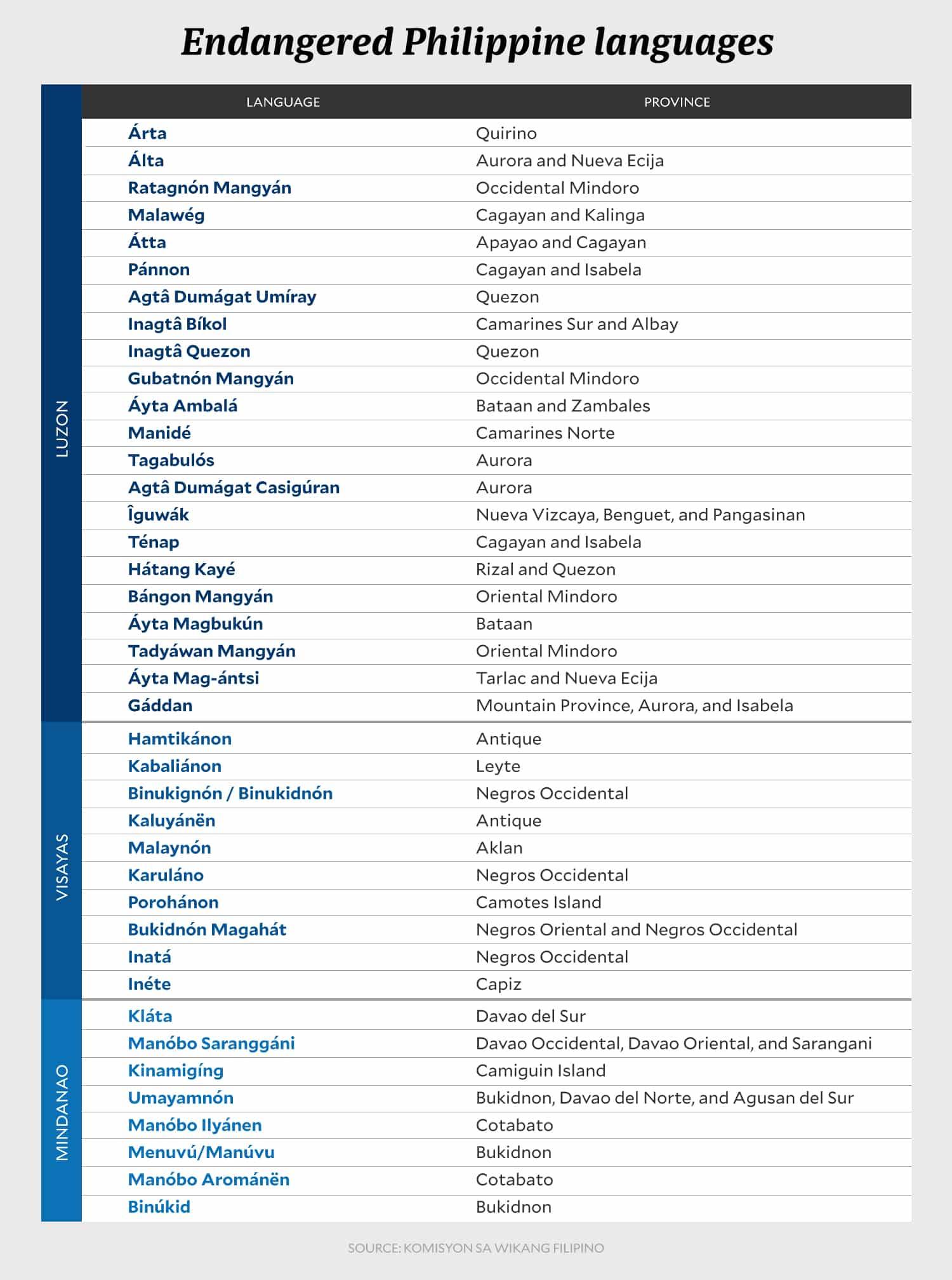
Of the 40 endangered indigenous languages, 22 are spoken in Luzon, 10 in the Visayas and eight in Mindanao.
Article continues after this advertisement
According to the United Nations Educational, Scientific and Cultural Organization (Unesco), language endangerment may be “the result of economic, religious, cultural, and educational factors” or may stem from negative attitudes within communities toward their own languages.
FEATURED STORIES
NEWSINFO
NEWSINFO
NEWSINFO
In the Philippines, the KWF identifies endangered languages using criteria adapted from Unesco’s Language Vitality and Endangerment framework. One example is Árta, which, as of 2022, was spoken by only 10 people in Barangay Disimungal in Nagtipunan, Quirino.
The KWF considers a language at risk when only a small number of community members still speak or communicate using it.
Hamtikánon, for instance, was considered severely endangered after its use was reduced to just 21 households in the towns of Hamtic, Valderrama and Laua-an in Antique. Kabaliánon was similarly spoken by only 22 households in Southern Leyte, according to commission records from 2020.
The KWF said one indication that a language is endangered is when children in a community no longer use or speak it, even though their parents still do. Another indicator is a decline in the number of members of an ethnolinguistic group.
Article continues after this advertisement
When a language disappears, a community can lose part of its culture, identity, history and traditional knowledge passed down through generations.
Verge of extinction
Two indigenous languages in the Philippines are already considered extinct, according to the University of the Philippines Department of Linguistics: Agta, Dicamay, once spoken in Jones, Isabela, and Agta, Villa Viciosa, once spoken in communities in Abra.
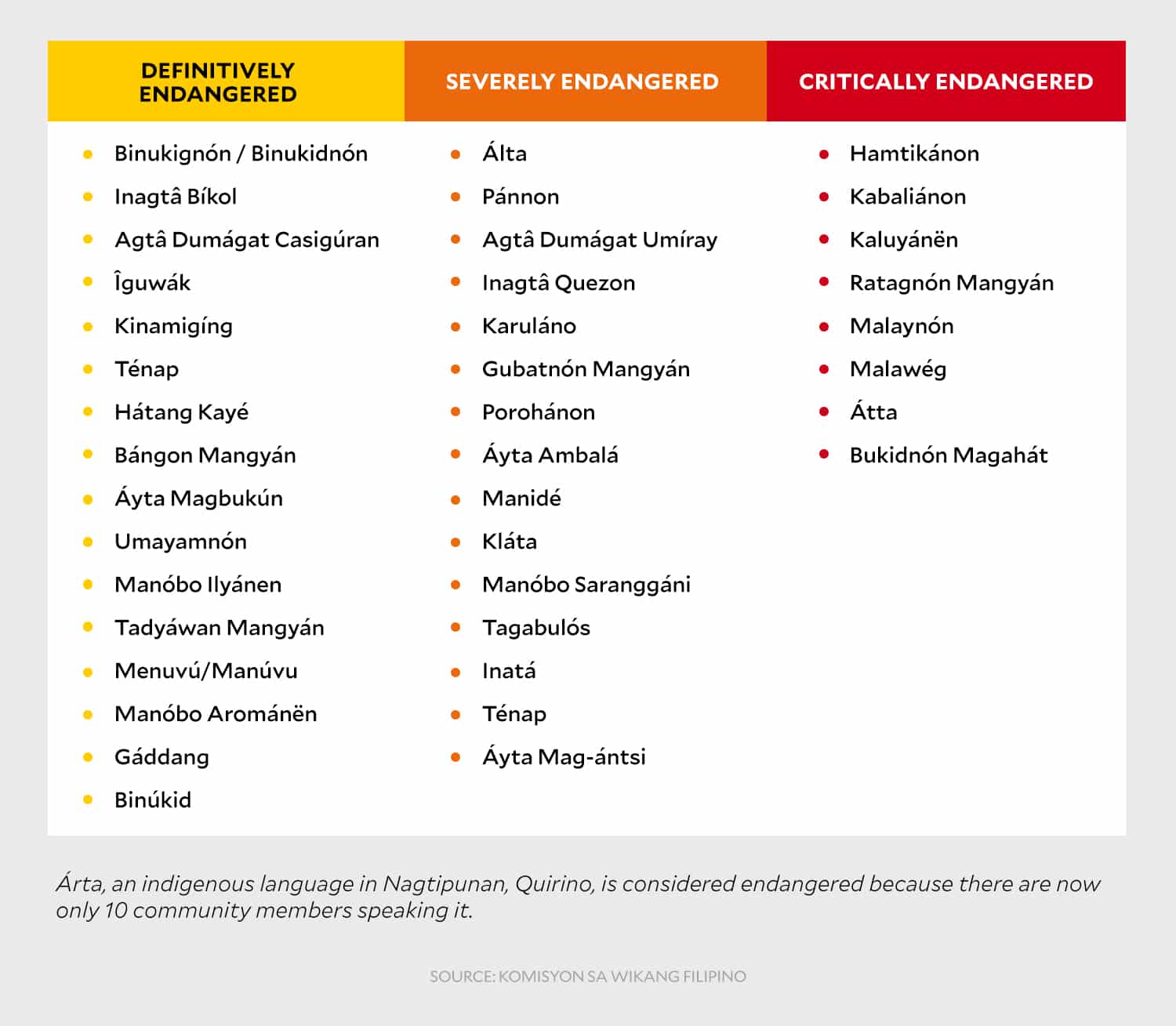
Of the 40 endangered languages identified by the KWF, eight are classified as critically endangered, 15 as severely endangered and 16 as definitively endangered. One is considered endangered because only a small number of community members still use the language.
Among those classified as severely endangered is Álta, spoken in the towns of San Luis, Dipaculao and Maria Aurora in Aurora province, as well as Gabaldon, Nueva Ecija. Only about 53 households still use the language, according to Philippine Statistics Authority data.
The indigenous language Pánnon is also severely endangered, with only 105 households still speaking it in the towns of Gattaran, Sta. Teresita, Gonzaga, Lal-lo, Buguey, Sta. Ana, Amulung and Peñablanca in Cagayan, as well as the coastal town of Dinapigue in Isabela.
Meanwhile, Binukignón or Binukidnón is definitively endangered, with the language spoken in only 42 households in parts of Negros Occidental. Inagtâ Bíkol is likewise considered definitively endangered, with around 156 households using the language in Buhi and Iriga City in Camarines Sur and Tiwi, Albay.
Saving endangered languages
In an interview with the Philippine Information Agency last year, the KWF said it continues to implement programs aimed at saving the Philippines’ endangered indigenous languages, including “Bahay Wika” and the “Master Apprentice Language Learning Program.”
Under these programs, the KWF works with local governments to establish centers where “expert speakers of endangered languages” are trained to teach their languages to younger generations.
KWF Chairperson Marites Barrios said the commission would not allow endangered languages to disappear completely. Through these programs, she said, children can learn to communicate and converse using their native languages.
When only a few people continue to use a language, their numbers can gradually dwindle until the language eventually disappears, often without the community realizing it.
Earlier, one of the KWF commissioners opposed the passage of Republic Act No. 12027, which removed the requirement to use the mother tongue as the primary medium of instruction in early education, making its use optional from kindergarten to Grade 3.
READ: Use of mother tongue as mode of instruction ends as bill lapses into law
Your subscription could not be saved. Please try again.
Your subscription has been successful.
Former KWF Chairperson Arthur Casanova said the most important thing to remember is that across the Philippine archipelago, there are many native languages that should continue to be patronized, explored, preserved and fostered.
“This [teaching the language] is very important because, as the common saying goes, our language is the window to our souls. This symbolizes our identity and individuality, which is why we need to use and patronize our language,” he said. /dm
KioskNews shows a cleaned-up reading view extracted from the publisher’s page — the original always lives on their site, not ours.