Smaller classes, streamlined teacher duties among ideas MOE will pilot in 6 schools
SINGAPORE: A pilot in six schools will study measures to redesign classrooms from 2027, including whether more students can benefit from smaller classes, Education Minister Desmond Lee announced on Wednesday (Sep 16).
The Ministry of Education (MOE) will also study streamlining teachers' duties outside the classroom, letting them focus on two of three areas – form teachership, co-curricular activities (CCAs) and committee work, he said.
The six schools are St Anthony's Canossian Primary, Woodgrove Primary, Zhangde Primary, Commonwealth Secondary, Deyi Secondary and Jurongville Secondary.
MOE will use the pilot to explore where smaller classes can make "the greatest difference" to teaching and learning, said Mr Lee.
Smaller classes have been adopted on a needs-based approach for years, he added. Primary 1 and 2 form classes have been kept at about 30 students since 2006, while learning support programme classes have eight to 10 students and Crest and Spectra Secondary Schools typically have about 20 students a class.
With the recent introduction of full subject-based banding, subject class sizes now vary depending on students' learning needs and the nature of the subject.
“We have observed positive experiences on the ground. With smaller classes when needed, teachers are better able to cater to individual learning needs and customise a more engaging and effective learning environment,” he said.
Smaller classes allow closer attention to students and more timely feedback, but do not automatically mean less work for teachers, Mr Lee said. It could mean they take on more teaching, as happens in other countries.
The government cannot simply hire more teachers given its limited workforce. “And even if we were to hire more teachers, it must be done in a sustainable manner, without compromising quality.”
This is why smaller classes must be part of a broader redesign of teaching and learning. If teachers are to teach more classes, MOE must create the capacity and conditions they need to do so, Mr Lee said.
Beyond classroom teaching, many teachers also take on roles such as being form teachers, managing CCAs and working on committees. While these are important, constantly switching between responsibilities takes time and mental bandwidth, he said.
MOE will study letting teachers focus on two of the three areas, taking into account each school's needs and teachers' strengths and interests.
“We also recognise that not every task in school requires a teacher. So we should keep asking four questions: Is it still necessary? Can we simplify it? Can technology or other processes help? And must a teacher do it?”
CCAs and other student development programmes are important for students' holistic development, and teachers will continue to play a key role in helping students develop social-emotional and 21st-century competencies, said Mr Lee.
At the same time, MOE will explore tapping coaches, instructors, non-teaching staff and external partners more deliberately to support these programmes, including administrative duties.
MOE will also study adapting existing school spaces for more flexible use and using technology to free up time for teaching.
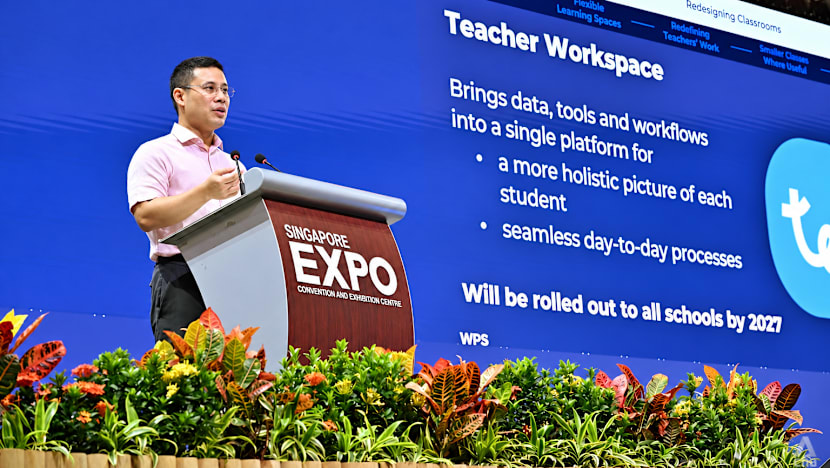
Teacher Workspace, a platform piloted in about 20 schools, will be rolled out to all schools by 2027, allowing teachers to coordinate support and communicate with parents and partners more seamlessly, said Mr Lee.
Artificial intelligence and other capabilities will be introduced to the platform over time. For example, collating relevant information about students to generate first drafts of administrative reports to cut down on manual work.
Mr Lee said MOE would proceed carefully given the complexity of the six-school pilot, and would assess whether the changes lead to better learning outcomes and more sustainable teaching.
"We will keep schools updated and share what we learn before considering how these approaches might be applied more widely," he added.
KioskNews shows a cleaned-up reading view extracted from the publisher’s page — the original always lives on their site, not ours.