When you see the Ynares name, you know you’re in Rizal
Editor’s note: This is part of a Rappler series on Filipino families that have held political power for generations. The series traces how they built their influence, where it is strongest, and how it has endured over time. Each profile examines family ties, political networks, business interests, and roles in local and national government.
Inside the grounds of the Rizal provincial capitol in Antipolo City is the Ynares Center, an indoor arena of 7,400 seats.
Scratch that. Rather: Inside the Ynares Center Complex is the Rizal provincial capitol.
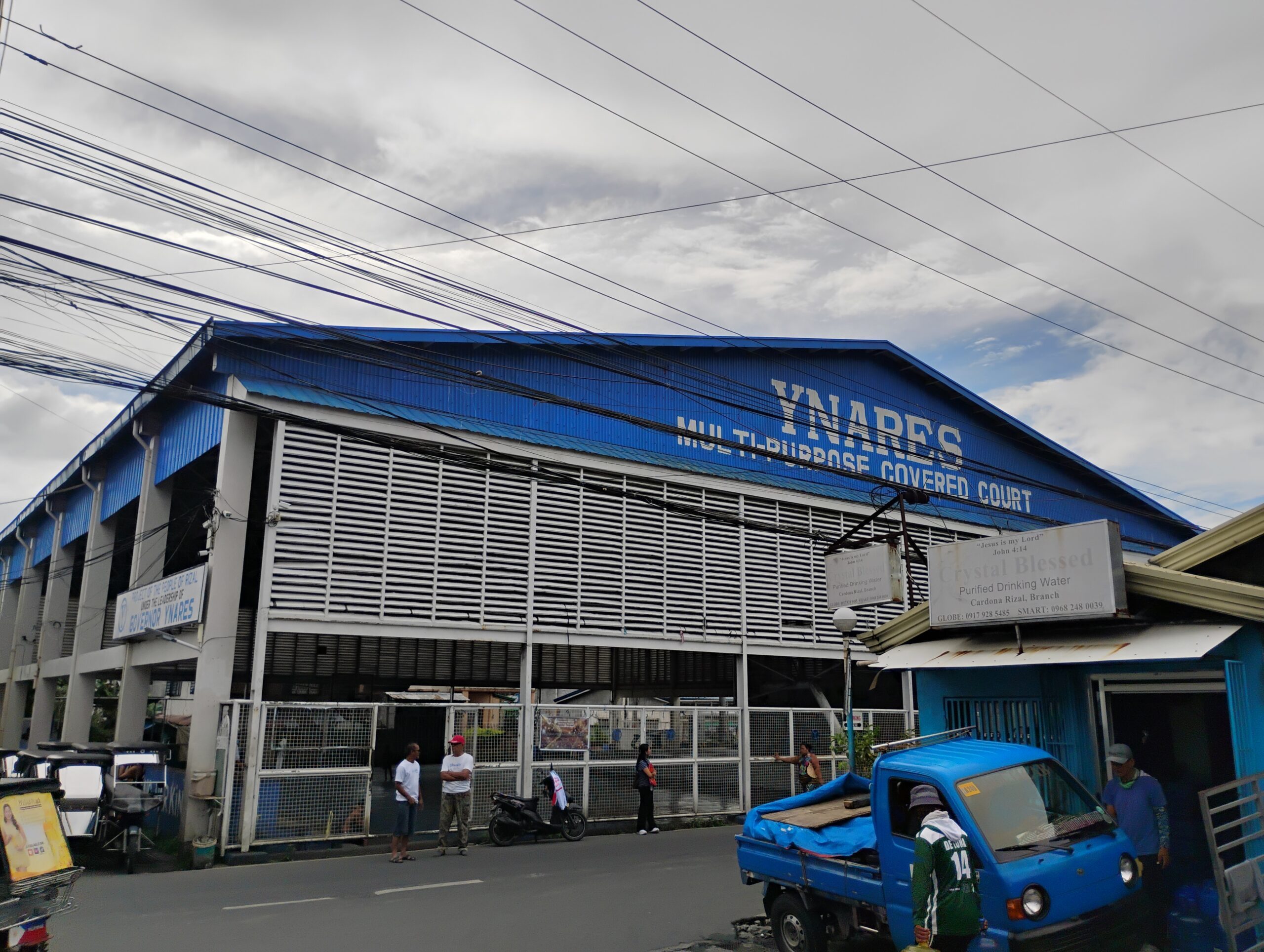
Across Rizal, a province of 13 towns and one component city, are old waiting sheds with Y-shaped concrete columns. Covered courts have blue galvanized roofs and a facade with white painted text: Ynares multi-purpose covered court. The older ones are white and have the same name. Plastic chairs have “Ynares” embossed on the back.
Rizal sits east of Manila and used to be bigger until 1975, when Metro Manila was created and carved out some parts of it. The towns that were left went much farther east: Tanay and Pililia touching the borders of nearby provinces Laguna and Quezon. Binangonan’s Talim Island wedged in the middle of Laguna de Bay.
The clan dates back to 1901
1901 was the year Rizal province was created. 1901 was when the story of the Ynares clan started as well — the year their patriarch, Don Jose Ynares y Granados, was appointed as presidente (or mayor) of Binangonan. Then he was elected in 1902 and went on to serve for four years.
The Ynares patriarch’s leadership was tied with the American colonizers. “With help from the Americans, Ynares made remarkable improvements in the town,” the town website said.
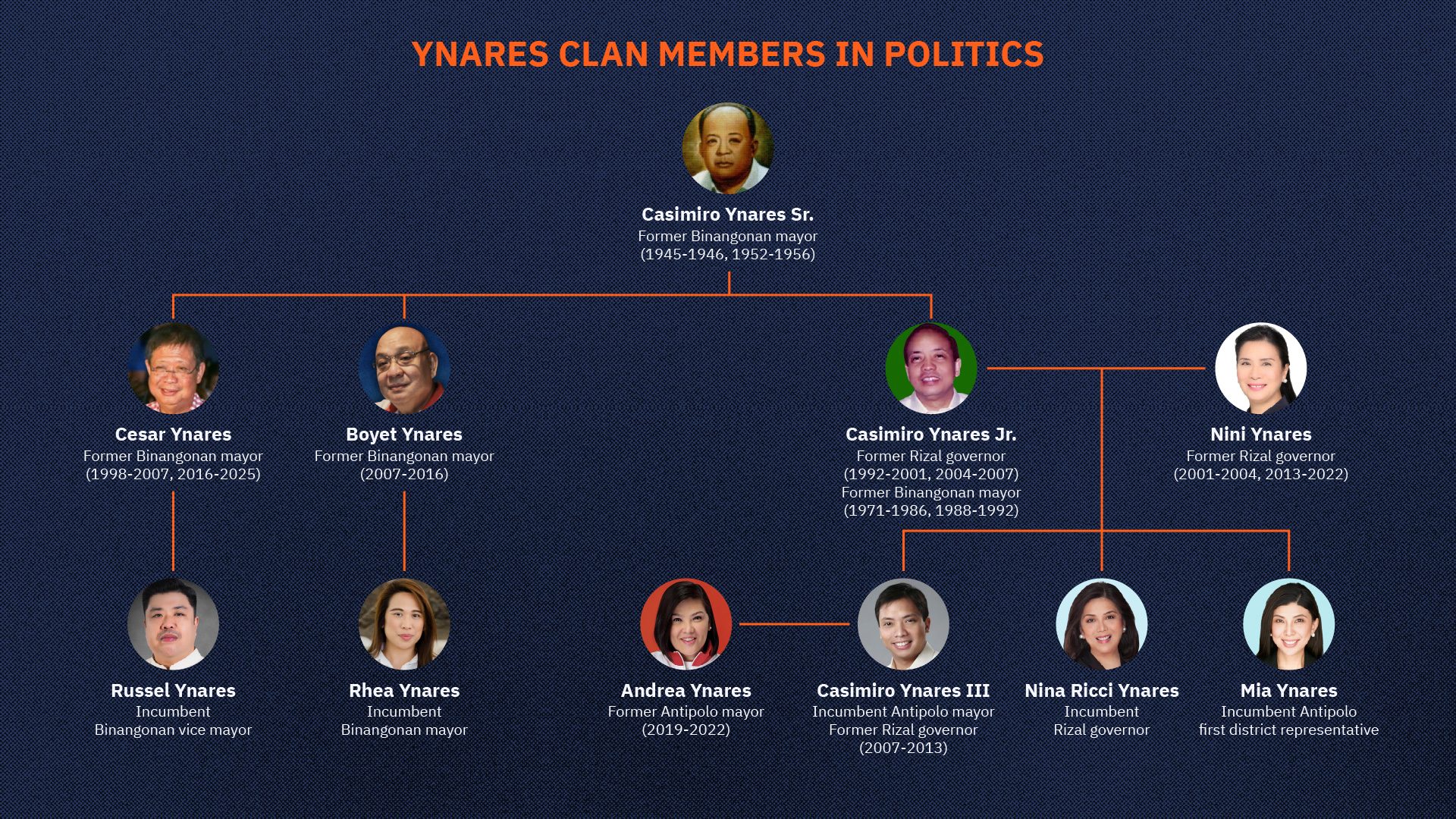
The next Ynares to claim Binangonan’s mayoralty was Casimiro Ynares Sr., son of Don Jose Ynares, from 1945 to 1946.
It is Casimiro “Yto” Ynares Jr., son of Casimiro Ynares Sr., who is more remembered in very recent history. Before becoming Rizal governor, Yto was Binangonan mayor for 15 years due to Martial Law, from 1971 to 1988. When Yto became Rizal governor in 1992, it was exactly 90 years after the first Ynares was elected in a Rizal town.
Since 1992, family members have occupied the position. Yto was Rizal governor for nine consecutive years (1992 to 2001) and served another term from 2004 to 2007.
Yto’s brothers, Cesar and Cecilio (known as Boyet), eventually became Binangonan mayors when Yto went on to become governor. Cesar prevailed for three terms and his brother Boyet succeeded him when he reached his term limit.
Not all of the siblings went to politics. Their sister, Consuelo Ynares-Santiago, was a Supreme Court justice who started as municipal judge of Cainta, Rizal.
Casimiro “Jun” Ynares III, the only son among Yto’s three children, was the first to succeed his parents in the governorship.
His mother, Rebecca “Nini” Ynares, substituted for husband Yto when Yto was term-limited in 2001. Nini then substituted for son Jun in 2013 when Jun was term-limited as well.
Nini, the wife of Yto, served until 2022. When she reached her term limit, she was succeeded by their daughter, Nina Ricci Ynares, who is now on her second term as governor.
There are currently five members of the Ynares clan holding public office.
Jun is now Antipolo mayor. It was under his term that Antipolo City received its fourth seal of good governance in 2024.
His youngest sibling, Mia Ynares, is the congresswoman of the 1st District of Rizal, which is composed of four towns that include the Angono, the art capital; and Taytay, known as the garments capital of the Philippines.
Their cousins hold the fort in Binangonan: Rhea Ynares is mayor and Russel Ynares is vice mayor.
When Jun Ynares was term-limited in 2019, his wife Andrea “Andeng” Ynares, succeeded her husband. A member of the Revilla dynasty of Cavite, Andrea served as Antipolo mayor for only one term — as if just a placeholder until Jun could run again.

A playbook for political preservation
During the 2013 elections, crowds in yellow shirts gathered to protest alleged vote buying in Antipolo. Their placards read, “Lantarang pagbili ng boto ng mga Ynares.” (Open vote buying by the Ynareses.)
Jun Ynares had won by a razor-thin margin over reelectionist Antipolo mayor Nilo Leyble. Ynares got 128,108 votes against Leyble’s 121,032.
Jun denied the allegation. “Alam ‘nyo po dito sa napakatagal po natin sa larangan ng pulitika, wala hong ganyan…sa buong lalawigan ng Rizal,” Jun, who at the time was Rizal governor, said in an interview with GMA News on May 15.
(You know, I’ve been in politics for such a long time, there have been no [vote buying] in the province of Rizal. In the whole province of Rizal.)
The spat between the camps of Ynares and Leyble boiled over to an alleged murder plot against Jun and his father Yto. The assassination plot did not push through because according to the hitman allegedly hired to do the killings, the information given them were wrong and the plot supposedly became unnecessary because nobody thought Jun would win his first term as Antipolo mayor.
In 2025, there were no obstacles to Jun’s reelection bid. There was no real rival to pose a threat. There were no protests on the streets. Jun had 208,100 votes, a landslide victory over runner-up Red Llaga, who only got 55,027 votes.
That same year, Nina Ynares also won the gubernatorial race by a landslide, leading the second placer by more than 200,000 votes.
Since Jun’s close race in 2013, there had been no serious contenders against the Ynareses.
Another family, however, enjoys strong recall in Rizal: the Duavits, who opted for self-preservation and not to go against the Ynareses.
The Duavits ran alongside the Ynareses to ensure their grip on the congressional seat representing Rizal’s 1st District. The baton passed from Gilbert Duavit Sr., who started his term in 1994, to his sons Jack and Joel. Jack was Rizal congressman from 2001 to 2010, and again from 2016 to 2025.
In the last polls in 2025, no Duavit ran for the congressional post. At the time, Mia Ynares ran and won.
Other political stalwarts follow the same playbook. The politicians in the Puno and Acop families do not run against the Ynareses and instead go for lower posts. Josefina “Pining” Gatlabayan, another Rizal politician, served as Antipolo vice mayor to couple Jun and Andeng Ynares. She is now vice governor to Nina Ynares.

Online, there are more disgruntled netizens complaining of the Ynareses. The threads touch on similar things: their more than three decades of rule over Rizal, alleged corruption and business links, and a general discontentment on matters of progress.
Lately, when the rainy season comes around, people would air out frustrations online over flooding and the seeming lack of viable solutions.
Beyond hearsay, however, any damning proof of corruption against the Ynareses has yet to surface. In 2022, the anti-graft court Sandiganbayan acquitted Yto Ynares of graft in relation to the procurement of fertilizers. Yto was Rizal governor in 2004, the year the fertilizer fund scam broke.
Rizal residents continue to vote for them. The Ynares name has recall and the heft of history intertwined with the province. It is a name that 30-year-olds grew up seeing on waiting sheds, in hospitals they visited for checkups, in the schools they attended.
“Wala namang ibang pagpipilian (There’s no one to choose from),” was how one Antipolo resident put it a month before the 2025 elections.
She offered some justification, “Marami naman silang naging achievement dito sa Antipolo eh.” (They had a lot of achievements in Antipolo.) – with a report from Dwight de Leon/Rappler.com
KioskNews shows a cleaned-up reading view extracted from the publisher’s page — the original always lives on their site, not ours.