Gautam Gambhir’s ‘right decisions, not popular decisions’: What lessons in ethics can we learn?
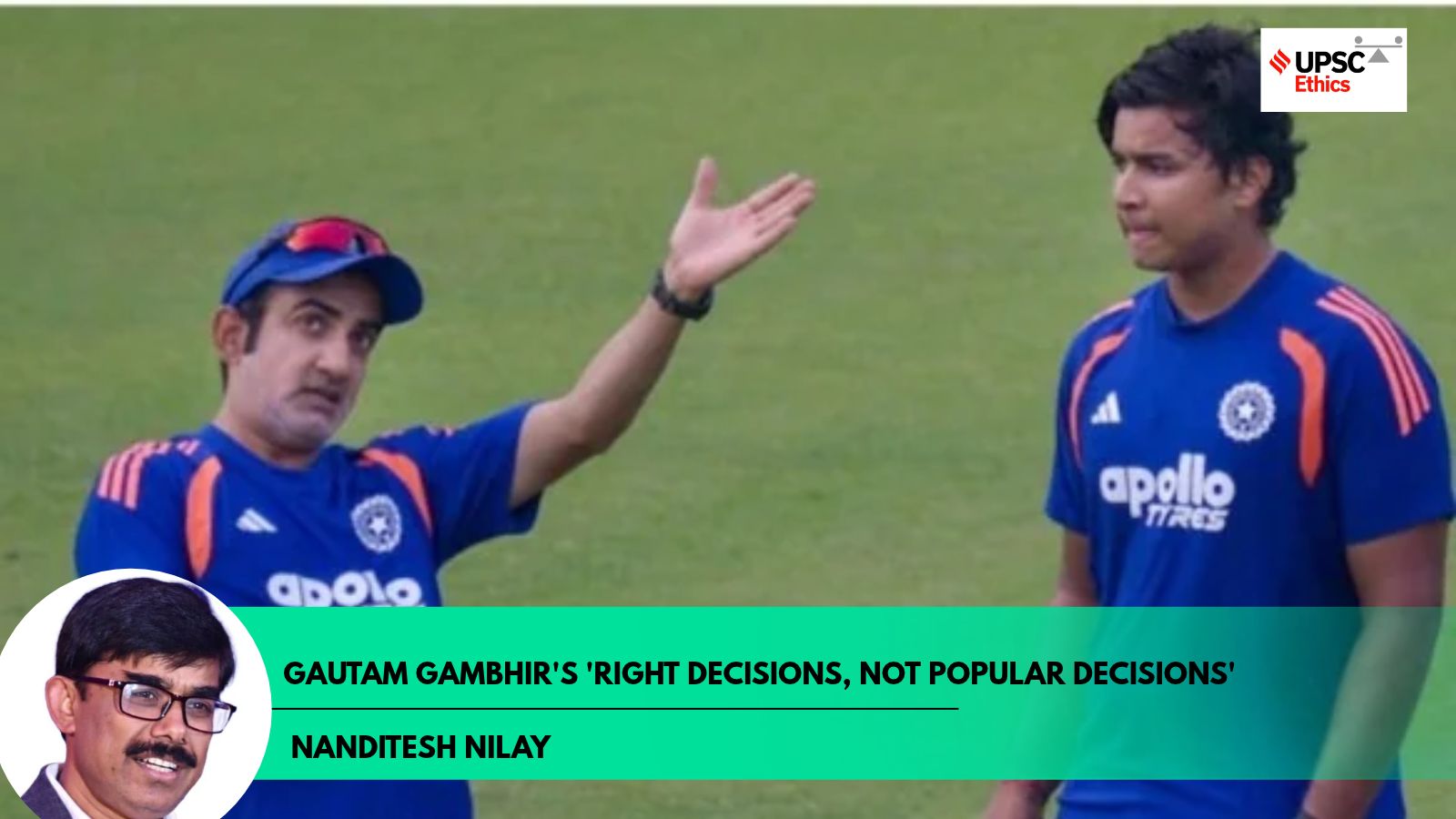
(UPSC Ethics Simplified, a special series under UPSC Essentials by The Indian Express, examines ethical dilemmas through contemporary issues. This edition uses Gautam Gambhir’s remarks on team selection to explore ethical leadership and the principles that guide decision-making.)
“My job is not to make everyone happy. My job is to take the right decisions, not the popular decisions. And that is what I’m there for,” India’s head coach Gautam Gambhir said while defending the team’s selection decisions amid questions over young batter Vaibhav Sooryavanshi’s limited opportunities.
Gambhir’s remarks bring this dilemma into focus: Should decision-makers prioritise public approval or uphold what they believe is right? Ethical decision-making requires more than seeking popularity. It calls for fairness, objectivity and sound reasoning, even when these lead to uncomfortable choices.
Being popular and being right are not mutually exclusive, but they are distinct. Player selection, for instance, requires decision-makers to balance individual merit, potential, performance and the team’s collective interest. Consider this: if MS Dhoni had not been entrusted with the captaincy at a young age, would the world have witnessed the extraordinary leader and sporting legend he became?
Providing opportunities must be guided by merit, potential and the team’s objectives, rather than popularity alone. Ethical decision-making begins with moral sensitivity, followed by moral judgement, moral motivation and moral character. These elements help decision-makers recognise dilemmas, determine the right course of action and find the conviction to act.
Story continues below this ad
Aristotle’s idea of justice: Giving everyone what they deserve
Aristotle believed that justice means giving each person what they deserve. But how do we determine what an individual deserves? His answer is to consider the telos, or the purpose of the thing in question.
Suppose we have excellent flutes. To whom should they be given? Not the wealthiest person, because wealth has no bearing on the ability to play. Nor should they go to someone who simply enjoys possessing them. The purpose of a flute is to be played well. Therefore, Aristotle argues, the flutes should go to the most skilled players.
This reasoning can be applied to institutions and opportunities. If a tennis court exists for playing tennis, the best players should get priority. If a university aims to foster academic excellence, academic merit should inform admission. Aristotle’s idea of distributive justice is relevant whenever limited resources or opportunities must be allocated. Fairness does not always mean treating everyone identically. It means using criteria that are relevant, justifiable and consistent.
Merit, popularity and fairness in sports
In team sports, selectors and coaches have a responsibility to protect the team’s collective interest. Jofra Archer’s inclusion in England’s 2019 World Cup squad after his strong IPL performances is an example. His selection meant dropping a more established option and generated considerable debate. Archer went on to take 20 wickets in the tournament and bowled the Super Over in the final. The decision proved successful.
Story continues below this ad
Similarly, Virender Sehwag’s promotion to the opening position under Sourav Ganguly was an aggressive call. It unlocked one of the most destructive opening batters of the modern era and changed India’s approach to Test cricket.
These examples show that an unconventional decision can become popular and deliver results. However, its ethical worth cannot be judged by the outcome alone. A favourable result may follow an unfair process, while a fair and well-reasoned decision may sometimes produce an unfavourable outcome.
Selectors, coaches and captains must therefore assess players on their contributions, potential and the team’s requirements, rather than seek external praise. Giving high-performing players a consistent run, often described as giving them a long rope, can foster fairness and trust. But this should not become an unconditional entitlement. Past achievements must be balanced against current performance, consistency and team needs.
Decisions driven solely by public pressure can be unjust to players who have demonstrated their abilities. At the same time, disregarding public sentiment entirely may mean overlooking emerging talent or missing an opportunity to strengthen the team. Popularity is neither moral nor immoral in itself. It is one consideration to be weighed against a player’s ability, expertise and the team’s objectives. If a 15-year-old batter can dominate the best players in a league, that talent deserves recognition. An opportunity, however, must also be supported by objective assessment and the team’s requirements.
Story continues below this ad
From sports selection to public administration
The same dilemma arises in public administration. Civil servants may face pressure while selecting welfare beneficiaries, recruiting personnel or allocating limited resources. Decisions must be guided by objective criteria, impartiality and established rules, while remaining sensitive to vulnerable groups. Resisting undue pressure and remaining accountable reflect moral courage and ethical leadership.
Ultimately, ethical leadership is not about making decisions everyone likes. It is about decisions that can be justified on grounds of fairness, merit and the larger public interest. Whether in sport or public administration, decision-makers must balance individual aspirations with collective objectives and remain accountable for their choices, even when challenged publicly. The true test lies not in the applause a decision receives, but in the values and reasoning behind it.
Ethical Takeaway: A decision is not necessarily ethical because it is popular or produces a favourable outcome. Its ethical worth also depends on the principles, fairness and reasoning underlying the decision-making process.
(The writer is the author of ‘Being Good’, ‘Aaiye, Insaan Banaen’, ‘Kyon’ and ‘Ethikos: Stories Searching Happiness’. He teaches courses on and offers training in ethics, values and behaviour. He has been the expert/consultant to SAARC countries, UPSC, Central Bureau of Investigation( CBI),National Judicial Academy, ATI, RAKNPA, Haryana Institute of Public Administration, ISA MountAbu, National Centre for Good Governance,Competition Commission of India (CCI), etc. He has PhD in two disciplines and has been a Doctoral Fellow in Gandhian Studies from ICSSR. His second PhD is from IIT Delhi on Ethical Decision Making among Indian Bureaucrats. He writes for the UPSC Ethics Simplified (concepts and caselets) weekly.)
Subscribe to our UPSC newsletter and stay updated with the news cues from the past week.
Story continues below this ad
Stay updated with the latest UPSC articles by joining our Telegram channel – Indian Express UPSC Hub, and follow us on UPSC section of The Indian Express on Instagram and X.
For your queries and suggestions write at manas.srivastava@indianexpress.com
PREVIOUS ARTICLES ON UPSC ETHICS SIMPLIFIED:
What makes a good journalist? Philosophers’ lessons that hold true for civil servants too
Story continues below this ad
What Rs 700 crore Delhi medical scam teaches about probity, bioethics
What ethical questions does Delhi’s Satya Niketan tragedy raise?
Gen Z and the ethics of communication
IAS Tukaram Mundhe | Beyond the officer, study the ethical issues
As Divya Mittal resigns from IAS, 3 ethical questions on public service
Can fear of punishment create an ethical society?
Story continues below this ad
CJP protest: Why responses to protests are an ethics case study
KioskNews shows a cleaned-up reading view extracted from the publisher’s page — the original always lives on their site, not ours.