China using extremists to sow division, official says
By Chen Yun and Jake Chung / Staff reporter, and staff writer


China is seeking to weaken Taiwan by influencing extremists to enter its democratic system and exploit political divisions, National Security Council (NSC) adviser Alex Huang (黃重諺) said yesterday, warning that the election of just one or two such politicians could make it harder for society to reach consensus.
“The goal is to weaken Taiwan. China does not need to attack you, it just needs to keep you arguing among yourselves,” Huang said in an exclusive interview with the Chinese-language Liberty Times, the Taipei Times’ sister paper.
Chinese election interference overseas is nothing new, with past incidents including attempts to influence the latest US presidential vote, efforts to turn Chinese-Canadian communities against certain politicians in Canada and attempts to fund pro-China candidates in Australia, Huang said.
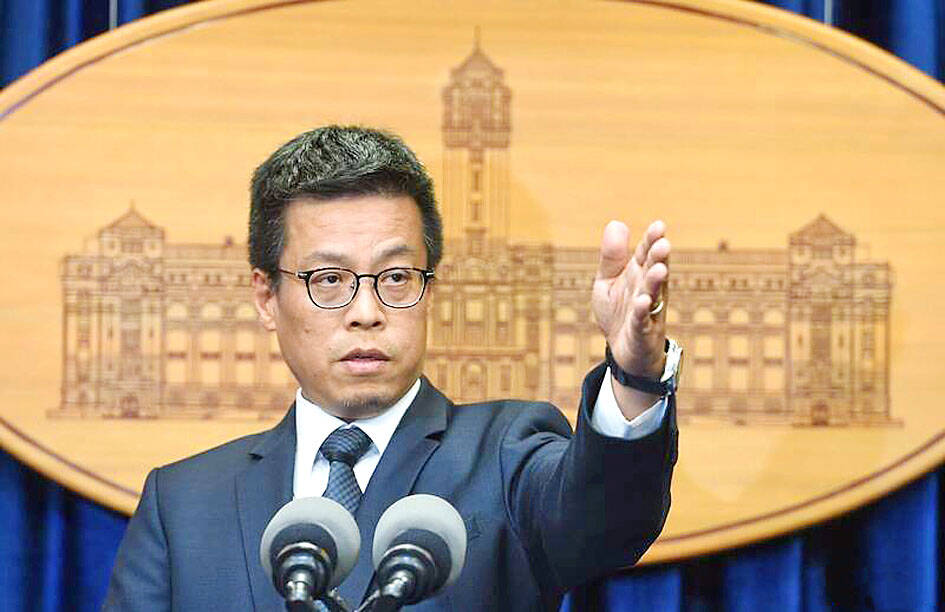
National Security Council adviser Alex Huang gestures during a news conference at the Presidential Office in Taipei in an undated photograph.
Photo: Taipei Times
Asked about who are pro-China candidates in Taiwan, Huang said that in a democracy, people should be allowed to run as long as they meet legal requirements.
In Taiwan, candidates must be Taiwanese citizens and give up permanent residency or citizenship in other countries, Huang said, adding that the Central Election Commission and other authorities conduct rigorous checks for Chinese citizenship.
It is certain that China would seek to use such people to enter Taiwan’s political system, he said, adding that Beijing was trying to undermine democracy through its processes.
All China needs is one or two radical political figures to deepen political polarization, making it harder for society to reach consensus, he said.
Once elected, these people could become a source of risk by obstructing important legislations, Huang said.
Revisions to national security laws remain stalled, with some lawmakers seeking to sway public opinion and discredit the measures, while other organizations are being used to prevent legislation from advancing, he said.
Political infighting could prevent the government from obtaining essential uncrewed aerial vehicles and even lead to the leaking of sensitive information to undermine opponents, he said.
Taiwan is like a “real-life encyclopedia” of Chinese election interference, Huang said, adding that Beijing is constantly developing new tactics using artificial intelligence (AI).
These include generating tens of thousands of “live accounts” capable of real-time interaction as well as AI-generated videos targeting President William Lai (賴清德), former president Tsai Ing-wen (蔡英文) and Taipei mayoral candidate Puma Shen (沈伯洋) of the Democratic Progressive Party, he said.
A political party during its chairperson election last year also detected signs of interference, with such operations exploiting gaps in Taiwan’s laws and using content that is difficult to verify to confuse the public, Huang said.
The government is exchanging information with international partners to bolster Taiwan’s information and democratic resilience, and is urging the public to remain alert to suspicious content and avoid sharing it, he added.
KioskNews shows a cleaned-up reading view extracted from the publisher’s page — the original always lives on their site, not ours.