Apec summit finds Marco Rubio again admiring Chinese architecture
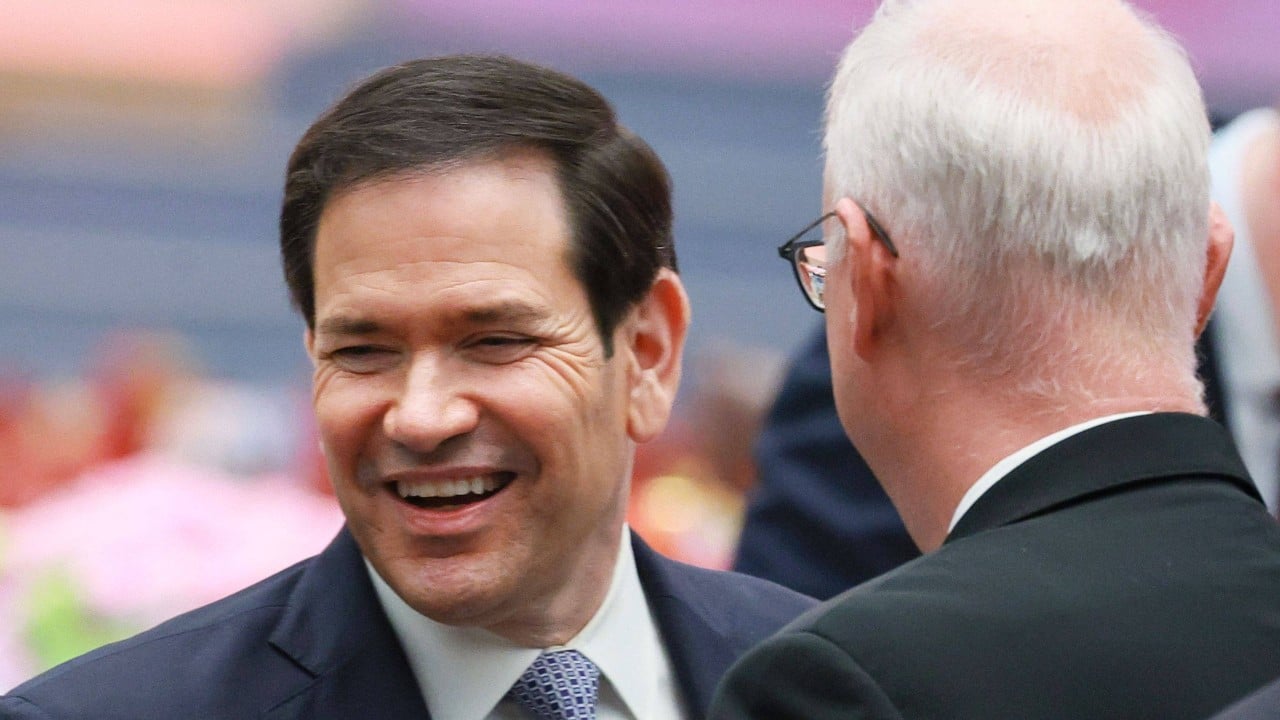
US Secretary of State Marco Rubio was once again generous in his admiration for China’s grand architecture, this time at the Apec summit’s welcome dinner ahead of Thursday’s main meeting.
At the Shenzhen International Communication Centre on Wednesday night, Chinese President Xi Jinping and first lady Peng Liyuan welcomed US President Donald Trump and other leaders to the southern tech hub.
A video showed Rubio speaking to China’s ambassador to the United States, Xie Feng, and US ambassador to China David Perdue, as they waited for the state leaders to enter the hall.
Perdue suddenly looked up in apparent awe at the hall’s ceiling, spreading his arms wide as if to take in its scale.
Following his gaze, Rubio looked upwards and appeared to smile in agreement.
The ceiling that drew their attention featured a strikingly futuristic black lattice of gently curving bands against a white surface. Tiny spotlights glimmered overhead, the ceiling’s dark geometry contrasting with the warm tones of the banquet hall below.
Onstage, an LED screen glowed in shades of orange and red. Warm light bathed the upper part of the hall, and the stage backdrop showed flowers rendered in a Chinese ink-wash style.
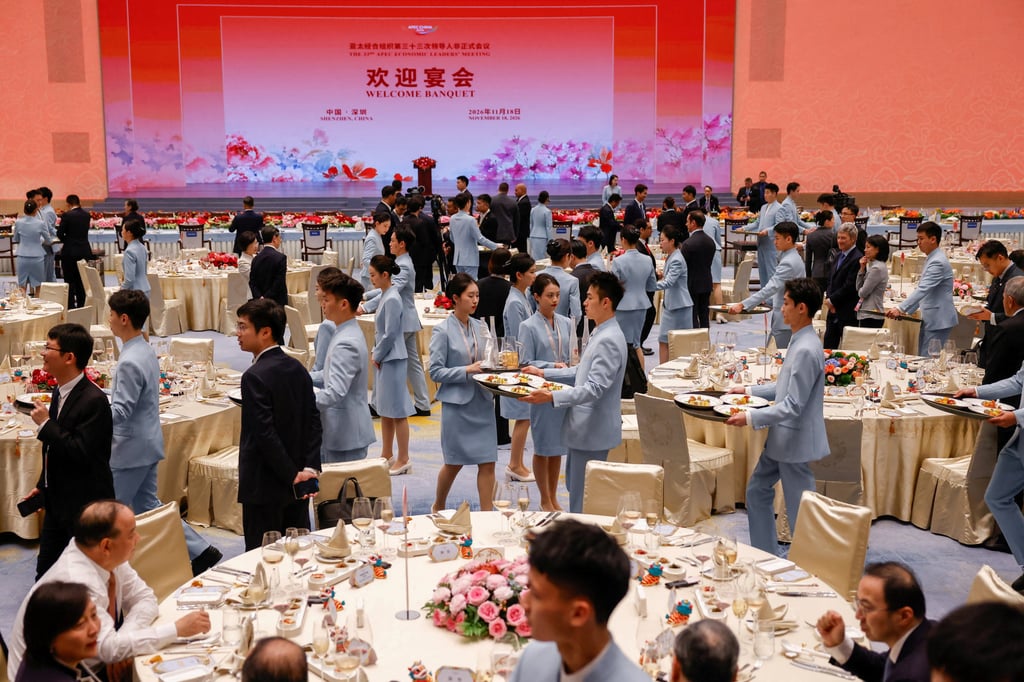
Round tables with cream tablecloths and floral centrepieces recalled the banquet Xi hosted during Trump’s state visit to Beijing in May. Cream-coloured screens decorated with traditional Chinese landscape paintings lined the walls.
It was not the first time the US secretary of state had been visibly impressed by Chinese interior design.
In May, Xi received Trump at the Great Hall of the People amid trade tensions and technology competition between the two countries.
A video of Rubio appearing to admire the reception hall quickly went viral at the time.
The footage showed the secretary of state gazing up at the ornate ceiling of the East Hall of the Great Hall, near Tiananmen Square. The vast building is used for state ceremonies and legislative sessions.
Rubio pointed upwards, moving his fingers as though following the contours of the design, before giving a thumbs-up. He then turned to US Defence Secretary Pete Hegseth and gestured towards the ceiling again. On Weibo, a hashtag saying Rubio had given “a thumbs-up to Chinese aesthetics” gained traction.
The East Hall, on the building’s second floor, covers about 1,120 square metres (12,056 sq ft). Its ceiling draws on traditional Chinese architecture.
In May, Rubio became the first sitting US secretary of state to visit China after being sanctioned by Beijing. China sanctioned him twice in 2020, when he was a US senator: first in July, in retaliation for US sanctions over alleged human rights abuses in Xinjiang, and again in August, after Washington sanctioned mainland Chinese and Hong Kong officials over what it described as a crackdown on the 2019 Hong Kong protests.
KioskNews shows a cleaned-up reading view extracted from the publisher’s page — the original always lives on their site, not ours.