AI job fears drive students back to core engineering courses in Gujarat

Eighteen-year-old Dixit Patel was clear in his head that he wanted to be an engineer, a first in his family. As the admission process completed in October, Patel had chosen Civil Engineering, not Computer Science.
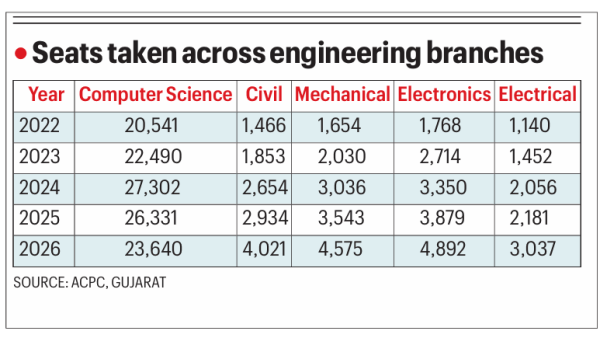
Admissions to core engineering courses — mechanical, electrical, civil and electronics — witnessed a nearly three-fold spike this year in Gujarat compared to last year, a trend academics attributed to “job prospects” and Artificial Intelligence (AI) takeover.
Reasoning his decision to choose Civil, Patel, now a student at LD Engineering College, one of Gujarat’s oldest government colleges, Told The Indian Express, “With infrastructural development, there are better placement and government job opportunities. Artificial Intelligence cannot replace you at the construction site.”
Several students like Patel have preferred core engineering courses over computing-related disciplines, enrolment data for the new academic term across the 140 engineering colleges in Gujarat shows.
Till last year, an average of 1,500 students would take each of these core engineering courses and the figure has risen to 4,000 this year.
The overall number of students enrolling for Computer Science, which is 23,640, however, beats the sum of those enrolling in the Mechanical, Electrical, Civil and Electronics, ie, 16,525 for 2026.
Nearly a decade ago, the enrolment in the core engineering courses had dropped to an extent that the government had to cut down the intake quota while increasing seats in computer-related disciplines. While seats taken in computer engineering dropped, those in Robotics and Automation saw a rise from 32% in 2024-25 to 82% in 2025-26 of the total seats getting filled.
“Job prospects have improved both in terms of average salary and the number of placements in the core branches. The seats in government colleges for these conventional branches are completely filled, even in colleges in (remote areas of) Dahod, Godhra, Morbi and Kutch, which earlier went vacant,” N N Bhuptani, member-secretary of the Admission Committee for Professional Courses (ACPC), said.
“You may find an unemployed computer engineer, but not a jobless civil, mechanical or electronics engineer now,” Bhuptani, who is also the principal of LD Engineering College, observed.
The ACPC is a regulatory body responsible for enrollment in professional and technical institutes in Gujarat.
Prof C S Sanghvi, Secretary, Association of Consulting Civil Engineers, Ahmedabad, observed that an artificial deficit was “created” in the conventional engineering branches due to the policies.
“A large number of seats were available for computer science and allied branches a few years ago, still institutes have reduced seats in the core branches to make room for computer and IT courses,” Prof Sanghvi pointed out.
Reversal of trend
Data accessed by The Indian Express shows the trends began to change from 2022, witnessing a growth in the share of seats taken in Civil, Mechanical and Electrical engineering, while those in Computer Science and Engineering began to fall from 2025.
Admissions in Electronics Engineering rose drastically after 2022 by 24 percentage points, but fell marginally in 2025.
In the case of Computer Engineering, the enrollment numbers fell from 27,302 in 2024 to 23,640 in the current academic session.
In the ongoing academic session, against the total intake of nearly 84,400 seats across 140 engineering colleges — government (16), grant in aid (3) and self financed (121) — in Gujarat, 52 per cent seats are taken, with more students preferring the government and grant-in-aid institutions. While only 45 per cent of the total seats of private engineering colleges were filled.
Prof C S Sanghavi, who teaches Applied Mechanics at LD Engineering College, said trends reversed because of jobs being outsourced to Artificial Intelligence.
“As many as 25,000 students graduating as computer science engineers every year would not be absorbed in the sector due to a decline in demand after Artificial Intelligence (AI) taking over some jobs. The computer engineering market space is evolving at a fast pace unlike the conventional ones, reducing the demand for computer professionals. There is technological upgradation in civil and mechanical engineering sectors too which are witnessing an AI integration, but that would require human intervention. Advancements in conventional branches, for instance drone surveillance of site inspection as an option, are available now but not at the same pace as that in the software branches,” Prof Sanghvi said.
Mantavya Gajjar, Managing Director at Odoo India (a Belgium based business management software suite), who is an alumnus of Gujarat Vidyapith, said the job scenario is changing “drastically”.
“Jobs in the computer sector are somewhat affected because of AI, but people with real skills who can work with AI continue to be in demand. AI is delivering, but human intelligence is required to detect and choose between the best. People with those kinds of skills are well paid. In the computer sector, which is a service industry, the offshore projects are going down and the sales are impacted due to the geopolitical situation resulting in the financial crisis,” Gajjar told The Indian Express.
KioskNews shows a cleaned-up reading view extracted from the publisher’s page — the original always lives on their site, not ours.