Sharp merger, outdated plan are choking Delhi’s new Barapullah flyover
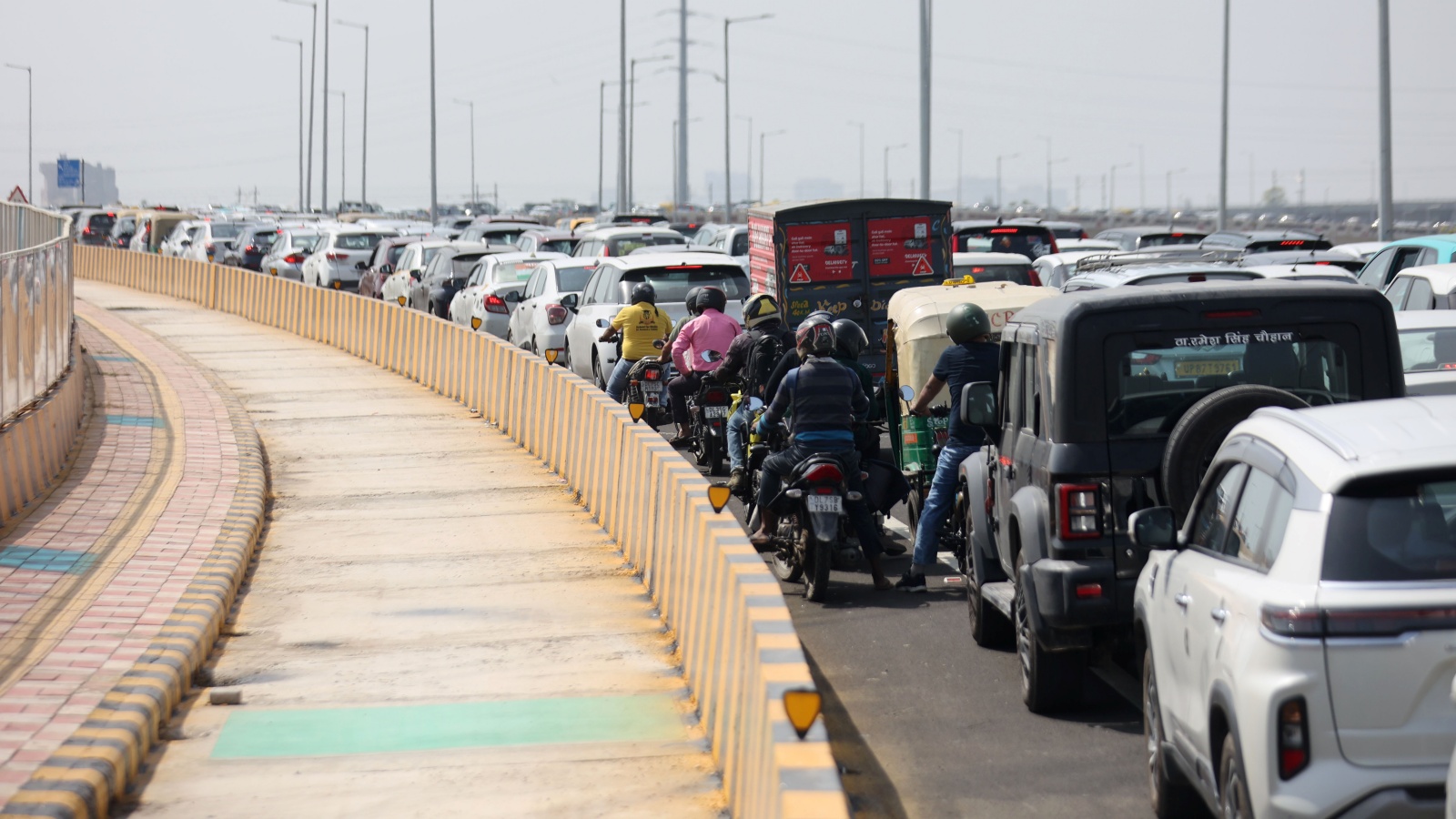
The snarls frustrated motorists, particularly as the corridor was opened to improve connectivity between East and South Delhi and reduce travel time. Express Photo by Tashi Tobgyal
Traffic coming from Mayur Vihar on the new Barapullah Phase III elevated corridor, vehicles joining from the Sundial loop and those approaching from the DND side all meet at Sarai Kale Khan before entering the narrower existing Barapullah flyover. The result: Long queues where all the three lanes merge due to availability of less space, slowing traffic on the new corridor as well as roads around Sarai Kale Khan.
According to Delhi Traffic Police and the PWD, who have conducted a joint inspection of the whole corridor, the sharp merger and the difference in road capacity are the immediate reasons for the bottleneck that commuters have been facing since Wednesday, a day after the flyover was launched.
But officials have also flagged a larger problem – the traffic pattern for which the project was planned more than a decade ago has changed considerably by the time it was opened for public use.
Officials said the project was conceived at a time when traffic movement between East Delhi, Noida, Ghaziabad and South Delhi was different.
Originally scheduled for completion in 2017, construction delays pushed its opening to 2026. In the intervening years, the number of vehicles has risen, so has the population in East Delhi and the wider NCR, resulting in commuting patterns changing significantly.
The corridor, meant to redistribute traffic from some of the city’s busiest routes, including the DND Flyway and National Highway 24, is now attracting a substantial volume of vehicles from precisely those routes, adding pressure to the roads around the new flyover.
Phase III brings a large volume of vehicles from the Mayur Vihar side towards the existing flyover. At the Sundial loop, another stream joins the movement, while traffic approaching from the DND side adds further pressure. These movements come together where the available road space reduces sharply.
Story continues below this ad
Traffic police have described the merger near Sundial as sharp and rectangular. Instead of allowing vehicles to gradually move into the existing flyover, the design forces them to merge over a short distance. Officials have now proposed changing the geometry to create a smoother curve and a more gradual merge.
The lane configuration makes the problem worse. While Phase III is three lanes wide, the existing Barapullah flyover at the merging point is narrower. Several lanes therefore converge before entering the narrower section, with vehicles jostling for space.
Authorities are now considering introducing traffic control measures at the merging points. A signal is among the options being examined to regulate vehicles entering the existing flyover and prevent large volumes from reaching the bottleneck at the same time. Until a permanent arrangement is put in place, traffic personnel have been manually regulating the flow.
Since Wednesday, queues of several kilometres were reported on the new flyover, with commuters facing delays much longer than the journey times advertised before its launch. The congestion subsequently spread to other surrounding major roads.
Story continues below this ad
There is also an information problem, officials said. Traffic police said there is a need to update Google Maps and other navigation platforms so they reflect the latest road configuration and real-time traffic conditions. The aim is to allow navigation systems to divert vehicles towards alternatives such as NH 24 when Barapullah approaches saturation.
Additional Commissioner of Police (Traffic) D K Gupta said, “Commuters are advised to remain attentive to traffic advisories, follow the directions of traffic personnel and use alternate routes wherever advised, particularly during peak hours. Delhi Traffic Police remains committed to ensuring smooth, safe and uninterrupted movement of traffic for all road users.”
© The Indian Express Pvt Ltd

Sakshi Chand is an Assistant Editor at The Indian Express, based in New Delhi. With over a decade of experience in investigative journalism, she is a leading voice on crime, the prison system, and institutional governance in the National Capital. Professional Background Specialization: Her reporting focus includes high-stakes crime, national security, prison reforms, and traffic governance. Key Coverage: She has been on the frontlines of major events such as the 2G spectrum case, the 2020 North-East Delhi riots, and communal clashes across Uttar Pradesh (Kasganj, Aligarh). Earlier Career: Before joining The Indian Express, she was a reporter for The Times of India. Personal Interests: Outside of her career in journalism, Sakshi is a National-level basketball player and coach, bringing a unique sporting discipline to her professional life. Major Recent Coverage (Late 2025) Her reporting in the latter half of 2025 has been dominated by a major terror investigation and administrative accountability: 1. The Red Fort Blast Investigation Throughout November and December 2025, Sakshi led the coverage of a car explosion near Delhi's Red Fort: Forensic Breakthroughs: She reported on the use of TATP and ammonium nitrate in the IED and identified the shops where raw materials were sourced (Nov 14-16, 2025). The "i20 Route": She meticulously tracked the journey of the vehicle used in the blast, tracing it to a Pulwama-based resident who entered Delhi via the Badarpur toll plaza (Nov 12, 2025). Victim Support: She recently reported on the Delhi Police providing a list of damaged vehicle owners to the Finance Ministry to expedite insurance claims for those caught in the blast (Dec 4, 2025). 2. Crime & Police Accountability "Crackdown on Extortion Gangs": In December 2025, she reported on a syndicate that was blackmailing traffic cops. Following five arrests, the Special CP directed officers to report all such attempts (Dec 12, 2025). "Corruption in the Ranks": She covered the arrest of five Delhi Police personnel by the Vigilance branch following a wave of public complaints (May 19, 2025). Cold Cases & International Murders: She has extensively tracked the case of a man who allegedly killed his wife in London and fled to India, reporting on his "Proclaimed Offender" status and the denial of his anticipatory bail (May 2025). 3. Governance & Public Policy "13,000 Homes for 90,000 Cops": A data-driven feature on why the majority of Delhi Police personnel are forced to live on rent despite the city's housing projects (May 4, 2025). Traffic Decongestion: Using her interest in urban logistics, she detailed how the Traffic Police eased congestion on Vikas Marg by switching off signals and creating U-turns (April 2, 2025). Signature Style Sakshi Chand is known for a data-driven and investigative approach. She frequently uses forensic reports, CCTV analysis, and administrative data to go beyond the "official version" of a crime story. Her work in prison reporting is particularly noted for highlighting the legal and humanitarian conditions of foreign detention centers and local jails. ... Read More
KioskNews shows a cleaned-up reading view extracted from the publisher’s page — the original always lives on their site, not ours.