Chris Selley: The PQ wins a reprieve from the humiliation of a losing referendum
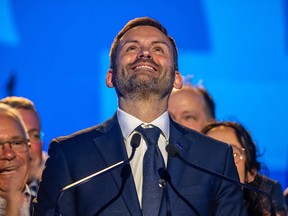
Premier-presumptive Paul St-Pierre Plamondon (PSPP) doubled down on his referendum promise Monday evening, despite winding up five seats short of a majority. “We will … not forget our commitment to consult Quebecers on their future,” he told supporters in downtown Montreal, “with, of course, the support, we hope, of other independentist MNAs from other parties who will make this … possible.”
Sign In or Create an Account
In all but name, that was an appeal to the hard-left Québec Solidaire (QS) and its nine MNAs elected Monday night. QS supports sovereignty, but not a referendum, at least not now, preferring some kind of “constituents’ assembly,” “co-created with First Nations” (bonne chance!), that would instill a sort of provincewide progressive-sovereigntist vibe.

Columnist Jesse Kline keeps you up to date with what’s happening in Israel and the effects of antisemitism on life here in Canada. Friday mornings.
By signing up you consent to receive the above newsletter from Postmedia Network Inc.
A welcome email is on its way. If you don't see it, please check your junk folder.
The next issue of Channel Israel will soon be in your inbox.
We encountered an issue signing you up. Please try again
“It’s important to talk to people and to rally Quebecers around this project, because if you want to make a country of Quebec, it’s not against Canada,” QS co-leader Ruba Ghazal recently told the Gazette, talking sense. “And it will not be done only with two political parties in a closed office.”
Except that the Parti (and Bloc) Québécois’ modern version of separatism is absolutely anti-Canada. PSPP and federal Bloc Québécois Leader Yves-François Blanchet ooze antipathy toward Canada as a nation, not just as a home for Quebec. (Readers may recall Blanchet ruminating on Alberta separatism: “I am not certain that oil and gas qualifies to define a culture.”)
For one thing, the PQ intends to defund the lieutenant governor’s position, except for the purposes of signing bills — which is kind of funny, because they could just pass a law (probably unanimously) declaring third reading in the National Assembly to constitute royal assent, and no one in Ottawa would lift a finger to stop them. It’s not just the likes of outgoing premier Christine Fréchette and PSPP, who no longer swear an oath to the monarch, which is an unambiguous constitutional requirement (except it apparently no longer is). Quebec Liberal leader Charles Milliard didn’t swear the oath either.
PQ and QS partisans get along about as well as federal Liberals and New Democrats, but Ghazal waxed co-operative at a Tuesday press conference in Montreal. “Quebecers (have) decided that’s what they want: for us to work together.”
But then she said this: “When people are experiencing economic insecurity, it’s hard afterwards to say, ‘I’m going to rally to independence.’ That’s why I say we must listen first and foremost.”
That’s fine. But one of the things they’ll hear from the public, if they listen, is massive lack of support for sovereignty in any meaningful sense. That has a lot to do with the aforementioned “financial instability.” No politician can convince people living on the edge that things are better than they are.
PSPP may not realize it now, but I think winning a strong minority was the best thing that could have happened to him. Ultimately, it will give him an off-ramp from that very, very silly promise to hold a referendum in the next four years (but after U.S. President Donald Trump leaves office). At some point along the way, with a majority, he would realize it would certainly fail, as every poll for 20 years has resoundingly shown, and he’d be left looking a bit of a boob. Huge political capital expended for naught. (Not holding the referendum has risks as well, with respect to the party base, but the party base doesn’t want to lose a referendum either.)
There are other ways to pursue Quebec’s functional sovereignty and make the federal government miserable, thus fulfilling the PQ’s basic proposition in government. Demand even greater (and unique among provinces) control over immigration. Demand a seat on every international body willing to take them.
In the short term, Quebec nationalists are furious over Prime Minister Mark Carney scrapping the digital services tax. They’ll want that back and much more. Anti-internet taxes and regulations, and demands for francophone content funding from the streaming giants, are hugely popular in Quebec. (This is the reason former Montreal Liberal MP Steven Guilbeault was given two shots at running Canadian Heritage.) They are not at all popular in Trump’s Washington.
The Laurentian commentariat is overwhelmingly in favour of targeting “the web giants,” anglophone and francophone alike. And when it comes to the sovereignty movement, they tend to be quite panicky, constantly barking in the prime minister of the day’s ear, as if stuck in 1997, that he has to devote all his time to placating Quebec or else the country will die.
We shall see what Carney makes of all this. I hold out faint hope he might care so little about any of this nonsense that he’s disinclined to bend the knee toward Quebec City for its own sake. He is, after all, very popular in Quebec as it stands — as high as 60 per cent support in recent polls. He has leverage, and he should use it.
National Post
cselley@postmedia.com
Join the Conversation
This website uses cookies to personalize your content (including ads), and allows us to analyze our traffic. Read more about cookies here. By continuing to use our site, you agree to our Terms of Use and Privacy Policy.
KioskNews shows a cleaned-up reading view extracted from the publisher’s page — the original always lives on their site, not ours.