Slight fall in carbon emissions from fossil fuels as Iran war drives renewables push
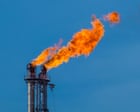
Soaring oil and gas prices following the war in Iran have encouraged people to look beyond fossil fuels, leading to an easing of climate-damaging carbon emissions this year.
Carbon dioxide from oil, gas and coal is forecast to flatline for 2026, based on data from the year so far, according to a comprehensive assessment by scientists. Emissions from burning oil alone will drop by 2% as drivers economise on fuel use and flock to electric vehicles instead.
The findings, presented on Tuesday morning at the Cop31 climate talks hosted by Turkey in Antalya, show both the impact of the Iran war and the global expansion of cheap renewable energy, chiefly solar and wind power.
Talk of a global turnaround would be premature, however, the report’s authors and other analysts said. The reduction in emissions from fossil fuels for 2026 will be about 0.4% compared with last year.
Yet this year’s slight fall could be temporary, and was more than offset by increased emissions from deforestation and land use change, following major fires in south-east Asia and further conversions of wild land to agriculture.
Many factors could disrupt the fragile trend of slowing emissions from fossil fuels, including an intensified expansion of coal in India, an easing of oil prices and US president Donald Trump’s enthusiasm for fossil fuels. Much greater investment in renewable energy, and low-carbon technology such as electric vehicles, would still be required to make permanent reductions in annual emissions, the report’s authors said.
Glen Peters, research professor at the Cicero Centre for International Climate Research, said: “A drop in emissions in one year is not a peak, unless it is driven by structural change. Accelerated deployment of solar, wind, batteries and electric vehicles are pushing emissions down in dozens of countries, and slowing emissions growth in many more, but the changes are not sufficient to lock in a peak in global emissions.”
About 38.2bn tonnes of CO2 will be emitted this year, according to the Global Carbon Budget, an annual assessment by scientists from scores of universities and science institutions around the world, published in the journal Earth System Science Data.
Energy demand continues to increase around the world, as more people gain access to electricity and are pulled out of poverty, but two-thirds of the increase is being met from rising generation from the sun and wind and the uptake of electric vehicles.
On the downside, emissions from deforestation and the conversion of land to agriculture have also ticked upward this year, leading to total carbon emissions rising slightly for the year, from 42.8bn tonnes last year to 43.3bn forecast for 2026.
The scientists warned that the world’s remaining “carbon budget” – the amount of carbon that can be poured into the atmosphere before global heating is likely to permanently exceed 1.5C above pre-industrial levels – was about 150bn tonnes, or less than four years at current rates.
Already, temperatures have exceeded the 1.5C threshold for more than two years, and El Niño conditions are heating the sea and air further. Global emissions must peak imminently and fall rapidly in subsequent years if the world is to have a chance of limiting the “overshoot” of temperatures above 1.5C.
after newsletter promotion
China, the world’s biggest emitter of greenhouse gases, is likely to reduce its carbon output by close to 1% this year, mostly because of a 5% reduction in oil use, following the Iran war. Peters said: “China has had flat emissions for the last few years after a fairly steep increase in the last decade. There’s been a lot of discussion about whether China has peaked or not. Whether this is just a one-off and China rebounds next year, we’ll have to wait and see, it’s too early to say.”
India’s emissions have grown strongly, mostly from an increase in coal use, while the country’s oil use has declined slightly. Emissions from the US are likely to fall by about 1.3% this year, as less coal is used, despite Trump’s attempts to boost it.
Bill Hare, chief executive of Climate Analytics, who was not involved in the research, cautioned against taking too much from the report. “The picture from the Global Carbon Budget is a flatline, not a decline – a projected fall of just 0.4% in 2026, a figure that is unfortunately statistically indistinguishable from zero,” he said. “We are heading towards a sustained breach of 1.5C by around 2030. With imminent overshoot, we are entitled to expect governments everywhere to move decisively to cut fossil fuel CO2 emissions.”
There seemed little sign of such a decisive move at Cop31, where more than 90 heads of state and government, and high-level representatives from more than 190 countries are gathering for a fortnight of talks on the climate crisis.
Hare said: “We see governments in countries such as Canada, the US and New Zealand rolling back climate policies as fast as they can, and countries such as Australia – co-president of Cop31 – continuing to press forward with massive coal and gas developments that are holding fossil fuel CO2 emissions at record levels. There is little sign yet that the Turkish and Australian leadership [of Cop31] intends to build on [the commitment to transition away from fossil fuels made three years ago] with stronger action.”
KioskNews shows a cleaned-up reading view extracted from the publisher’s page — the original always lives on their site, not ours.